
 Poet Emma Lazarus was active from the mid-1860s until her death in 1887. She descended from a well-established Sephardic family in Manhattan. Her presence coincided with the arrival of waves of Ashkenazi refugees from Eastern Europe. Their customs, Yiddish language, and political activism were distinct from the assimilated Sephardic community.
Emma created two contrasting sonnets on immigration, both dated 1883. Set against the socio-political background of their time of publication, these poems highlight some of the historical and continuous controversies surrounding the issue.
Recife & New Amsterdam
 During the seventeenth century, the scattering of Jewish communities reached a global dimension. When in 1630 the Dutch West India Company (WIC) took the Brazilian coastal state of Pernambuco from the Portuguese, Sephardic (Iberian) refugees living in Amsterdam and elsewhere in the Dutch Republic were encouraged and supported by the WIC to settle there.
New Christians (“conversos”) who had returned to Judaism joined them. Many settled in the capital Recife. Enjoying freedom of worship and civil equality, they established a synagogue there in 1636/7, the first one in the New World.
The community’s economic activity in Recife was significant. As the region’s humid tropical climate made the cultivation of sugarcane profitable, Jewish merchants developed the sugar industry. They owned the slave-based plantations and ran trading networks between Recife and Amsterdam. Their activities fostered a period of prosperity.
When in 1654 the Portuguese retook the colony, Jewish settlers scattered. Some returned to Europe, whilst others moved within the Americas, forming Jewish communities in the Caribbean that helped launch the sugar trade in Barbados.
In early September that year, twenty-three Jewish refugees fleeing Recife, landed in New Amsterdam on board the French barque Sainte Catherine (later referred to as the “Jewish Mayflower”). Upon arrival, the ship’s captain Jacques de la Motthe sued his passengers for the cost of the journey, leaving them destitute.
 Although governor Peter Stuyvesant resisted their reception, fearing that the New Netherland colony would be torn apart by the presence of multiple religious groups, he was vetoed by the directors of the WIC in Amsterdam who ruled that these Portuguese Jews “shall have permission to sail and trade in New Netherland and to live and remain there provided the poor among them shall not become a burden to the Company, or the community.”
The first permanent Jewish congregation to settle in New Amsterdam, its members founded “Shearith Israel” in 1654.
They met in rented spaces until dedicating a synagogue in April 1730 on Mill Street (now South William Street), Lower Manhattan. It was a significant moment in New York’s Jewish history.
Poet & Activist
Emma Lazarus was born on July 22, 1849, in the city of New York into a wealthy family. Her father was a sugar merchant who descended from the early Portuguese Jews in New Amsterdam. Her ancestors had cemented assimilation of the Sephardic tradition into the city’s socio-religious life, giving the dynasty considerable status in metropolitan circles.
Growing up in the city, Emma received a “classic” European education by private tutors. Her father backed the publication, at the age of seventeen, of her Poems and Translations (1866). Ralph Waldo Emerson appreciated her work and became the young poet’s mentor.
 Throughout the 1870s and early 1880s, her work appeared in various magazines reaching a mixed audience, but social and political circumstances were deteriorating. Acts of antisemitism, even directed towards assimilated Jews, were on the increase.
In 1881, Tsar Alexander II was murdered in St Petersburg. Ashkenazi Jews, already compelled to live in a restricted region (the “Pale of Settlement”), were held responsible. Their persecution by the Romanov government started a process of mass movement to America.
Elite Sephardic families in New York tried to stay clear of indigent Yiddish-speaking immigrants, but Emma was determined to offer help. She taught English at the Young Men’s Hebrew Association; volunteered for the Hebrew Emigrant Aid Society on Ward’s Island; and joined Henry Leipziger’s Hebrew Technical Institute to provide vocational training to young immigrants.
During these years, she created the “Songs of a Semite” (1882), in which she rallied uncommitted American Jews. She also became a contributor to American Hebrew newspaper. After publishing her “Songs,” the paper’s editor invited her to write a column called “An Epistle to the Hebrews.”
In fifteen letters (1882/3), she challenged New York Jews to acknowledge their privileged social status and support refugees from Eastern Europe. At the same time, she warned about Jewish vulnerability, even in the United States. She knew antisemitism to be a “very light sleeper” (a phrase attributed to Irish politician Conor Cruise O’Brien), lying just beneath the surface and ready to spring up at any time.
More than a decade before Theodor Herzl made the Zionist case in Der Judenstaat (The Jewish State, 1896), she spoke of Jewish “repatriation” in Palestine. Deeply concerned about developments, she transformed from a poetical observer into a committed activist, trying to unify her Sephardic community with that of Ashkenazi refugees.
Your Huddled Masses
In June 1865, Édouard de Laboulaye invited some liberal friends for dinner at his home in Paris. A Professor of Law at the Collège de France, he was the author of a three-volume Histoire des États Unis (History of the United States) and translator of Benjamin Franklin’s autobiography.
The party celebrated the end of American slavery with the imminent ratification of the 13th Amendment. In his word of welcome, the host proposed that the French people should present America with a monument to honor the values of liberty and abolition. There was no mention of immigration or refuge.
Political upheaval delayed the project, but work started in Paris with the construction of the Statue of Liberty’s torch-bearing arm which, in May 1876, was on display at Philadelphia’s Centennial Exhibition. The parts were then moved to Madison Square Park, before returning to Paris.
 Between 1882 and 1884, the statue was assembled in a foundry at Rue de Chazelles where Parisians were astonished to see a colossal female figure appearing above buildings surrounding the workshop. American participants in the project agreed to finance its pedestal.
Emma Lazarus must have been impressed by seeing the exhibit in Manhattan. In 1883 she composed her poem “The New Colossus,” hoping to raise funds for the pedestal.
In this sonnet, she contrasted the bronze “brazen giant of Greek fame” on the island of Rhodes (one of the Seven Wonders of Antiquity) with the Statue of Liberty, defining her as the “Mother of Exiles.”
The ancient male Colossus intended to overwhelm and intimidate; Emma’s Lady evoked hope and anticipation. She redefined a statue that stemmed from the spirit of liberal French Republicanism as one that stood for a humanitarian mission: to welcome the poor immigrant.
The poem was included in the “Catalogue of the Pedestal Fund Art Loan Exhibition” at Manhattan’s National Academy of Design. Emma lent her voice to stress the Statue’s role as a symbol of compassion. It called for “your tired, your poor, your huddled masses yearning to breathe free,” in reference to destitute refugees.
Her words soon faded away. When the Statue of Liberty was dedicated, the poem did not figure. More than fifteen years after her death in November 1887, composer Georgina Schuyler commissioned a plaque with the text of the sonnet inside the pedestal as a tribute to her late friend.
During the 1930s, an era of quotas and immigration hysteria, the sonnet gained new relevance. In 1949 Irving Berlin, who himself had arrived as a five-year old with his Russian-Jewish family at Ellis Island in 1893, set it to music in “Give Me Your Tired, Your Poor” as part of the Broadway musical Miss Liberty.
A Two-Faced Year
Within days of writing “The New Colossus,” Emma penned a parallel poem entitled “1492.” This sonnet reflected on her Sephardic heritage, linking the expulsion of Iberian Jews in 1492 to that of the mass of new arrivals settling on American soil. History books tend to remember the year for Christopher Columbus’s transatlantic voyage, rather than for the tragic fate of Spanish Jews.
Until the late fifteenth century, the Iberian Peninsula had been a center of Jewish life. On March 31, 1492, the “Catholic Monarchs” Isabella and Ferdinand II signed an edict ordering all Jews living in Castile and Aragon to convert or leave. New Christians suspected of holding on to their faith were persecuted by the Inquisition.
An exodus followed. Small groups of Jews settled in port cities such as Livorno, Antwerp, or Amsterdam, but most of them moved to Portugal. In 1497 King Manuel I
decreed, under Spanish pressure, that all Jews had to convert to Christianity or leave Portugal.
 In “1492,” Emma Lazarus explored the “two-faced” nature of that year, contrasting the face of the Inquisition’s “zealous hate” with the “smiling” welcome of the “virgin world.” She personified the year as a “Mother of Change and Fate” for Jews, a turning point from persecution to freedom.
With Europe closed to them at “every gate,” the New World opened “doors of sunset” in a dark age of persecution. The tone of the poem is more upbeat than that of “The New Colossus,” as if the poet is challenging her community to rise to the task.
The poem may be a celebration of refuge and sanctuary, but political developments were moving in an opposite direction. In May 1882, President Chester Arthur had signed into law the Chinese Exclusion Act, the first federal law to restrict immigration and the only one to single out a specific nation, fueling racial discrimination.
At the Statue of Liberty’s dedication on October 28, 1886, politicians on that rainy day showed little concern with welcoming any huddled masses.
Headlines were stark. The recent Haymarket bombing in Chicago had killed eleven people. The culprit was never identified, but eight men were convicted for conspiracy – six of them newcomers. For many, immigration meant terror.
America for the Americans
A gate marks passage, but also limitation or denial of access. As a metaphor, it is often used to advocate or justify immigration policies, framing a nation as a bounded space with borders (gates), controlling entrance and exit. When Emma Lazarus applied the metaphor, her Jewish background was relevant.
In Judaism, the imagery of gates is embedded in religious tracts and liturgical practices. Traditionally, the city gate was a place where traders met and from where news was circulated. In ancient Israel, elders and judges sat at the city gates to hear legal cases and administer justice.
On a spiritual level, the gate was central in the relationship between man and God. The final service of Yom Kippur (Ne’ilah) symbolizes the “closing of the gates of Heaven,” regarded as the penitent’s last chance at redemption. The gate was the threshold between the known and unknown, between past and future.
The gate entered the nativists’ rhetoric too. In the July 1892 issue of The Atlantic Monthly its editor Thomas Bailey Aldrich published a long poem entitled “Unguarded Gates.” Structured in three parts, the narrative moves from the country’s former unspoiled landscape to demographic invasions, ending in a plea for preclusion.
The poem’s first line is a leitmotiv: “Wide open and unguarded stand our gates!” Overrun by a “wild motley throng” of incomers, socio-cultural identity is at peril:
“In street and alley what strange tongues are loud,
Accents of menace alien to our air,
Voices that once the Tower of Babel knew!”
The concluding section of the poem raises a question that reads as a polemical response to the image of Lady Liberty painted by Emma Lazarus: “O Liberty, white Goddess! is it well / To leave the gates unguarded?”
 Aldrich merged his anti-immigration stance with the notion of Anglo-American superiority. Many contemporaries shared this view.
Writing to a friend in 1892, the author said that he drafted the poem in anger after being subjected to a robbery. He abhorred an America that would be the “cesspool of Europe,” concluding with the xenophobic statement “I believe in America for the Americans.”
Reflecting nativist fears and prejudices, Aldrich voiced a tendency of intolerance towards racial and social diversity. Attacking the “open gate” reality, he called for exclusionary measures.
The poem became part of the political debate. Two years after its publication, the Immigration Restriction League was founded in Boston by Harvard graduates, a nativist organization that campaigned for strict laws to curb the influx of “inferior” southern and Eastern Europeans.
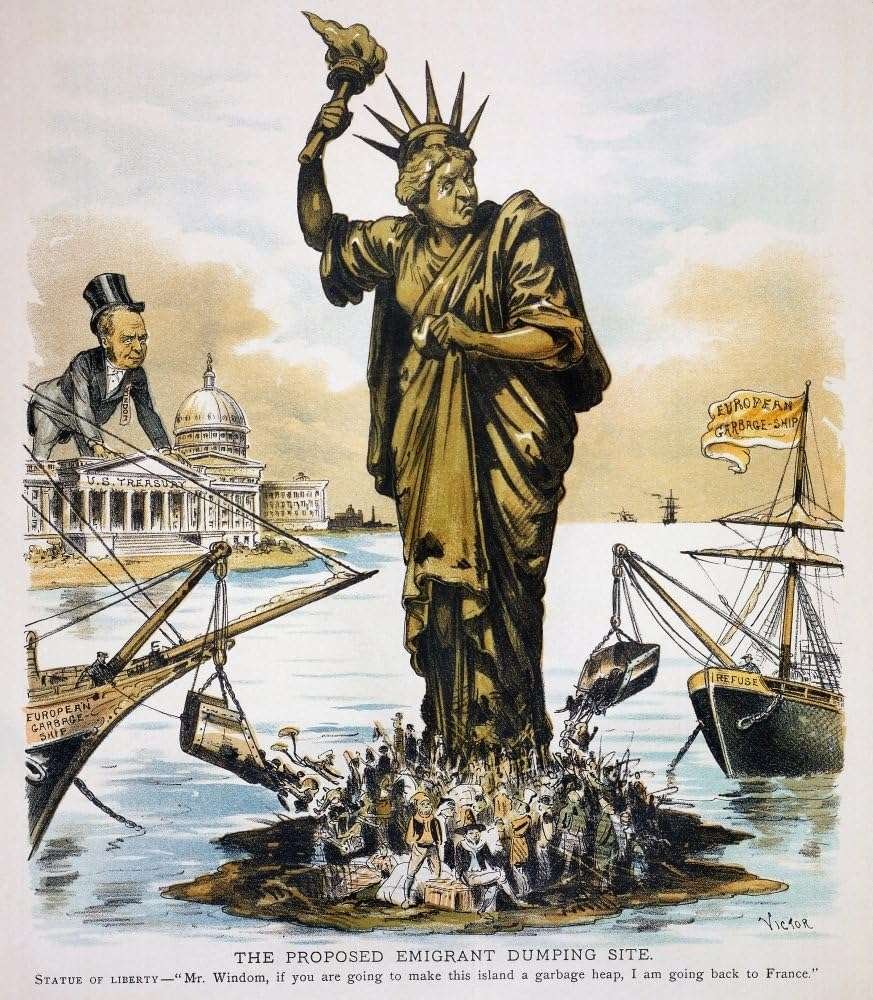
To them, the symbolism behind Lady Liberty’s statue was contentious. She was wrong embracing the world’s poor and huddled masses. In their vision, the chains at her feet should be interpreted as deportation tools in defense of the nation’s broken identity and fractured self.
Read more about immigration in New York State.
Illustrations, from above: “Come Unto Me Ye Opprest!,” a nativist, anti-Italian and anti-Anarchist cartoon by James “J.P.” Alley published in the Memphis Commercial Appeal, July 5, 1919; Jewish owned sugar mills and slave labor in Dutch Brazil; The First Mill Street Synagogue in the City of New York, 1730; Portrait of Emma Lazarus, ca. 1872; The Statue of Liberty’s hand and torch on view in Madison Square. (Museo Bartholdi Colmar); The original 1883 manuscript of “The New Colossus”; and an anti-immigration cartoon featuring the Statue of Liberty by F. Victor Gillam, 1890 (from the cover of Judge magazine).
Recent Comments