
 With weather events often predicted down to the minute, it is hard to imagine life without today’s real-time forecasts. Looking 120 years back into Warren County history, often that forecast came from old men sitting around a pot-belly stove who talked of woolly caterpillars and the color of the sky at sunset.
That changed in the late 1800s, when not one, but two weather prognosticators stepped into the limelight to share their predictions with the public.
John Brady
One of these weather prophets was Glens Falls resident John Brady. Born in Ireland in 1823, he came to America in 1849, where he settled his family in Queensbury, taking work in a paper mill. By 1886, this family had settled in Glens Falls, living on Prospect Street.
His weather predictions were first acknowledged in 1890 when the Glens Falls Daily Times called him a “local weather prophet.” That year he called for a severe winter, with heavy snow for November and December.
While talking to a reporter from the Glens Falls Daily Times on March 22, 1895, Brady revealed one of his methods for determining the weather:
“Do you see that eagle and arrow?” said Mr. Brady, pointing to the top of the flagpole on the Peck building, “well, it points northeast; that shows how the wind blows, and the wind regulates the weather. That is the way I know what the spring is going to be like.”
When the reporter asked about the upcoming summer, Brady admitted, “Well, I can’t say as to that until this day is over. Today regulates the summer.”
When our weather prophet called for a mild winter in 1895, one with more rain than snow, the community took notice. Adding to this general prediction, Brady also called for a storm with wind and rain around December 21st.
In what one newspaper later called an “exceedingly successful” call, not one, but two storms did indeed lash the region around the time he had predicted. As a result of these storms, a small steeple was blown over, impaling the roof of St. Mary’s choir loft, and a tree toppled over onto the Crandall Library building in Glens Falls.
Of course, predictions were sometimes off, and these failures were often quickly pointed out. One example was in June of 1895 when Brady called for a heavy frost, but none arrived. The Saratogian newspaper of June 15th pointed out this error, even wondering if this would injure his reputation as a weather prophet.
In closing, they did give him the benefit of the doubt by questioning if the frost might not have gotten beyond the borders of Glens Falls.
As a weatherman, John Brady was so well known that several local businessmen began using his name in their advertisements. One of these was the Warren Street wallpaper store of Shead & Clark, which carried this banner over their advertisement in the May 26, 1893, Glens Falls Morning Star: “Brady Spoke the Truth when he prophesied a Cold Backward Spring!”
 The clothing store of B.B. Fowler followed suit a few years later, also using Brady’s name in advertising. In a quarter-page advertisement in the spring of 1900 that reminded readers of Brady predicting severe snowstorms well into summer, Fowler pointed out that their store on Glen Street was the best place to shop for those preparing for the predicted weather.
John Brady was living on Prospect Street in Glens Falls with his daughter Elizabeth and son John, Jr when he passed away at 78 in 1901. For years after his passing, Brady was still noted for his weather predictions in advertisements for Fowler’s store.
Nathan Davis
Next, we head to Johnsburg in the northwest corner of Warren County and the self-made weather sage Nathan Davis. Born near Rutland, Vermont, Nathan had moved to Johnsburg with his family by the time he was school age, the place he would spend the rest of his life.
Through perseverance and industry, Nathan built on his rural school education and became a respected surveyor.
For Nathan, his quest for knowledge rose far above just measuring the landscape, taking him into the study of astronomy and gravity. By his 40s, Davis had refined his scientific study enough to put his research on paper. The announcement of this work was published in the Glens Falls Messenger of January 29, 1869:
“Mr. Nathan Davis, of Johnsburgh, has “entered according to the act of Congress,” an unpublished work, of which he is the author, entitled “Natural Science and the Solar System: a Discovery in Science, proving by the laws of science and the facts observed that the solar system is a series of cells, one within another, the earth being one, forming a cup galvanic battery the atmosphere being the acid, and that the solar light and heat is caused by the electricity thus envolved.”
For the next eight years, Davis continued to develop his unusual theory that the planets and stars, as well as night and day, are only apparitions created by rotating electrical cells that encircle the Earth.
In the summer of 1877, he presented his findings to the public at the Good Templars Hall in Glens Falls. In a review of his talk, the Glens Falls Messenger gave him low marks as a speaker and then even went on to suggest that any scientific authority presented with his ideas would pronounce him as “demented.”
 Davis was not deterred by this rebuke, as in the spring of 1893, he sent a letter to the Lake George News in which he again explained his theory on the effects of the moon on our planet. A reader, under the pen name Spectic, quickly responded, pointing out flaws in his ideas.
In his response, Davis shared his observation that the moon is a cold planet and influences the weather based on how high in the sky it sets.
Going back to his weather forecasts, the Warrensburg News of February 17, 1898, provided its readers with his end-of-winter prediction:
“The present warm spell will continue, with more or less variations, some days longer, or until the 20th or 22nd. There will be another cold wave with blizzards. March will both come in and go out cold, with heavy snow in the middle of the month.”
Though his timing was off by a week, the newspaper admitted that his prediction of bad weather arriving in the region was correct, with what they called a “sturdy young blizzard” hitting the region on February 15th.
In 1902, the Warrensburgh News acknowledged the accomplishments of this weather sage in an article headlined “A Johnsburgh Genius: Nathan Davis, Philosopher, Engraver, Printer, Etc.” Here they recounted his life and work, honoring him for his efforts in exploring the mysteries of astronomy and his work as a surveyor.
The newspaper also acknowledged his reputation as a weather prophet, saying that while he was not always correct, his predictions were often more accurate than those of other weather experts.
Sadly, only a year later, Nathan Davis died of stomach cancer at the age of 77. When he was laid to rest in the Mill Creek Cemetery in Johnsburg, his passing marked the end of an era of homespun weather prophets in Warren County.
Read More About New York’s Weather
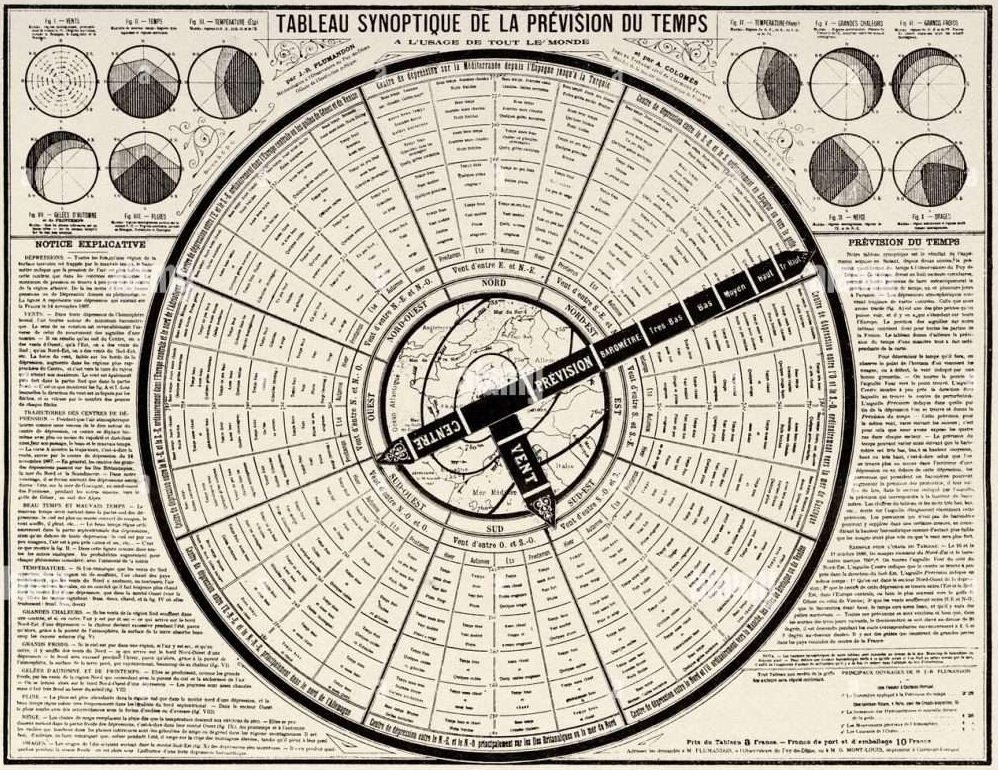
Illustrations, from above: Synoptic table for weather forecasting from La Nature, 1889; John Brady’s mentioned in a B.B. Fowler advertisement in the Glens Falls Daily Times, October 21, 1908; “Cosmical Indications,” Lake George News, October 8, 1891.
Recent Comments