
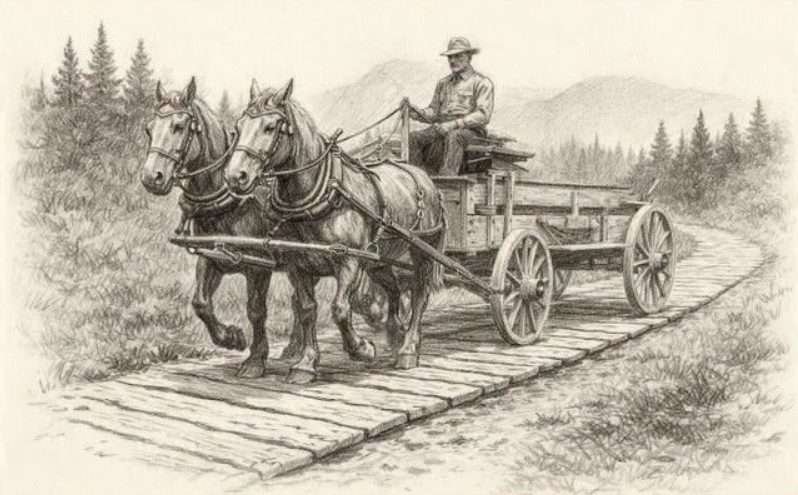
 Before I-87, Route 9, and the railroad, the fastest way to reach the Town of Chester, NY, in Northern Warren County was over a plank road, part of a trend of wood surfaced roads that began in the late 1830s.
The New York State Legislature awarded monopolies to dozens of companies to construct (and collect tolls) over 2,000 miles of plank roads. As their name implies, plank roads were built with wooden planks (generally hemlock) laid perpendicular to the direction of travel.
As the craze spread to Northern New York the Warrensburgh & Chester Plank Road was constructed in 1850.
 Utilizing planks seven feet long and 2½ inches thick, it was part of a series of plank roads that ran north from Glens Falls roughly along the path of modern Route 9 to Warrensburg and on to Chestertown, connecting the community much more effectively to the rest of the State.
A team of horses could travel more rapidly and draw a much greater load over a well-maintained plank road than over a common dirt road.
The plank road provided a greatly-improved way to move freight (especially logs, lumber, hides and tanned leather) and passengers in and out of Northern Warren County. It also facilitated the developing tourist industry.
The enthusiasm for plank roads faded quickly, however, wood planks deteriorated more quickly than had been anticipated, making upkeep expensive. An estimated forty percent of the miles of plank roads constructed in New York State were abandoned within ten years.
The Warrensburgh & Chester Plank Road Company survived longer however. An 1860 traveler to the “beautiful and picturesque village” of Chestertown noted that the plank road was “as good as can be desired” and a group of sportsmen heading north in 1869 reported they traveled “at a good pace over the plank-road to Chester.”
Indeed, the population of Chester in 1870 (2,329) was the highest in the 19th century and higher than the town would see again for the next hundred years.
By the 1870s parts of the road were macadamized (paved with crushed stone). By the final decades of the 1800s, complaints arose about the condition of the road and burden of the tolls.
 Nevertheless, the company continued until 1911 when Warren County purchased the company’s franchise, enabling the State to construct the highway that would later become Route 9 and help usher the community into the age of the automobile.
Until eclipsed by the opening of railroad transport to nearby Riverside Station (now Riparius) on the Hudson River in 1872, the Warrensburgh-Chestertown Plank Road helped foster an expansion of the local economy.
The Town of Chester Museum of Local History, located in the Chestertown Municipal Center, 6307 Route 9, holds hundreds of items from the town’s history, including a sign for the Plank Road. The museum is open 10 am until 2 pm on Wednesdays and Saturday mornings, and by appointment.
Read more about the Early Roads in New York State.
Illustrations, from above: a horse and wagon on a plank road; a map showing the route of the Warrensburgh and Chester Plank Road; and the Plank Road sign at the Town of Chester Museum of Local History.
Recent Comments