
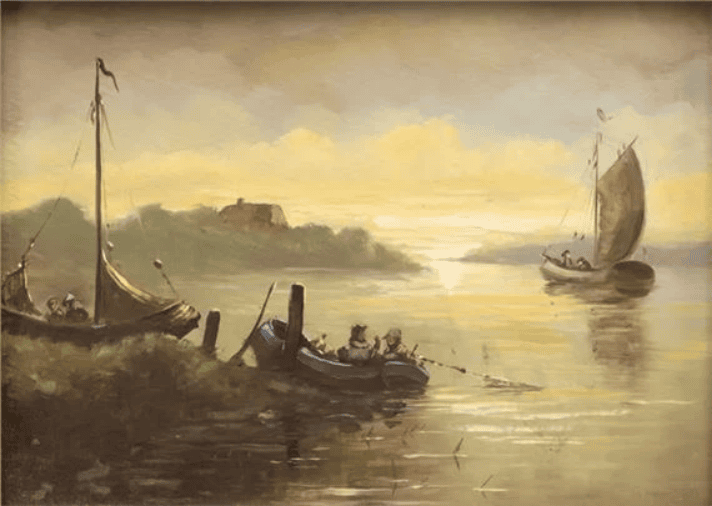
 Between 1748 and 1751, Swedish botanist Pehr (Peter) Kalm (1716-1779) made a journey through Pennsylvania, Delaware, New Jersey, New York, and Canada. The Swedish Royal Academy of Sciences had selected him to explore the territory and collect plants that would thrive in Scandinavia’s cold climate.
On his return, Kalm published a three-volume journal of his experiences, translated into English in 1770/1 as Travels into North America. By 1772, there were renderings in German and Dutch, as well as a second English edition. The book provided a reasonably reliable account of America’s natural history and social structure in the eighteenth century.
 Kalm catalogued both native plants and imported European species, but his work is more than just a botanical resource. He also described life in the city of New York and its lingering Dutch presence. While the British held political control, Dutch residents and traders dominated the island, although English was the most common language.
He was appalled by Manhattan’s olfactory environment. A wooded landscape that featured swamps and wetlands, the island reeked of autumn rot and decay. Stinking plants like skunk (swamp) cabbage added to the repulsive smells.
Kalm made note of the city’s poor sanitation. Well water was exceptionally filthy. There was “no good water to be met within the town itself” – at times even horses refused to drink it.
The pre-industrial city struggled with uncollected refuse, unmanaged cesspits, and free-roaming livestock. With no sewage system, insufficient street cleaning, and polluted groundwater, New York stank. The big stink was reported two or three miles away from the settlement.
Pigs of New Amsterdam
Ever since the early days of New Amsterdam, its water quality had been dreadful. Built on the island’s swampy southern part, its closest water sources were underground. Lower Manhattan’s natural water table was shallow and prone to seepage of seawater.
Settlers dug wells and built cisterns to collect rain, but neither source was enough to satisfy the colony’s ever-increasing needs. Clean drinking water was a rare commodity.
New Amsterdam was a noxious place to live. Runoffs from tanneries flowed into waters that supplied the wells. Slaughterhouses, breweries, and stables disposed of their waste indiscriminately. Cesspools were rarely cleaned and settlers emptied chamber pots outside their doors.
 Pigs, cattle, and goats ran free, leaving piles of excrement. Dead animals lay rotting in the streets. Human and animal waste contaminated the underground aquifers. New Amsterdam was a pigsty, literally and metaphorically.
In 1633, Wouter van Twiller succeeded Peter Minuit as the (fourth) Director of New Netherland and stayed in post for five years. His political presence may have been insignificant, but he amassed great personal wealth by acquiring land and setting up farms.
In 1637 he bought the East River island of Minnehanonck from the Lenape. Known as Roosevelt Island today, Van Twiller used the land to breed pigs and named it Varkens Eylandt (Hog Island).
From the outset, New Amsterdam was an unregulated outpost, attracting drifters, drunks, pirates, and smugglers. The colony was a profit-driven undertaking, not treated as a long-term investment. Infrastructure and urban embellishment were secondary considerations.
Its last Director-General Peter Stuyvesant tried to combat the filth. On February 20, 1657, he issued a ban on the practice of throwing “any rubbish, filth, ashes, oyster shells, dead animals or anything like it” in the street. His attempt to clean up the settlement failed.
Lack of water hastened the take-over of New Amsterdam by the English in August 1664. Fort Amsterdam was devoid of a functioning well or cistern. Without water reserves the garrison could not withstand a siege.
In his justification of surrender in front of the Dutch West India Company, Stuyvesant argued that the catastrophic state of water infrastructure made it impossible to defend the fort and colony.
Manhattan’s Stench Map
English settlers did little to improve the colony’s poor sanitation. They demolished the old Dutch wall (today’s Wall Street) as the settlement expanded northwards, digging a dozen wells into garbage-infested streets.
The stench did not deter newcomers. By 1820, the population had reached between 120,000 and 150,000 inhabitants, but Manhattan was still an outhouse crawling with stray pigs.
By the 1820s, the wandering hog population had reached around 20,000. Pigs acted as the city’s street cleaners, scavenging edible waste. During the 1850s, the area between 6th and 7th Avenues was referred to as “Hogtown” or “Pigtown.”
 Hundreds of thousands of horses worked the streets, depositing millions of pounds of manure. In the blistering summer heat, these piles dried into a dust that coated buildings or, during rainstorms, turned into sludge.
In 1836, the New-York Mirror described Manhattan’s streets as a “realm of mud,” covered with a slimy, bean-soup like deposit. Ankle-deep muck made even Broadway impassable.
New Yorkers loved their meat. Processing took place in the city center. Abattoirs, shambles, hog pens, and swine butchering dominated an area between Eighth Avenue and the Hudson River. Residents endured the nauseating smells of boiling fat and tanning hides. New York City reeked of death and dying.
Residents stored human waste in backyard cesspools which tended to overflow. By the mid-century, they produced thousands of tons of excreta, causing a public health crisis. Laborers hired by private contractors hauled away raw excrement from privies.
Known as “night soil men,” they had to carry their tubs in closed carts and travel late at night or early in the morning. Some loads were delivered to fertilizer producers; most were deposited in rivers where they coated the dock pilings with slime. Factories at Hunter’s Point dumped toxic waste directly into the East River.
In 1870, the Metropolitan Board of Health produced a pioneering “stench chart” of Manhattan. Kept at Columbia University Library, the document named “offensive” trades such as fat renderers, tanneries, and others.
As current medical science believed that bad air carried diseases (hence the word malaria, literally “bad air”), it detailed the location of polluters and the nature of their malodorous activities. It was a first step towards the imposition of public health regulations.
Mosquitos & Epidemics
The topography of Lower Manhattan was dotted with tidal salt marshes and ponds. Before urbanization, the environment was mosquito-ridden, which contributed to disease and high mortality rates among European settlers. One of the most feared afflictions was malarial fever which caused more anguish than the “threat of Indians.”
With its breeding grounds in putrid marshlands, the invasive Aedes aegypti mosquito became a summer menace to the humid port districts along the East and Hudson Rivers.
Native to Africa and introduced to the Americas by transatlantic slave and trade ships, these small flies caused panic in dense urban settings. A highly contagious viral disease with lethal consequences, yellow fever swept through the city, disrupting social life and economic activity.
Epidemics during the sweltering summers of 1793, 1795 and 1799 claimed the lives of between 3,000 and 3,500 New Yorkers.
Doctors and civic leaders were unaware of mosquito-borne diseases. They blamed the illness on “miasmas” (bad air from rotten garbage and stagnant water), prompting wealthy residents to look for “country air” in places like Greenwich Village.
 Others explained the disease as divine punishment for human sin and uncleanliness. The discovery of the causative agent of yellow fever was a lengthy process.
The cover of Frank Leslie’s Illustrated Newspaper, September 21, 1878, depicted a sailor with yellow fever coming ashore at New York Harbor. Embodied as “Yellow Jack” (originating from the nautical yellow flag or “jack” that ships carried to warn of quarantine), its caption reads “Shall we let him in? Mr. Mayor and gentlemen of the Board of Aldermen, the answer rests with you.”
The message is significant, showing that efforts to contain the virus focused on people, not mosquitoes. It was not until 1951 that Pretoria-born Max Theiler of the Rockefeller Foundation received the Nobel Prize for developing a vaccine.
Cholera (nicknamed “Blue Death”) was a consequence of over-population and poor hygienics. It devastated Manhattan in June 1832, killing over 3,500 people as the epidemic hit the slums, including the Five Points neighborhood.
Tragically, until 1811 this was the site of the Collect Pond, once a body of clear water and a pastoral picnic spot that was drained because of industrial pollution. Rich residents fled, but the poor had to face the waterborne disease.
Later outbreaks followed in 1849 and 1854. The spread of cholera was driven by contaminated water. As the routes of germ transmission were not understood, city officials blamed outbreaks on destitute Irish immigrants, rather than systemic sanitation failures.
Population density became a concern when large-scale urban expansion led to a division between rich and poor communities. By the 1830s, inequality was a serious social problem.
 The cholera epidemic of 1832 killed many slum dwellers. Mortality rates soared. Public health became an urgent issue. The elite moved uptown to escape the city’s noxious smells, retreating to the outskirts, the countryside, or the coastal resorts.
The term “suburbia” as we understand it today was not in circulation, but the concept itself goes back to that era.
New York City was suffocated by its own filth and in dire need of fresh water. In October 1832, the City Council commissioned a study on means to improve water supply to the metropolis.
Its authors reported that the Croton River in Westchester County was a possible source to satisfy the city’s urgent needs. On February 26, 1833, legislation was passed that allowed for the appointment of five agents to plan the construction of an aqueduct.
New York City & Imperial Rome
At the request of the newly appointed New York State Water Commission (led by the former 56th Mayor of the city, Stephen Allen), surveyors declared the Croton proposal a workable project. The plan was backed by a lobby of developers, bankers, and entrepreneurs.
Many industries were struggling with poor water supply, not to mention the city’s many hotels and taverns. Fire was a continuous risk that crippled insurance companies and threatened the real estate sector.
Civil and military engineer David Bates Douglass was requested to map the aqueduct’s location and trajectory. On May 2, 1834, the legislature passed a law for “Supplying the City of New York with Pure and Wholesome Water.”
New York’s residents had the final say. Despite the eye-watering estimated cost of over five million dollars, the vote’s outcome was never in doubt. The plan was accepted in April 1835 as New Yorkers were desperate for clean water.
Construction of the Croton Aqueduct would not begin until two years later amid the financial Panic of 1837. Another five years elapsed before water would flow to the city.
When the Croton Aqueduct was first put into service, it delivered a hundred million gallons of water every day along a forty-one-mile-long route, fed by gravity alone, to a population of over 312,000.
Stretching from the Croton River, the water flowed through an underground tunnel into Manhattan. Thousands of Irish immigrants worked on the project. Living in makeshift settlements along its route, they endured exploitation, harsh working conditions, cholera outbreaks, and nativist hostility.
 When water first began flowing through the Old Croton Aqueduct on June 22, 1842, the city rejoiced. The official opening took place on October 14th. Set aside as a holiday, the day-long celebrations included a seven-mile-long parade.
Over 25,000 people gathered to see the unlocking of the gates that released water from the aqueduct into the receiving reservoir at 86th Street and the distribution reservoir at 42nd Street. Guns were fired to mark each mile of the water’s journey.
In City Hall Park, President John Tyler was joined by crowds to gather around an ornate Croton-fed fountain unleashing a jet of water that surged fifty feet high. The New York Sacred Music Society performed a specially commissioned “Croton Ode.”
Having learned lessons from grand ancient aqueducts, New York City set out to rival Imperial Rome. The Old Croton Aqueduct was an engineering marvel that transformed Manhattan. By providing an abundance of clean water, it halted rampant epidemics and stopped city-wide fires.
A deepening sense of public safety sparked a population boom and paved the way for New York City’s urban growth. Already the nation’s most important port city, a reliable water supply meant that industrial expansion could continue apace. To New Yorkers, October 14, 1842, was Independence Day.
Read more about the history of New York City.
Illustrations, from above: Peter van Berkel’s “Scheepjes op kalm water” (Ships on Calm Water), late 20th or early 21st century; Second English Edition of Peter Kalm’s Travels Into North America (London, 1772); Domestic pigs in a wallow courtesy Mark Peters (Poplar Spring Animal Sanctuary); “Map Showing Location of Odor Producing Industries in New York and Brooklyn and the District Claiming to be Affected Thereby,” 1870 (Columbia University Library); Yellow Fever nativism in the cover image in Frank Leslie’s Illustrated Newspaper, September 21, 1878; “Slum landlord meets cholera in the poorest part of town,” 1866; and Croton Water Celebration at City Hall Park (Friends of the Old Croton Aqueduct).
Recent Comments