
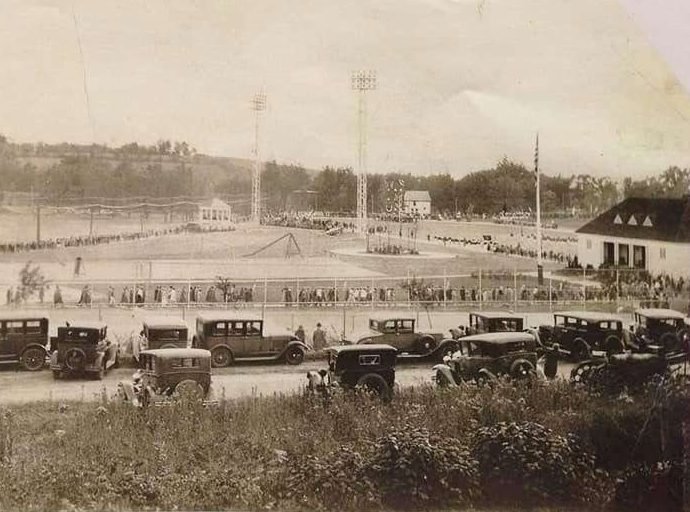
 On October 1, 1930, as America was sinking toward the depths of the Great Depression, the people of Johnstown, NY celebrated. The Knox Athletic Field complex officially opened.
The fifteen-acre plot in the town located between Albany and Utica was gifted to the Johnstown School district by Mrs. Charles B. (Rose) Knox, the President of Knox Gelatine from 1908-1947 and a resident of Johnstown for all of her adult life.
She helped transform an undeveloped expanse of uneven ground into a facility which held a terrace, combination football field, baseball diamond and quarter-mile running track (lighted for night play) and a grandstand of steel and concrete covered with wooden seats for fifteen hundred people (14 percent of Johnstown’s population at the time).
Another baseball field with bleachers for six hundred, seven tennis courts, an outdoor playground, a softball diamond, a wading pool for younger girls and boys, a roller rink/ice skating rink, and a large field house equipped with lockers, showers for home and visiting teams, and an office for the field supervisor, were all a part of the complex.
Twenty-five hundred evergreens, trees, and flowering shrubs adorned the area. Its total cost would be varyingly estimated by some newspapers at $200,000 ($4 million in 2026 dollars) or the New York Daily News’s estimate of $1 million ($20 million in 2026 dollars).
In 1928, Mrs. Knox had heard of the school district’s plan to spend $50,000 to build an athletic field. Already the most prominent philanthropist in Johnstown, she had given bells and meeting rooms to churches and added an elevator and rooms to the Willing Helpers Home for elderly women.
 She understood the obligation that conventional society believed a wealthy woman had to her community: that was to support institutions which could help improve the general population.
Rose Knox believed in offering individuals opportunities to better themselves through religion and education. But rather than sending undesignated dollars to charitable institutions, or becoming known for frivolous opulent balls, Mrs. Knox preferred funding tangible things.
She went to the Johnstown School Board, paid them one dollar for the ground designated for the field, and took over development. Work, which began before the stock market crashed in October 1929, continued afterwards and included the installation of two miles of drainage pipe to reroute an underground stream, and movement of between twenty thousand and sixty thousand cubic yards of dirt.
When she sold the completed Field back to the school district for $1 and it opened, Mrs. Knox was one of the most famous businesswomen in America and Knox Gelatine, the best selling unflavored gelatine in the country, was used by millions of American housewives. The New York Daily News reported on the inaugural day at the Field by featuring a big picture of Mrs. Knox at its opening ceremony.
It placed this picture directly underneath its other sports photo of the day – a photograph of opening day at the World Series. For the event, Johnstown declared a “civic holiday,” canceled classes, and sponsored a “monster street parade” to the field with children, organizations, city officials, floats, bands, and a presentation to Mrs. Knox of a thank you book signed by students and teachers.
When Mrs. Knox spoke at the opening, she espoused her philosophy of work/life balance and always being active. As she said:
“Nothing can aid us better… than systematic, wholesome recreation and athletic exercise in the open air. Life is a good deal like a game— we must be in the spirit of it to win—we must have faith and confidence, both in it and ourselves… The world’s best thinkers, and workers, are the men and women who know how to play well, for they know to give their undivided attention to work when they work—and to play when they play—and to be aware of the folly of trying to do the two things at one time.”
 Knox Gelatine, whose iconic orange box was produced and packed in Johnstown, survived the Depression without laying off a single worker, though sales dropped by a third. Working at the company was said to be like being part of an extended family, with employees invited to the Knox Mansion for holiday events and generations of families holding jobs there.
Like other Upstate New York family-run companies Mrs. Knox protected her own. She successfully built Knox Gelatine because of her savvy understanding of what would resonate with both her female consumers and the all-male manufacturers and brokers with whom she did business.
In Johnstown and, across the country within the food industry, Mrs. Knox leveraged her money for power and impact. During her life, she was respected and acclaimed not only in Johnstown but throughout the country.
After her death, America forgot about Mrs. Knox. Johnstown, however, needs no reminder. She is still a household name there.
The Field, the Knox School, the Museum in the old director’s building – all still exist and are enjoyed by everyone.
Rachel Greenfield is the author of the biography Rose Knox: How One Woman Mixed Kitchen and Boardroom to Remold an America Business (Cornell University Press, 2026).
Read More About Johnstown History
Illustrations, from above: Knox Athletic Field Complex in Johnstown on opening day, October 1, 1930; Rose Knox in The American Magazine, 1921; and a classic box of Knox Gelatine.
Recent Comments