
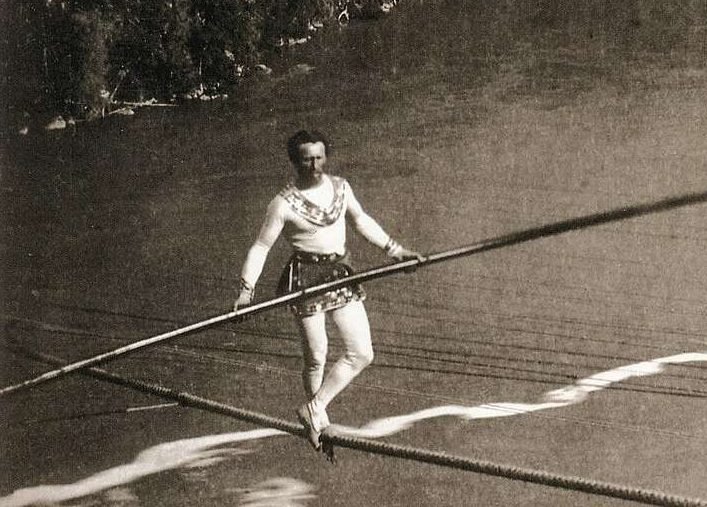
 The tightrope is the simplest of spectacles. It relies on a human aerialist strolling along the abyss. In Roman times it was called funambulism, walking on rope.
Amid the golden age of daredevils during the nineteenth century, said to be the greatest of all “rope dancers” was the Frenchman Jean François Gravelet, born in 1824.
Gravelet was sent to a gymnastic school in Lyon when he was five years old. He quickly became known as the “Boy Wonder.” His blond hair and blue eyes gained the nickname, “Blondin.”
A phenomenal performer, Blondin toured North America in 1851. Captivated by Niagara Falls, he knew that somehow he wanted to include this marvel in his performance.
In 1859, he devised an astounding sensation by stringing a cable along three-quarters of a mile across the Niagara River gorge just below the falls. No one had pulled off such a feat before.
Platforms were constructed atop the two cliffs. The three-inch-thick cable stood two hundred feet above the river. Its weight sagged down toward the center. Guy ropes steadied the lines along the way on both banks. The tumult of the falls swirled amid clouds of mist. Many spectators thought the notion was absurd, even suicidal.
Blondin’s spectacle brought life and death as close to each other as possible. Danger, he felt, would excite watchers, would take their breath away. There was no hidden support, no safety device, no net. His protection was the iron control built by decades of relentless physical conditioning.
 “The rope is safe,” he said. “I am safe. It is only the spectators who are in danger from fright.”
Blondin stepped onto the platform as tens of thousands of viewers watched. Holding a thirty-eight-foot balancing pole, he crossed the void along the narrow cable from the United States to Canada.
Spectators were astounded. Blondin waited an hour and then crossed back again. Headlines shouted the newspapers. “He certainly stands at the head of tight rope walkers,” said the Buffalo Morning Express. “Vive Blondin!”
Simply walking across the rope proved stunning. But this was only a teaser. More would come. Much more.
On July 4, 1859, a far greater crowd packed the grandstands and clung to every vantage tree or rock. The tightrope walker stepped out above the raging river. Part way along, he stopped and, to the horrors of viewers, turned a complete somersault.
Then he stood on his head, he hung on one leg, spun his body around the rope. He brought a line up from the Mist of Maid steamship below and drank a bottle of champagne.
By then, the crowds were convinced that somehow Blondin would lose his balance and plunge into the gorge. Thousands gambled that the performer would perish.
He stood five feet five and weighed 140 pounds. He possessed a mix of imagination, nerve, and complete self-assurance. “The slightest false step would have been fatal,” wrote The New York Times, “yet he moved as if on firm ground.”
Blondin devised new “daring antics.” He took a wooden chair with him and balanced the rope on two legs while he sat down. He tied a blindfold and walked out onto the rope in darkness. “In fact,” wrote the ecstatic Express reporter, “one can scarcely believe the feat was indeed real. I look back upon it as upon a dream.”
Blondin came back to Niagara repeatedly and crossed the gorge dozens of times. He walked the rope with a basket attached to each foot. He carried a wheelbarrow across. He rode a specialized bicycle along the cable. He walked the rope on stilts. He hauled a 55-pound coal stove onto the middle of the rope, cooked an omelet, and lowered the dish to tourists in the boat below.
One of Blondin’s most challenging escapades was to carry his manager, Harry Colcord, on his back as he walked across the gorge. Holding both the man and the 45-pound balancing pole was a grueling physical burden.
Colcord wore a harness that held him up and grasped Blondin around his neck. As they set off, the funambulist warned his manager not to look down — yet the man’s eyes were drawn irresistibly toward the churning river.
 The crowd was riveted. Emotions were taut. Many covered their mouths with their hands, waiting for the awful moment.
Near the middle, fatigue began telling on Blondin. He was forced to pause briefly. He allowed the manager on the rope and rested. Then Blondin started again with his encumbrance, continuing along the upward rope.
“Rest like a dead weight on my back,” Blondin told Colcord. “If I should sway or stumble, do not attempt to balance yourself.” The terrified manager tried his best. Blondin finally made the daunting journey. The rapturous onlookers exploded in relief and euphoria.
The Great Blondin set off a craze that swept around the world. He performed spectacles at the Crystal Palace in London, at the Melbourne Opera House, at Paris and Coney Island.
Dozens of imitators tried to emulate his show, but none matched his pageantry. His last performance took place in Belfast in 1896.
He died of natural causes a year later at the age of seventy-two having defied gravity for decades on a single strand of rope.
This essay was first published on Jack Kelly’s substack Talking to America.
Read more about circus and circus performers in New York.
Illustrations, from above: The Great Blondin at work, and in promotional photos.
Recent Comments