
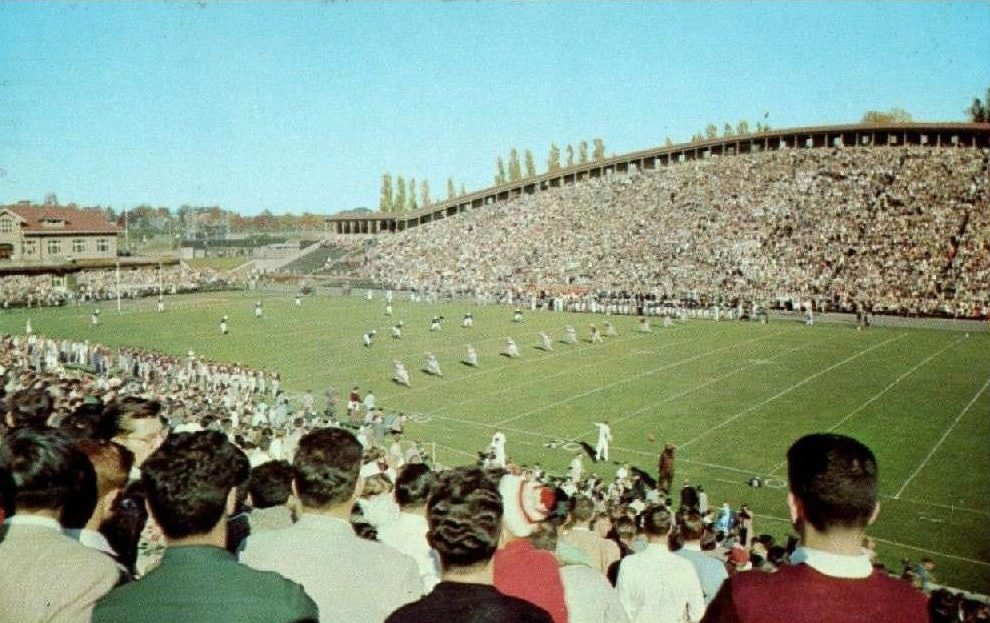
 The NFL training camps have begun for another season, with the preseason beginning in mid-August.
During the 1960s the New York Football Giants would play a series of preseason games during a five year period at Cornell’s Schoellkopf Field in Ithaca, NY, which would come to be called the Finger Lakes Pro Bowl.
This event was the brainchild of longtime friends David Abbott, Ithaca businessman, and Jim Lee Howell, Giants player and head coach.
Thrown together during World War Two, these men island hopped the Pacific with the US Marine Corps and remained friends, who developed the notion the Giants should play a preseason game in Ithaca. Howell stepped down as Giants head coach in 1960, replaced by Allie Sherman.
 These pigskin events were sponsored by the Ithaca Chamber of Commerce, where Cornell University donated the use of their 34,000 capacity stadium, with its iconic stone-and-concrete “Crescent” grandstand, which served as the home of Big Red football, high above Cayuga Lake’s waters since 1915. Proceeds from the event benefited a local community service program.
The first Finger Lakes Pro Bowl in August of 1963, although it was not called that at the time, was termed an “exhibition game” and would match the upstate New York Giants against the “Monsters of the Midway,” the Chicago Bears.
The Bears would come to Ithaca with Papa Bear himself, George Halas, one of the founders of the National Football League, on the sidelines on a bright day in the August sun, with his eventual successor, Mike Ditka.
Giants head coach Allie Sherman, considered an offensive innovator, would start quarterback Y.A. Tittle, supported by Frank Gifford, Alex Webster, Joe Morrison and Hugh McElhenny, newly arrived from the Vikings, and the QB’s favorite pass-catcher, Del Shofner. Jim Katcavage anchored the defense.
The Bears began the scoring with a field goal; the Giants answered with a touchdown scored by Tittle on a one-yard run. With Tittle’s sore back, elbow and knees, Coach Sherman needed to get playing time for the back-up QB, Ralph Guglielmi, who became the signal caller for most of the second half.
In this game, the Giants kicker Don Chandler, known as “the Toe,” who previously led the league in accuracy, had difficulty finding the mark. His four field goals in wintry Chicago the previous December nipped the Bears by two points in the game that clinched another NFL divisional title for the Giants.
Yet in Ithaca he missed four field goals in a game the Giants would lose by 10 points. The Bears kicker, Roger LeClerc, joined Chandler in disgrace by missing a chip-shot field goal from the 14.
 What was the reason the kicking game fell apart? Prior to 1974, the NCAA college goalposts were on the end line, and pro’s on the goal line, so for this exhibition game there was a double set of goalposts, Cornell’s permanent uprights were left implanted at the rear of the end zone while duplicate sets were erected on the goal line to meet NFL standards, proving a confusing and unfamiliar target.
The Bears and Giants played their first game against each other for the 1963 season in Ithaca and would also play the final game of the season, with the Bears prevailing at home in the single-digit cold NFL Championship game in the friendly confines of Wrigley Field.
The New York Football Giants held their training camp at Fairfield University, Fairfield, Connecticut from 1961-1969, and liked the idea of an easy trip to Ithaca.
In 1964, the Giants played the Washington Redskins. This second match-up was termed the Finger Lakes Pro Bowl, and spoken of as the second iteration, much like the Super Bowl, which was originally known as the NFL-AFL Championship, until the third game when it became Super Bowl III.
In the days before online commerce and marketing, the Ithaca Chamber of Commerce hung posters in Finger Lakes and Southern Tier bars, restaurants, hotels and Elks Club’s, returning to these venues with a mobile ticket office, directly marketing the Pro Bowl.
The Ithaca Chamber distributed NFL films to sportsmen’s groups, and also sponsored a late spring luncheon at the Statler Hotel on the Cornell Campus to announce their upcoming Pro Bowl event planned for that August, featuring NFL players.
Many believe the Giants 1960s trip to perdition began by Coach Sherman trading defensive standouts, initiated with Rosey Grier going to the Rams, and later linebacker Sam Huff to Washington and defensive tackle Dick Modzelewski to Cleveland during the 1964 off-season.
The friction between Huff and Coach Allie Sherman began before the 1962 season, with a change in scheme that confounded the All-Pro player. In Sherman’s defense, Huff was required to fill the strong-side gap between the guard and center, rather than reading the offensive plays that Huff had executed to near-perfection in the Tom Landry 4-3 defense.
At the end of the pre-season schedule, Huff confided his discontent with defensive captain and coordinator Andy Robustelli who, although he agreed, felt this call belonged to the Head Coach. Huff eventually voiced his dissenting opinion directly to Coach Sherman, with the predictable result – he went down the road. The personnel who made up the Giants’ once impermeable defense were no longer in place.
 In the 1964 Finger Lakes Pro Bowl, Y.A. Tittle, in the twilight of a fabulous career, and Gary Wood shared QB duties. Gary Wood was a Cortland High School QB sensation and Ivy League phenom with Cornell. Gary Wood was drafted by the Giants, but in those days, also by his Uncle Sam.
The Giants rookie quarterback returned to the scene of so much success for him on the Cornell Hill. However, Wood had a disappointing 3-for-8 performance, where Sam Huff and the Washington defense prevailed, 27-24.
Father Time wins all races, and where the Giants once won because of experience, they now lost because of age, finishing the season with a 2-10-2 record. Frank Gifford, Alex Webster and QB Tittle retired.
Y.A. Tittle’s departure, brought on by an injury in Pittsburgh, was more than just a replacement in the key quarterback position. The Giants lost his leadership poise, and an on-field coach. Expecting a rookie QB, no matter how talented, to fill his cleats, was a misconception by Coach Sherman.
In 1965, the Finger Lakes Pro Bowl was supposed to feature the Giants against the Green Bay Packers on Labor Day in Ithaca, but Packer management suggested they play in Green Bay instead, where they could pack 50,000+ in their newly enlarged stadium, and they did. The home team prevailed, 44-7.
The Finger Lakes Pro Bowl and New York Football Giants returned to Ithaca in 1966 to play the Pittsburgh Steelers on a sunny and hot day with temps in the 90s and dehydrated people collapsing everywhere. They carried stretcher after stretcher down into the shade formed by Cornell’s ancient Crescent.
 The only one not hot was Giants QB Earl Morrall, a dismal 2-for-9 in first half passing and an end-zone fumble, resulting in a Pittsburgh score.
The only bright spot for QB Morrall was a first quarter 19-yard pass to Homer Jones for a TD. Backup Gary Wood entered, and the Giants threatened downfield and converted on a 34-yard field goal by his former Cornell teammate, Pete Gogolak.
The Giants finally prevailed, beating the Steelers on a late-game turnover, with a spectacular end zone interception by “Spider” Lockhart leading to rookie Steve Bowman’s go-ahead TD, winning 16-14.
This season of 1966 also saw the NFL expansion Atlanta Falcons enter the league, and begin 0-9, winning their first game ever in New York’s Yankee Stadium against the heavily favored Giants. A bad time indeed for Giants fans.
The 1967 Finger Lakes Pro Bowl pitted the Giants against the same Falcons who embarrassed them in Gotham the previous season. Ticket prices at Schoellkopf Field remained the same as the previous year, $5.50 in the Crescent, $3.50 for end-zones and bleachers.
The Giants lost QB Gary Wood to the New Orleans Saints via the expansion draft, which allowed the new club to select players from existing teams, and shortly afterward acquired QB Fran Tarkenton from the Vikings for future draft picks, as Earl Morrall was suffering from a wrist injury.
The Giants lost their other Cornell alumnus as well, when their leading scorer Pete Gogolak was drafted into the Army.
The Finger Lakes Pro Bowl was QB Tarkenton’s first game with the Giants, the Binghamton Press reported; “He threw with only sporadic accuracy, threw long hardly at all and had three interceptions.
He scrambled for 42 yards rushing, but had 30 of it stuffed at him in losses and was the culprit in a key too-much-time penalty that forced a late Giant bid to settle for a tying 20-yard field goal by Chuck Mercein after reaching a first down at the Falcon 5.”
The Norm Hecker coached Atlanta Falcons would end in a 10-10 tie with the Giants in what proved to be the fourth and final Finger Lakes Pro Bowl game Ithaca would host.
Allie Sherman’s tenure with the Giants continued through the 1968 season, when he was replaced by former backfield star and assistant coach, Alex Webster.
The NFL was expanding its season, and wanted September, rather than August dates for the Finger Lakes Pro Bowl, which Cornell felt would imperil their own squad’s season.
There appears to have been a 1969 effort to revive another Giants-Steelers match-up at Schoellkopf Field in Ithaca, but when that fell through it signaled that times had changed for NFL teams playing in modest sized gridiron venues in upstate New York.
Read New York Football History.
Illustrations, from above: Cornell’s Schoellkopf, ca. early 1960s; the Crescent in ca. 1920; TOPPS football card showing the 1966 Giants team (from the height of the Civil Rights Movement, the player seated in the first row at the far right, #45 Homer Jones, and the player seated next to him, #19 Gary Wood, were the first integrated roommates when the Giants traveled); and Y. A. Tittle and Homer Jones TOPPS football cards.
Recent Comments