
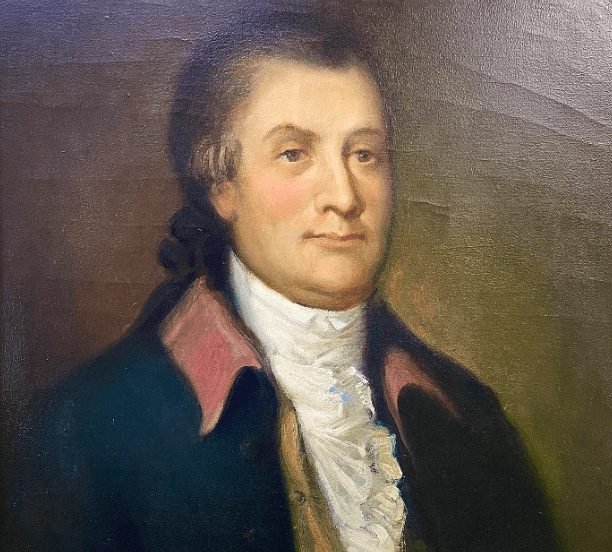
 Christopher Yates (1737-1785) of Schenectady was a surveyor by trade, a job that brought him into the frequent employ of Sir William Johnson. When the French and Indian War began in 1755, Yates joined the Second Albany Militia, serving under Johnson at some of the most crucial battles.
He was among the British troops defeated at Ticonderoga early in the contest during the July 8, 1758 Battle of Carillon, the bloodiest event of the war, with over 3,000 causalities. He later participated in the successful siege of Fort Niagara in July 1759.
Likely due to his military experience, Yates emerged as an early leader when Schenectady was seized by Revolutionary fervor in 1775. On May 6 of that year, he was elected to the first Committee of Safety and was quickly made chairman of that ad-hoc government.
He would later be commissioned to serve as a quartermaster for Patriot forces north of Albany, and would spend much of the war in the vicinity of Old Saratoga.
The Schenectady County Historical Society (SCHS) recently gained new insights into this local leader in the form of the Christopher Yates Papers, a folio in the possession of Syracuse University. It’s a vast collection spanning multiple generations of this illustrious family. (Another collection is held at Yale.)
While most of these documents date to the late 18th century, the remainder span a range from 1677 to 1936. Crucially, these are letters written to Yates rather than by him. So while they don’t preserve his exact words and sentiments, they do show us his conversations with other local notables like Henry Glen and Philip Schuyler.
Careful reading provides invaluable insight into the experiences and attitudes of Schenectady’s leading patriot. In theory, these papers have been available to researchers through the University.
However, without digital copies, these were largely inaccessible. To remedy this, SCHS staff drove out to Syracuse University to photograph the papers. The Society then began the long process of transcribing the often opaque handwriting and diction of the 18th century authors.
Quartermaster Yates & the Northern Army
Unsurprisingly, most of Christopher Yates’ letters relate to his work as quartermaster. There are the occasional glimpses of wartime drama, daring action, or gruesome details. But, to be frank, a quartermaster’s work generally makes for dry reading.
Pity the researcher who must sift through endless lists of military stores and marching orders in exacting detail. But we know that the outcome of the American Revolution depended on exactly these mundane details.
 The tug of war between American and British forces was confined primarily to the principal waterways north and west of Albany. The Hudson River led north to Lake George, which in turn led to Lake Champlain at Ticonderoga.
Some of the most significant early battles of the war, from the failed American Invasion of Quebec in 1775 to the British defeat at the Battles of Saratoga in 1777, occurred along this corridor.
We might imagine thousands of men marching north or south, with their attendant masses of camp followers, animals, and baggage. Poor logistics could lead to casualties as severe as any battle through starvation, exposure, disease, and desertion.
One of the most significant of these letters was sent from General Philip Schuyler to Yates on May 10 of 1776. This commission imbues him with the responsibility and authority over Revolutionary supply lines between Albany and Lake George.
Indeed, the whole letter reads like a virtual how-to guide for any 18th century logistician. Schuyler describes how supplies must be first carried by wagon from modern day Waterford to Stillwater. There, the Hudson River is calm enough that small boats can ferry the goods a further 22 miles north to Fort Edward.
There again, the Hudson has too many rapids to continue and wagons are needed for another 12-mile journey over land, which required a herculean effort of many days for the men under Yates’s command.
Schuyler is sure to stress the importance of this supply chain. “No person,” he warns, “can neglect any part of his duty without creating confusion in the whole chain of communication.”
He expects Yates to directly supervise the whole 40-mile route, traveling constantly to ensure compliance at every junction. Schuyler offers a stern conclusion
to the orders: “I trust I shall not have reason to complain of you.”
As the war progressed, Yates would prove himself more than equal to the task, laying the the groundwork for the eventual American victory at Saratoga. And while Quartermaster Yates was responsible for logistics of a grand, strategic nature, we also see him burdened with matters that seem surprisingly petty.
Specific requests, personal favors, and mundane details clutter Yates’ letters. A perfect example of this comes in a letter from Hugh Hughes of Schenectady, sent to Yates on February 21 of 1782. By this point, Cornwallis had surrendered at Yorktown, and the threat of British attack was diminished but still real.
The Continental Congress and Army had amassed debts to countless private citizens in prosecuting their war for independence. Hughes had been issued Continental currency and charged by one Major Hendrick (Henry) Quackenbush with riding to Saratoga to settle some of these accounts.
But alas, Hughes has no saddle to ride! His own two personal saddles had been worn out in previous public service. Major Quackenbush, apparently, has nothing to spare and little sympathy for his subordinate. Hughes writes to Yates to request a saddle and writing paper (then in seriously short supply) to discharge his duties.
 “I have been six years in service of my country,” Hughes laments, “and never had a public saddle for my use.” It seems Hughes is embarrassed by this complaint because he actually crosses out his own words, leaving them just legible enough these centuries later. To our eternal suspense, we may never know if Yates was able to fulfill this request.
With the ideological stakes and mortal peril inherent in war, should Christopher Yates really be worried about one man and his riding accessories? Surprisingly, the answer might be yes.
With the Continental Congress being so distant and disorganized, its resources and credit could not sustain the Revolution. Congress had no effective way to levy real taxes and thus had no way to pay its real debts. When it did, it generally issued a worthless fiat currency – the same that Hughes was charged with dispensing.
If these payments ever happened, they were invariably delayed by such trifling circumstances as Hughes’ lack of a saddle. Indeed, who knows how long these anonymous Saratoga creditors waited for satisfaction, while Hughes pleads his case with Yates.
As such, the Revolution was generally sustained not by Congress but by the resources and credit of local leaders like Yates, and to a lesser extent Hughes. In his letter, Hughes complains that “All my private money is spent in the public service.”
This reminds us that, almost by definition, Revolutionary leaders were men of property and preferably prominence who could afford to play the role. Sometimes even they were overwhelmed by the expenses.
By leveraging their networks of personal relationships, they maintained cohesion amongst Revolutionary individuals and communities that otherwise would pursue their own specific interests in the chaos of war. So indeed, while no single personal favor would ever prove decisive, Yates’ attention to even trivial matters likely had a significant cumulative effect.
Yates & The Committee of Safety
While much of Yates’ letters deal with managing supplies, he also has the responsibility for policing people. When the conflict begins in 1775 and Yates is elected to the Committee of Safety, he and his peers quickly begin adjudicating rumors that certain Schenectadians remained dangerously loyal to King George III.
For example, locals George Ramsay and Joseph Kingsley were sent to jail in Albany after certain “unwarrantable expressions” they allegedly spoke. It’s not surprising then, that the Yates letters show our preeminent patriot in conversation with an extended network of peers regarding suspected “Tories.”
Indeed we find in Yates’ papers a letter from John Younglove written in November of 1776. Younglove was the chair of the Cambridge, Massachusetts, Committee of Safety, just as Yates was for Schenectady.
The people of Boston had recently driven the British from their city and now set about rounding-up their perceived enemies from within. Younglove discusses two men that he has imprisoned by virtue of what might be described as hearsay.
 To be brief, a Cambridge man testified that a woman in the neighborhood told him these incarcerated men had trafficked contraband to British troops. It seems that evidence was sufficient to Younglove who goes on to warn Yates about an associate of the prisoners named Blake.
Younglove urges Yates to examine this Blake and to confine “Every person that is disaffected so near the mouth of the enemy as you are.” Depending on one’s perspective, such judicial proceedings might be considered a miscarriage of justice or a necessary wartime expediency.
However, it’s plain to see that Revolutionary leaders like Yates, were not inclined to tolerate any support for the King, be it material or simply verbal.
Another population Yates closely monitored was enslaved people, who might use the chaos of the Revolution to seek their freedom. In August of 1776, one T. Collins writes Yates that, “The Negro you write of I have taken up And I have had him hand cuffed and confined.”
Collins goes on to describe that the enslaved man will be brought under guard back to Yates to be forwarded on to Ballston. From this passage we see that Yates is not just responsible for facilitating the transport, but was the one who alerted Collins to the fugitive man in the first place.
Likewise, in June of 1776, Andrew Finke writes to Yates seeking to return a “servant boy” to his “Master” John Fonda. This person was not a fugitive, per se. Apparently, Fonda had loaned this “servant” to the army for a period of two months and expected him to be returned.
We should also note that this “servant” is not explicitly described as enslaved. But whether a Black man bound for life or a White man indentured for a set term, he is certainly treated much like Collins’ prisoner would be.
Finke will not let him return on his own but will have him escorted back only after Finke is reimbursed certain expenses. “He was in a manner Naked and he has cost me upwards of five pounds to clothe him,” Fink complains. It seems he expected Yates to provide that reimbursement.
Clearly, the work of a Revolutionary quartermaster involved upholding existing social hierarchies. Even when Yates isn’t directly supervising the return of escaped enslaved people, the activities of these people is a subject of concern for him and his colleagues.
Soon after the Declaration of Independence was signed, one William Wilke writes to Yates with general news from around the colonies. One curious passage states that “Dumore with his Black Brethren put the second Time to rout with loss of 11 killed.”
 The identity of these Black Brethren is confirmed as Wilke describes them as “the fugitive Black Squadren.” Lord Dunmore, the last royal governor of Virginia issued a proclamation in 1775 promising freedom to any enslaved person who joined British forces.
The creation of Dunmore’s “Ethiopian Regiment,” as it was known, was fiercely opposed by colonial leaders and likely served to radicalize many towards independence. For their part, Yates and Wilke are doubtlessly glad that these newly freed men were defeated.
The issue of Black British troops reappears later in the Yates letters. On October 31, 1781, Henry Glen writes Yates discussing some small local skirmishes. In the same letter, without any fanfare, Glen briefly mentions the British surrender at Yorktown earlier in the month.
The men may not have realized that would be the final, decisive battle in the war. For our purposes, Glen relates that the defeated British force contains 5,500 regulars as well as 4,000 “tories and negroes.”
The presence of Black troops amongst the British at Yorktown is generally unreported in traditional histories of the battle. Is their presence understated by tradition or overstated by Henry Glen?
It’s beyond my ability to comment on the actual number of freed Black men with Cornwallis. But what is clear from Glen’s comments is that he believed there was a significant number of them.
For Schenectady’s Revolutionary leaders, freed slaves flocking to British banners were just as significant a threat as free white men who did the same. We might wonder how seriously Revolutionary Americans took Jefferson’s words that “that all men are created equal, that they are endowed by their Creator with certain unalienable Rights.” But there is little debate that most had to wait until long after the war to achieve these rights, some for two centuries.
Schenectady’s enslaved Black population numbered nearly 500 people in 1790. The majority of these people wouldn’t be free until 1827. Yates’s letters are another reminder that many Patriots who desired separation from Great Britain, didn’t necessarily desire social revolution at home.
 The Yates Papers tell us much about what Yates did but very little about why he did these things. Did Yates embrace the radical Lockean worldview espoused in the Declaration of Independence? Or was he simply averse to the taxes and coercive policing of the British Parliament? Were his superlative efforts ideologically driven, or an attempt to further his personal interest in a time of crisis?
An individual’s motivations are usually complex and malleable, and we may never have the primary sources to truly understand Yates. Furthermore, Revolutionary Schenectady was obviously bigger than any one person. We should assume that the conversations, concerns, and experiences of someone like Chistopher Yates differed significantly from other people in Schenectady.
We’re entirely ignorant to the perspectives of those who, due to the social and economic limitations of the era, were not elevated to positions of leadership.
We might also wonder about the Loyalists jailed by Yates and his peers. Why did they risk persecution by their neighbors to remain loyal to a distant king?
Read more about Schenectady County History.
A version of this essay by Program and Education Manager at Schenectady County Historical Society Michael Diana was first published in the Society’s Newsletter, Volume 70. The Society is a private, nonprofit institution founded in 1905 to share and preserve Schenectady County’s history. Learn more and become a member online at schenectadyhistorical.org.
Illustrations, from above: Portrait of Schenectady patriot Christopher Yates, attributed to Maunsbach (SCHS collection); Map of the area of John Burgoyne’s 1777 Saratoga campaign during the American Revolution; Detail, William Lane, View of the West Bank of the Hudson River 3 Miles Above Still Water, Upon Which The Army Under the Command of Lt General Burgoyne Took Post on the 20th September 1777 (1789); Continental Soldiers Raid a Loyalist Home during the American Revolution; a member of Lord Dunmore’s Ethiopian Regiment; and the gravestone of Christopher Yates in Vale Cemetery.
Recent Comments