
 In the days of our great grandfathers the occasional ancient coach and the heavy lumber wagon in which the freight transportation of the country was carried on were almost the only vehicles that rolled along the roads. The people did not own private carriages themselves.
When they traveled they took to the coach or rode on horseback, the latter being the more customary plan.
The purchase of a private carriage was such a rarity that such an act was sufficient to stamp a man as an aristocrat and was very likely to create a prejudice against him.
So that in those days although the people fairly lived under the branches of boundless and apparently inexhaustible forests and though timber was as cheap as dirt, the amount of wood cut for carriage building was so slight as to make no perceptible impression upon the forests whatever.
But now things have greatly changed. Within the hundred years just gone by [1778-1878] an era of railroad building and carriage owning has come in and during the last fifty years carriages and cars have been building in increasing numbers year by year.
Now in 1878 the demand upon the forests of the country for the stuff with which to build these vehicles is some thing enormous and alarming. Upon the railroads of the United States there now roll 350,000 cars, and upon the highways and streets 15,000,000 carriages, stages, trucks, and carts.
To replace the old and supply the demand for new vehicles of these several classes it is estimated that the country now requires the growth of 500,000 acres of timber annually. These figures show better than any thing else can the enormous development reached by this special industry in the United States.
 The earliest efforts of the people of America at carriage making were put forth in the direction of building rude carts and wagons without springs for in teaming goods to and from the mill, from the farms to town, and vice versa, and from city to city.
The wheels for these vehicles were all or nearly all imported until the Revolutionary War at which date the colonists for the first time fell to making them generally for themselves.
The few private carriages of that day, one of which was owned by George Washington were imported. They were heavy coach-like affairs drawn by six horses and adapted to traveling on the bad roads of that period.
With the better times which came after the American Revolution, and particularly after the War of 1812, the carpenters turned their hands to something besides heavy wagons and especially to a new style of vehicles, stage coaches, for which there then grew up a great demand.
Stage coaches were unknown in the United States until after the Revolution. There were only 1,905 miles of best roads in the country in 1791 and the mail was carried in heavy wagons.
 Lines of stages were started to run in every direction however after 1791 in the coast States and the requirements of the companies recorded by a heavy tariff of forty-five percent soon gave carriage building a great impetus in all parts of the country.
Very little was done for the improvement of the ordinary freighting, or Conestoga Wagon, for a long period, but the models and arrangements of the coach were things which touched the people closely and this class of carriages received a great deal of attention accordingly. Woods were sought for to compose the axles wheels and body, which were at the same time, the toughest and lightest.
The seats were carefully cushioned. Every part of the vehicle was carefully studied and improved and the whole coach was made light, strong, comfortable and serviceable to a degree which had never been known before.
One factory started at Troy, New York, about the year 1815 became famous in the manufacture of a style of coach which was far superior to the ancient models of England and which soon came into general use in this country under the name of the “Troy Coach.” The stage coaches of the present day are still mainly of this pattern developed at Troy.
Another firm at Concord, Νew Hampshire, became famous for another style of coach adapted to summer travel. It had the three seats and the boot of the regular stage, but it had a wagon body and a light canvas top. It took the name of the “Concord Wagon” and is still known by that name wherever manufactured.
About 1830 still another style of coach was introduced which took the name of omnibus. It was an extremely long vehicle, a sort of ark with two seats running longitudinally of the coach.
Invented in France in 1827 it was introduced to New York in 1830 and was employed to run on regular routes in that and other cities for the accommodation of people going up and down and about town.
 These omnibuses are made much smaller now than formerly but are still run in most large cities. Their value lies in the fact that they are more exclusive than the street car and they supply the facilities for city travel without injuring the streets through which they run by the laying of an iron track.
After 1830 the business of carriage building developed very rapidly and many new ideas were introduced. The elliptical spring invented in 1825 began to be employed.
Smiths began to make the tires of their wheels in solid rings and to shrink them on by cooling instead of making them in pieces, breaking joints with the fellies.
[A felly, also spelled felloe, was a curved wooden segment that joins together with others to form the exterior rim of a spoked wheel.]
Hickory came into general use for wheels and frames on account of its strength and lightness. Machinery was invented to make the spokes hubs tops, the small metal work, and other parts of wagons and carriages by the thousand and tens of thousands.
New styles of wagons were contrived adapted to special needs. The business developed remarkably fast and improvement followed improvement so rapidly, especially in the construction of carriages, that particular builds of wagon became antiquated in less than ten years and were superseded by something else lighter, handsomer, stronger and cheaper.
 Hundreds of new factories were started and hundreds of ingenious brains were set to work devising new ideas in pattern build and materials. The general tendency of all improvements was to cheapen the cost of carriages and make them lighter and stronger.
The reduced cost and the improved roads and growing wealth of the country brought about a lively demand for the products of the factories and by 1850 the manufacture and sale of carriages were enormous.
The American patterns were very much admired in Europe. They were largely copied in Europe and heavy orders were sent here for the carriages themselves. The factories have always shown a readiness to change the styles of their work, and to pass from one thing to another according as fashions or the circumstances of the times have changed.
 Some of the factories shifted to the business of making railroad and street cars when railroads came into being and discontinued the wagon branch of the business altogether. Many of them took to making army wagons during the Civil War.
Express wagons were taken up by many of them at one period and there has been a long rivalry between the factories for the production of the wagon which should carry the largest number of tons of goods with the least draught upon the horses. Some of this class of goods are now made to carry five tons of goods.
Children’s carriages have been added to the business of many firms. Some factories now make from three hundred to five hundred styles of carriages.
Large numbers of the different styles of American wagons are now exported to the different parts of the world and America which once was beholden to Europe for her cart wheels now, in these latter days, returns the compliment by sending back wheels, steel axles and finished carriages of workmanship and material superior to any thing Europe herself produces.
Read more about New York’s Transportation History.
This essay was excerpted from Industrial History of the United States: From the Earliest Settlements to the Present Time (1879) by Albert Sidney Bolles. It was lightly edited for clarity and annotated by John Warren.
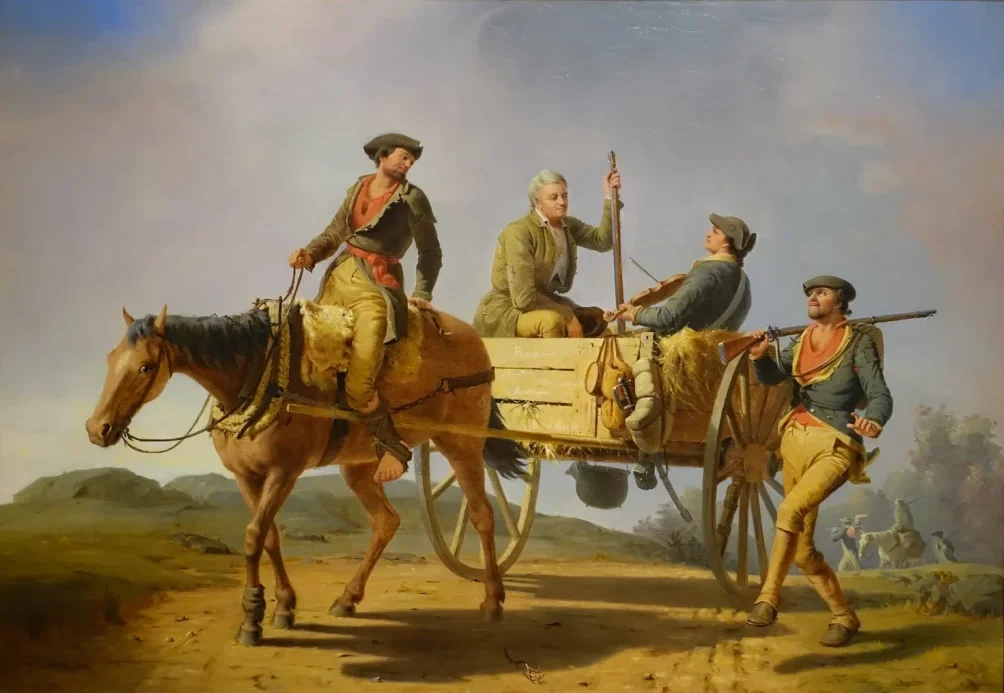
Illustrations, from above: Carl Rakeman recreates a scene of Deputy Post Master and later President Benjamin Franklin on the Boston Road in 1763, created for post riders to deliver mail from New York to Boston in 1673 (Federal Highway Administration); “Veterans of 1776 Returning from the War,” by William Tylee Ranney, 1848 (Dallas Museum of Art), depicts the common use of horse and wagon; Concord Coach, 1866, made by the Abbot-Downing Company, of Concord, New Hampshire (Long Island Museum); Grace Darling omnibus, early 1860s, built by Concord Carriage Builders, Concord, NH (Long Island Museum); US Carriage Factory Statistics, 1840-1873; and the James Cunningham and Sons carriage factory in Rochester, NY, ca. 1884.
Recent Comments