
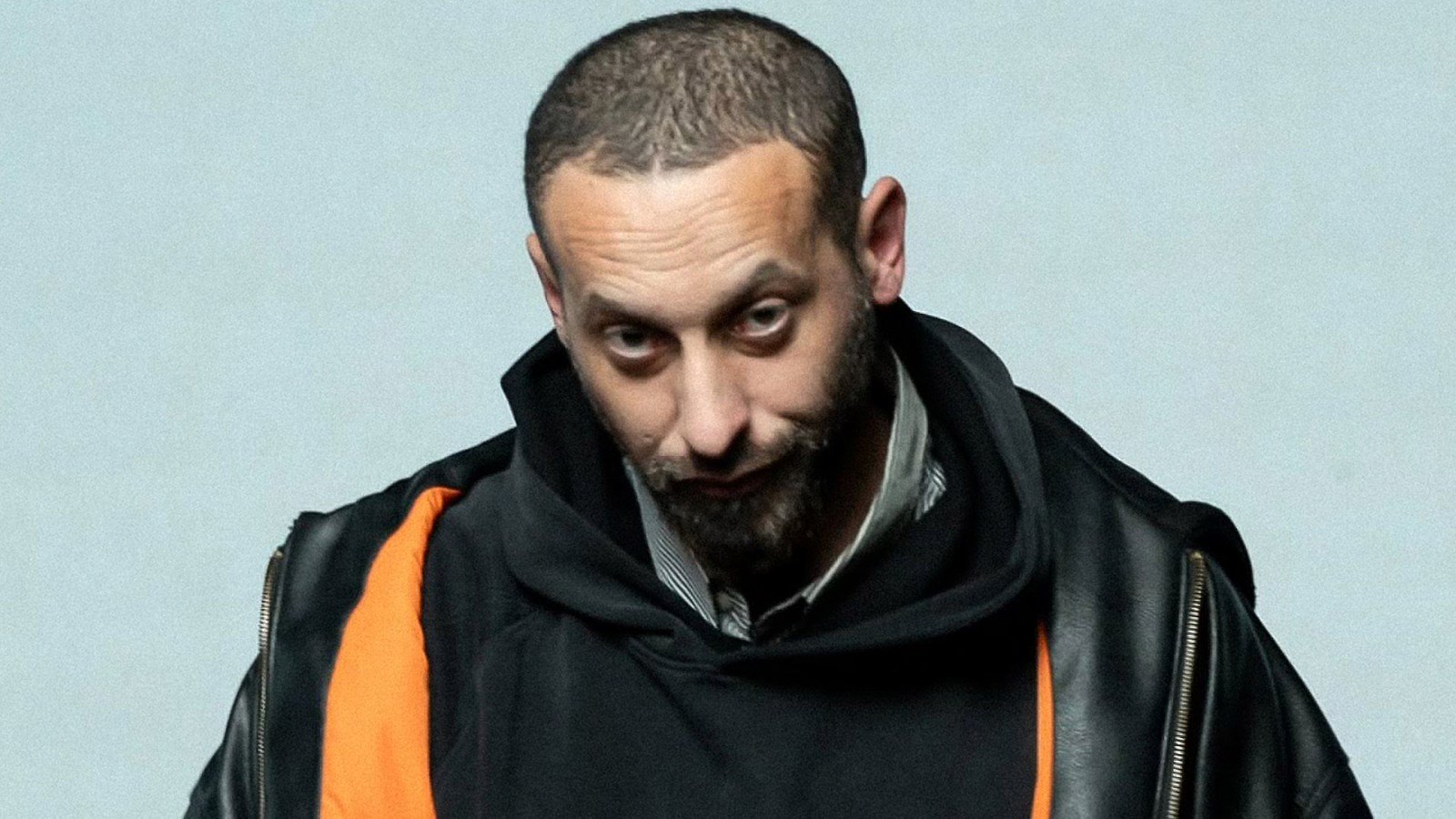
Tamer Nafar is in Amsterdam, having already performed in seven European cities — Birkenhead, London, Berlin, Hamburg, Paris, Brussels — by the time we speak. Touring his first solo album, In the Name of the Father, the Imam and John Lennon, the rapper and founding member of influential Palestinian collective DAM is adamant on discovering, or rather, refining his set-list to find the best sequence to convey his message.
Language and the arts that engage it are a dominant and recurring theme in Nafar’s life. Across music, acting, screenwriting, and activism, and being fluent in Arabic, Hebrew, and English, it’s the positioning of the words and the sequence of narrative that he instead focuses on as we dive headfirst into our conversation.
“Last night, I think we got it right. I think we got it good, like I think we nailed it,” he says, looking at his touring bandmates in the room. “That sequencing of the story, which song to go after which, it’s so important. We like to get it right, to experiment, to tell that story.”
Through this album, Nafar’s decades-long journey through hip-hop, identity, and activism converges. In the Name of the Father, the Imam & John Lennon is a record that’s been years in the making and born out of urgency both personal and political.
Nafar grew up in Lydda, a mixed Palestinian-Jewish city near Tel Aviv. Rife with neglect, poverty, and violence, he was attuned to observation as much as he was to writing. Teenagers in his neighborhood navigated one of the largest drug markets in the country, where police presence was often as threatening as it was absent. Amidst the chaos, he discovered an outlet in hip-hop. Tupac’s handcuffed youth and anti-authority ideas felt strangely familiar, and Nafar, armed with a dictionary and determination to dream beyond the misery in front of him, began translating lyrics, eventually finding words that would best convey his own story.
“This was in ‘98. I tried to find producers, but it was all wedding producers. Beats weren’t easily accessible like they are today. There just wasn’t the foundation to make hip-hop music, so it was very, very, very hard” Nafar shared in a previous interview.
By the late 1990s, Nafar had become a pioneering Palestinian rapper designing a sound that was still relatively non-happening in the Middle East. Together with his brother, Suhel Nafar, and friend, Mahmood Jreri, he formed DAM — a crew that would go on to become synonymous with Arabic hip-hop.
Their breakout single, “Min Irhabi” — ‘Who’s the Terrorist?’ — after a mention in Rolling Stone France, went viral with over a million downloads. It was hailed by Le Monde as the sound of a generation. Five years of trial, error, and invention culminated in Ihda (Dedication), an album that fused these stories — daily epics which Palestinians living inside the 48 territories could relate to instantly. Inspirations came through the news, the poetry of Palestinian children, through speeches by Gamal Abdel Nasser, even through dialogue from Egyptian comedy classics — all of which were sampled on the album.
Now, decades later, Nafar’s vision has expanded; crossing linguistic and geographic boundaries. In “The Beat Never Goes Off,” the album’s opener, Nafar brings into focus what the impenetrable border wall is designed to hide. Turning the wall’s starkness into revelation, the face of twelve-year-old MC Abdul, a rising rapper from Gaza, now 17-years-old, appears behind him.
Projected across the wall’s grey surface, it’s his voice that we hear in defiance despite the borders and bureaucracy that keep them apart. The visual briefly closes the distance between them, one that was never about kilometres to start with, but enforced by systems designed to turn neighbors into strangers. But for Nafar of Lydda, Abdul of Gaza, and Noel Kharman of Haifa — whose powerful vocals also deepen the poignancy of the track — they are standing clear in the message: we are anything but strangers.
“I did a song with Sammy Shiblaq who is so far from Palestine, he’s in the U.S. I’ve met all of these people, people who are so far. MC Abdul, he is right there, and I’ve never met him. Can you believe that? There’s a wall between me and MC Abdul.”
As Nafar launches his first European tour (he heads back to the U.K. in July), he insists on visibility: if the world is to enjoy and consume his art, it must also reckon with the realities that produced it. The album showcases an artist’s ability to blend personal reflection with sociopolitical critique, a skill honed over years of navigating censorship, targeted cancellations, and the pressures of life as a Palestinian citizen of Israel, where Arab residents — in the land of their indigeneity — contend with second-class status despite their citizenship.
In tracks like “Go There,” he confronts rising Arab crime and structural neglect, while “NaNa” flexes lyrical dexterity across Arabic and English, sampling the traditional Palestinian song “nana ya nana,” and featuring Palestinian-American rapper Sammy Shiblaq. There’s a lot of talk of melanging the global with the local, but Nafar’s success comes more from not caring, reacting only to the irrepressible urge to publish his truth.
I wanted to know how this process compared to his other musical projects. “It’s my first solo album. The process is entirely different because it’s so scattered. With DAM, we set a time frame. There’s a regimen and a schedule. There’s this structure we follow, we’re already thinking about each song and its stem structure. But this album was between projects, between COVID, between genocide” he says. (Editor’s note: The characterization of Gaza as a genocide remains legally contested.)
In the Name of the Father, the Imam and John Lennon is a solo record built from interruptions, pieces gathered and re-gathered — a far cry from the tight, collective rhythm that propelled DAM’s rise. “I was missing songs, I was recreating songs,” says Nafar. “At points I didn’t have clearances of the sample. I was taking pieces, I was trying to bring them together.”
Lines, Surveillance, and Poetry
“Write My Life With a Pencil” reads like a verbal insurgency which fights back against the lines imposed on him by racism, surveillance, classism and cultural caricature. Throughout the track, he weaponizes “lines” in every register: the throwaway pop-culture bar (“keep it hotline bling like Drake’s line”), the aesthetic lines he writes and rewrites into existence, and the bureaucratic lines that police his movement and identity.
He writes from experience, having had his fair share of the humiliating, racialized scrutiny that comes with international travel. In deconstructing these experiences into lines — comic, poetic, and serious — he exposes how they accumulate into a system designed to contain him, and then redraws them on his own terms: “Erase the airlines, bunch of fucking racist…all I have is rhymes up in my bag, you looking for bombs you better check your planes before they fly to Syria or Iraq.”
“I wrote this song seven years ago,” he tells me, a reminder of how enduring the cycles of violence have been under Israel. The tragic reality is that many of the headlines we read today could have been lifted directly from the moment this track was first written; so little has changed between its creation and its release.
One thing that stayed with me after our conversation is how Nafar refuses to linger in abstract critique. In life, as in music, he cuts cleanly through the tepid reverence for the West’s movies, culture — hollow iconography, in his view. Even as his work engages decolonial politics, his impulse is toward celebrating and amplifying the talents and wisdoms of his people. When I ask him about “The Way I Love Me,” his collaboration with San Francisco rapper and entrepreneur Stunnaman02 — a defiant self-love anthem that challenges judgement, betrayal and Hollywood stereotypes under oppression — he redirects the conversation to fullness rather than reaction.
“I stopped paying attention to that. So I was born in a society that was obsessed with showing us as terrorists. And they dehumanise us and all that. But so what? We do our music to humanise the Palestinians. I don’t give a fuck what they show in movies. Why should I give a fuck? How they present me is not my business. They should make art to humanise themselves.” Adding: “I’m a human being and my people have been massacred. I show love and care to everyone. I know my humanity. I know my standards. I am a human. My people are human.”
He has more urgent priorities. When I ask whether it frustrates him that so many people speak as if the crisis began on 7 October, he doesn’t dwell on the politics of late awakenings. For him, fragmentation within the struggle feels irrelevant when the scale of loss is so vast. What he sees, above all, is crisis. His first solo project moves like a single body navigating storms, piecing itself together every time the world, his own and the one outside, fell apart.
“I just wanna hug my people. I wanna give them warmth. I am mourning. I have more than 70,000 people that I love dead. People that I love. Dead.”
Innumerable ceasefire violations later, we are not used to the scene. The violence mutates into obscured, often worse forms that extend the nightmare that began two years ago in Gaza. Now with homes reduced to ruin and a decimated medical infrastructure, it’s an enduring crisis that sees displaced families surviving in tents through the unbearable, long winter months.
Fathers, Faith, and the Conversations Left Unsaid
The album’s title nods to personal history. His car rides through Palestine with his late father were accompanied by both Qur’an recitations and Beatles records. Those car rides embellished Nafar’s worldview and led to a pen game that harvested ideas and inspiration from all corners of life. Yet the record is not merely an homage; it is Nafar’s declaration of presence, survival, and artistic freedom in the face of systemic oppression and international indifference.
“[In this track] I’m talking about my dad, a very conservative person. He went to Mecca. He would pray on Fridays then take us to a hip-hop club to perform right after. What used to bother me is us driving to the show. We had a communication gap. So with this album, I had an amazing opportunity to talk to him. All he had was two CDs, the Quran and the Beatles. I used this as an outlet to invent the conversation.” He says, describing that he’d have a friendly debate with his father about which artists are better than the Beatles, whose lyrics are better crafted — Lennon’s, or McCartney’s — introducing his dad to the hip-hop artists that were dominating his headphones.
He starts to list the possible array of artists he’d select over his late fathers hypothetical choices, “Wait, I can’t say them, right? They’re in the Epstein files.”
“Everybody is,” I say, half joking, half serious.
“This song is not about the Beatles. I don’t have to imagine. I don’t need John Lennon telling me to imagine ‘there’s no country.’ The British gave away the country! I just wanna have a five-minute conversation with my dad.” Nafar’s wit darts in and out of contemplative talk so smoothly, I find myself laughing at the Beatles joke overlapped with sorrow — the grief of a son still aching to talk to his father, no matter how much time has elapsed since their final goodbye.
“I just wanna have a five-minute conversation with my dad.” he repeats, “I need that conversation.”
A Performing Body
When it comes to his own aspirations, it’s love songs that Nafar sees to be his true calling. For all the lyrical stamina and defiant hip-hop sensibilities that anchors his presence, there is a vulnerability underneath waiting to surface. Ask Nafar what he truly wants to create once the dust of politics and survival settles, and he talks about music that confronts our relationships — the romantic, those between parent and child, those between friends. Not the glossy, saccharine love songs for commercial radioplay, but an accurate portrayal of love that exposes who we are when no one is performing, of love’s cracks and fissures and eventually, repair.
“My main idea, my main passion is to do love songs. Not those crappy songs talking about ya omri ya ruhi bhbek (Oh, my life, my soul, I love you) and all that. Relationships to me are about the demons that each individual brings to the dynamic. A successful relationship involves discovering where it triggers you, why it triggers you, navigating it, motivating from certain traumas and the complicity. And it’s about facing those demons. I really would love to do an album about that.” He pauses, trying to pin down why this project keeps eluding him, then continues: “Everytime I write it, or go in that direction, something happens. Israel start genociding Gaza again, or causing trouble. So I just put it aside. It’s not the right time. But yes, this is really what I want to do.”
Theater gave him a new body to perform with. He started composing performances the way others write scenes: mood first, presence first. Theatre, with its emphasis on body, voice, movement, staging, crowd work, and light, allowed Nafar to see his shows as a paradigm of symbiotic forces and pressures where gesture, breath, spatial rhythm and audience feedback operate as an integrated system rather than discrete performance components.
“The director would stop me at every line, they were like: ‘go up go down go left go right, know where the lights are going, know about motion, know about the character, know about the build up.’ That kind of thing helps you build a setlist. So you sequence the songs in this way, and find out what works. Theatre helped me with this.”
His performance-aware mindset extends to his music in more ways than one. “I’m a big fan of rappers and rap music but I watch the shows and I fucking hate it” he laughs, “I hate the DJ and the posturing speeches. I’m not here for a podcast. I believe that for me, for myself, I’m not necessarily built to listen to 16 bars of rap. That’s too intense, for me, one great line can get me stuck on it, something really good. And then I’d just miss everything else.”
He continues, describing how this approach shaped his new album “That’s why I wanted to do it differently with instruments, every city has a different instrumentalist. I had Bassel Hariri who played the electronic violin with us. In Berlin, I had Milad [Khawam] playing trumpet. In every city, we have something different.”
In a time of mass silencing of Palestinians in Occupied and Historic Palestine, as well as allies abroad experiencing suppression through networked media, what might it mean to share a microphone?
Recalling a recent Haifa show, Nafar accounts the beautiful contact that emerged when he descended the stage and brought himself into unfettered connection with the crowd. “These Palestinians living in Haifa, they have been silenced for two years, so I gave them the mic.”
“Some told me about their dreams. Some spoke about wanting to travel. Some of them cried. They spoke about their realities and what they face day to day. I just wanted to hear my people speak. I did that show with 600 people, I felt honored to be able to say what I really feel. I felt that privilege to have my say, and the people need that too.”
This article first appeared on Rolling Stone MENA.
Recent Comments