
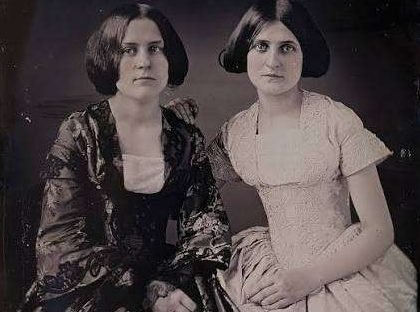
 The first indication that the Fox Sisters had spiritualist talents occurred on the evening of March 31, 1848 when 11-year-old Kate and 14-year-old Maggie Fox claimed they heard knocking sounds coming from the east bedroom of their parents’ rented farmhouse in Hydesville, Wayne County, NY, about 30 miles east of Rochester.
The next night, the young ladies revealed this strange knocking spirit to their mother and older sister, Leah. The family’s excitement about communicating beyond the grave took no note that the inaugural demonstration had been staged on April first.
A few days later several neighbors were invited to hear the strange knockings. The neighborhood assemblage asked the source to guess the age of a close family friend and received the correct number of raps in return.
Mrs. Fox then asked, “If you are an injured spirit manifest it by three raps.” The knocking’s reply convinced everyone assembled that Maggie and Kate were communicating beyond earth’s mortal bonds.
Neighbors then searched the house and found strands of hair and fragments of bone in the cellar. The find prompted someone to remind the group that a peddler had disappeared, and was probably murdered in the Hydesville farmhouse.
Older sister Leah wrote a letter to Isaac and Amy Post, who were prominent members of Rochester’s spiritualist movement. The Posts invited Maggie and Kate to their home to demonstrate their talents before a group of spiritualist activists. There the knocking thumps produced an emotional reunion with the Post’s recently deceased daughter.
The Posts then rented a hall for a public demonstration that attracted four hundred spirit believers. After an arousing performance, the constable’s wife took the two girls off stage where they disrobed for examination. Finding no evidence of trickery, the constable and most of the evening’s attendees departed, convinced the sisters had been gifted a special talent.
At the time, Horace Greeley, editor of the New York Weekly Tribune, was backing a tour of Dr. Franz Mesmer’s disciples promoting Mesmer’s theory of universal magnetic fluid. Evening after evening, the touring disciples waved their hands over volunteers to induce a relaxed hypnotic state they called being “mesmerized,” many of whom reported visions of a departed loved one.
Greeley recognized a good story, and his newspaper quickly followed the Fox sisters’ Rochester demonstration with an enthusiastic article about their unique talents. He then invited the sisters to the city of New York, where they met another aspiring spiritualist, Andrew Jackson Davis (1826-1910).
Davis called himself the Poughkeepsie Seer, but his real expertise lay in marketing, and he knew just how to promote the cute young prodigies. The sales pitch: “Communicating with the dead teaches the living about heaven and hell, assuring salvation.”
After their successful New York debut, Davis managed Fox sister tours from New York to Cincinnati. Seance attendees paid one dollar each, but private sessions were available for a considerably larger fee. In advance of their arrival, Davis paid local newspapers to carry updated stories about the sisters’ special skills. His favorite story was one about the Fox Sisters conjuring Benjamin Franklin’s spirit.
Fox seances were limited to 21 attendees and followed a format standard to the spiritualist movement. The rooms were bathed in blue-shaded gaslight, and a table of food was set out with a little sign that read, “Please partake of this fare. The spirit you seek is drawn to nourishment and encouraged by your contentment. Like us, the spirits seek sustenance.”
As customers gathered, Maggie and Kate mingled, speaking in voices so soft they were difficult to hear. With each approach, they hugged their guests, held hands, and gave the impression of a very private conversation. They asked the reason for attending and what message the departed would like to hear. Maggie did most of the talking, but neither girl took notes.
Maggie and Kate asked about the individual’s death, then asked for one pleasant memory and one memory that only the spirit would know. These pre-interviews established an intimacy that even made skeptics long for friends and relatives who had passed on.
Once they had circulated, a chime sounded, directing attendees to their seats. The sisters retreated behind a curtain while Mr. Davis (or their older sister Leah) explained that it was critical to maintain a total number of occupants evenly divisible by three. Therefore, no one could leave the room until the seance was completed.
There was to be no talking unless specifically addressed by one of the sisters. The final instruction warned everyone that alcohol must not be consumed until the cock crowed at dawn on the next day.
At this point, another chime rang out, and the sisters emerged from behind the curtain to take their places sitting in straight-back chairs in front of a small oval table covered with a long black cloth on which sat a loaf of freshly baked bread and three candles. As they lit the candles, the lamps in the room dimmed.
Maggie began, “We are deeply saddened by the loss each of you have experienced and are privileged to share with you God’s unique gift so generously bestowed on us. Communicating with the dead is serious and frightening business for both the living and the dead. By our silence we show our respect for those spirits with courage to speak. So too, it is essential that everyone hold hands no matter what transgresses. Tears can be wiped away later. Breaking the circle frightens the spirit and extinguishes the communication.”
The sisters then broke the loaf of bread into thirds. Steam rose from the broken loaf, and its freshness filled the room. Each sister tore a bite from the center of the bread; they then closed their eyes and remained silent for several moments. Soon, they began a chant of unintelligible words.
Suddenly, Maggie unleashed a forceful voice, “Our beloved Silas Abrams (or the name of another attendee’s departed loved one), we bring you gifts for life unto death. Commune with us Silas Abrams, and move among us. Join our bond of good will. Fear not our intentions.”
In response, a loud rap seemed to arise from the floor. Maggie said, “You are welcomed among these assembled souls as a friend and messenger. We are all pleased by your presence and respectful of your great exertions. One rap confirms and two raps deny. Please be open to the limitations of the living and accept our attentions.”
Over the ensuing hour, several, but not all, attendees were provided the opportunity to speak with dead relatives or friends through the code of knocking sounds. With some embellishment, Maggie and Kate recited stories shared during the earlier conversations.
As the hour closed, Maggie thanked the spirits who chose to attend and suggested that those spirits not revealing themselves might be welcomed at another time. They then closed with a few more unintelligible chants.
Audiences included farmers, businessmen, and laborers. The sisters did two shows an evening, taking in $42 a night (worth about $1,000 in 2027 dollars). It was more than common laborers made in two months and eclipsed the five-cent admission charged by most traveling lecturers.
To non-believers, the Fox sisters were dismissed as the “Rochester Knockers and Rappers.” But local newspapers, including Buffalo’s Commercial Advertizer, covered the Fox sisters’ spiritualism as a serious religious marvel, reprinting the press releases written by Mr. Davis.
Physicians, at least those making strides to embrace the principles of science, were infuriated. They dismissed the magical thinking encouraged by the Fox sisters much as they did the medical quacks peddling false hope.
In 1851, the Fox sisters booked a meeting room in Buffalo’s Phelps House Hotel. It happened to be the residence of Dr. Charles Coventry, professor of physiology and medical jurisprudence at Buffalo Medical College.
The curious Dr. Coventry attended a performance and afterwards he wrote a letter to the Commercial Advertizer that concluded, “such spectacles must propel all men of science to discourage all further waste of time, money, and credulity on the folly perpetrated by the Fox sisters.”
 At Dr. Coventry’s urging, the Erie County Medical Society appointed a committee of investigation comprising Dr. Coventry, Dr. Charles Lee, two community leaders with credentials in science, and Dr. Austin Flint as chairman. Flint published a letter in the Commercial Advertizer challenging the sisters to an inspection.
The Fox sisters responded by publishing their own letter, welcoming the medical society’s inquiry. In part, their letter claimed that, “the investigation will contribute to an understanding of the important and mysterious manifestations for which we are honored to serve as an exceptional and uncommon agent.” Both letters were reprinted in several newspapers across New York State.
Within the week, the inspection was scheduled at the same Phelps Hotel where the sisters had performed. Dr. Flint began by suggesting that the sisters assume positions that would best demonstrate their abilities.
The sisters chose to sit side by side on firm, upright chairs, but asked if another attendee might be invited to bring the total present to a number divisible by three. Coventry invited a “proper” lady known to reside at the Phelps.
Maggie and Kate lit three candles on a short table before them and began their incantations according to habit. They soon confirmed the presence of a chatty, rapping spirit. At the close of their initial demonstration, the sisters expressed their delight with how accommodating the Phelps was to spirits.
At this point, Dr. Flint placed the feet of both sisters on cushions that prevented solid contact with the floor. The table with the three candles was carefully rearranged, but the spirits proved unarousable. Maggie explained that the spirits likely found the presence of so many skeptics fatiguing.
Flint apologized and removed the cushion under Kate’s feet, still no spirits could be awakened. Now Flint removed Maggie’s cushions, and in very little time the spirits were revived and the knocking recurred.
In the last phase of the inquiry, the “proper” lady Dr. Coventry recruited was instructed to hold the younger Kate’s knees. After introductory incantations, the spirits returned. Flint then instructed the woman to firmly hold Maggie’s knees, at which time spirit communications could not be produced.
Clearly, the older sister, Margaret, was the source of the rapping. Kate’s role was to reinforce Margaret’s memory and add to the sing-song nature of their incantations, but otherwise she was entirely passive. With the source of the rapping revealed, Dr. Flint ushered in two women he knew to be capable of producing similar rapping sounds by flexing their knees and ankles.
The wooden Phelps Hotel floor produced results nearly as sonorous as Maggie’s well-practiced knocks. To Flint, the explanation was now obvious. In women with supple ligaments, the broad articular surfaces of the knee joint allow considerable lateral motion. When the foot was firmly planted, a sudden lateral force can generate a rather loud noise similar to cracking the knuckles of one’s hands.
Flint rushed the publication of the committee’s findings into the March 1851 issue of the Buffalo Medical Journal. In the article, Flint expressed sympathy for people who seek remedy from grief through spiritualist communications. He admitted that even men of science have fallen victim to deceptive reasoning and at least temporarily believe things that are later proven false.
Flint hoped that similar investigations would be conducted on the mechanisms used by the many other showmen then touring the United States. The article was signed by Austin Flint, MD, Charles A. Lee, MD, and C. B. Coventry, MD.
The sisters feigned protest. They claimed the committee was typical of non-believers, like those who once denounced Galileo’s planetary theories. The official statement from the Fox Sisters was:
“It is true that when our feet were placed on cushions stuffed with shavings, and resting on our heels, there were no sounds heard, and that sounds were heard when our feet were resting on the floor; and it is just as true that if our friendly spirits retired when they witnessed such harsh proceedings on the part of our persecutors, it was not in our power to detain them.”
The Fox Sisters relished the publicity. As one might expect, believers dismissed Flint’s paper as an attack rather than an enlightenment, emphasizing that doctors are not priests. Flint countered, “we have satisfactorily demonstrated the principal phenomenon [is] an imposition and fraud, I think it as well to leave such persons in their simplicity; for, in their anxious search after the marvelous and wonderful, I fear they would grasp at something still more absurd and ridiculous.”
Flint and his committee proved to be no match for the marketing skills of Andrew Davis. Now adding an unfair persecution bias to his promotional activity, Davis continued to promote the Fox Sisters for another twenty years. Eventually Maggie, Kate, and their older sister Leah went their separate ways, maintaining their lifestyles by holding private seances for wealthy patrons.
A Philadelphia philanthropist funded the Sybert Commission to investigate spiritualism in 1884-1887. When interviewing Maggie Fox, then a tottering alcoholic, the commission repeated Flint’s investigative method and again found the rappings failed to occur if Maggie’s feet were placed on pillows.
Finally, at the Academy of Music, on October 21, 1888, Maggie, with Kate sitting nearby, took the stage before a packed house and confessed forty years of deception. She then showed how she made the rapping sounds for the assembled audience. The story was reported in the New York Herald on October 24, 1888.
While in Paris in 1854, Flint was asked about the Rochester knockings. In his response he told of an examination he had conducted on the wife of a Buffalo physician who could produce the same intense sounds produced by Margaret Fox. This woman produced double clicks or single clicks and could adjust click volume by altering the speed with which she moved her knee.
The clicks could be heard for a distance of 100 feet and in the floor below, but required her feet to be firmly planted on a hardwood floor. Since the Fox Sister inquiry, Flint had encountered a number of women who could generate rapping sounds, though none claimed communication with the dead.
Flint concluded, “The extent with which spiritual rapping belief has prevailed in the United States offers a sad illustration of the credulity of mankind.”
Read more about Spiritualism in New York State
Illustration: Kate and Maggie Fox; and a detail from a lithograph of the Fox Sisters with the Buffalo doctors in 1851. Dr. Austin Flint (kneeling), and Drs. Charles Coventry and Charles Lee in background (courtesy of the Robert L. Brown History of Medicine Collection, University at Buffalo Libraries).
Recent Comments