
 Privatization is not a new concept; indeed, it was actively promoted by the United Provinces of the Netherlands to supplement its foreign policy by delegating certain responsibilities to the East and West India Companies. Formed as a joint-stock trading venture, the West India Company (WIC) was given a charter to monopolize trade from the Cape of Good Hope west to the outer reaches of New Guinea.
It had the power to raise its own armies and navies, make alliances with local sovereigns within its sphere of operations, and, if necessary, had the power to make war and peace in defense of its interests — essentially a privatization of foreign policy.
However, the Dutch Republic was at war with the Hapsburg Empire and engaged in fierce competition with England for control of global trade routes.
To secure overseas possessions against aggressive competitors and enemies — and to better supply those outposts with vital necessities — several directors proposed that the company encourage colonization.
The debate among the members of the board divided along two well-defined lines. One faction wished to discourage colonization because the expense would eat into profits and the colonists would soon compete with the company in the exploitation of the natural resources; again reducing income.
Isolated trading posts, they argued, were also vulnerable to heavily armed raiders and to native forces that might reconsider their willingness to accommodate foreign settlers. Disruptions in the arrival of supply ships could also jeopardize the company’s ability to maintain such distant and exposed locations.
They argued that a force of professional soldiers and well-formed alliances with the natives should be enough to maintain the security of the region, and that the expense in resupplying the post would be offset by the increased cash flow. These directors were embracing a short-term strategy: take the money and run.
A significant group among the directors, however, promoted the position that by encouraging colonization and by establishing support farms in the proximity of the trading posts the region would soon become self sufficient and immune to any disruption in the shipping.
This was the long-term strategy: invest in the future. Self-sufficiency would eventually increase profits because it would no longer be necessary to send over so many supply ships; or, take up valuable cargo space better used to ship trade goods.
The region also would flourish by natural increase, creating a population from which troops could be raised in emergencies. Best of all, a militia formed from the settlers would save the company the expense of recruiting and maintaining a large force of professional European soldiers.
This argument sounded logical. However, it would cost large sums of money to ship over significant numbers of colonists; set them up on farms; and maintain them until they could become productive. The opposing directors argued that the expense would be prohibitive.
What was the solution? PRIVATIZE! Why pour the company’s money into a colonizing venture, in which massive amounts of money would be required to attract healthy and skillful settlers; transport them to the New World; provide them with equipment, livestock, and dwellings; and supply them until they could sustain themselves; when private investors could assume the expense and risk.
This was the debate carried out by factions sitting on the board of directors of the Dutch West India Company. Although the proposal to privatize colonization appeared to be sound, there were powerful forces working against it.
New Netherland’s early years would be affected by the struggle between these two factions. The growth and development of the Dutch colony depended on an ability to attract colonists.
The resulting patroonship plan of colonization held promise and was ultimately attempted in various regions; however, only Rensselaerswijck on the Upper Hudson River proved to be a success.
The Dutch in North America
1609 was a banner year for the United Provinces of the Netherlands: the Bank of Amsterdam was established – the financial institution which enabled the Netherlands to become a commercial force around the globe; a twelve years’ truce with Spain was concluded which allowed the Dutch to focus on expansion of their commercial interests; and it was the year Henry Hudson entered the river which stills carries his name.
Hudson was hired by the Dutch East India Company (VOC) to find a northeast passage to the Far East. When his ship De Halve Maen (The Half Moon) encountered adverse weather conditions in the Barents Sea, Hudson decided to turn west and investigate possible western passages suggested by John Smith.
After being blown south to Chesapeake Bay, he sailed northward along the coast; entering Delaware Bay, only to decide that it was the outlet of a drainage system. He then continued on to the Manhattan area where he found the entrance to a magnificent waterway leading directly to the north.
Hudson followed its course for 150 miles until he was able to decide that he was in just another drainage system. He returned to Europe unaware that his failure to find a passage to Cathay, either to the west or east, would lay the basis for the Dutch claim to a large tract of territory in the New World.
Shortly after Hudson defined the limits of what was to become New Netherland, Dutch traders began to trade with the natives from Long Island Sound to Delaware Bay. Adriaen Block plied the trade along the coast of Connecticut with such success that his base of operations on an island between Long Island and Rhode Island still carries his name today.
Trading rivalries became so fierce that the New Netherland Company was formed as a monopoly in 1614 to deter the excesses of competition.
The aim of 17th-century commerce was to monopolize; crush competition; maximize profit, minimize loss. Modern business practices, of course, still adhere to these principles, though in more subtle ways, such as price-fixing.
Cartels of Dutch merchants – licensed by the States General – continued to send out ships to trade with the natives in New Netherland until the formation of the West India Company in 1621.
It was no coincidence that it coincided with the end of the Twelve Years’ Truce (1609-1621) with Spain, for the WIC was founded as a war company; its primary objective was to carry on the struggle for independence, which had begun in 1568.
The Netherlands had been a corner of the Hapsburg Empire for a century. In 1568 an outburst of anti-papal fervor coupled with a Hapsburg attempt to centralize authority at the expense of local rights and privileges, led to open revolt against the mercenary armies of the empire.
After forty years of stalemate on the ground and Dutch success at sea, an exhausted Hapsburg Empire, centered in Spain, agreed to a truce.
During this Twelve Years’ Truce a violent dispute came to a head between two political factions represented by opposing views of Calvinist doctrine. The followers of the theologian Arminius, who professed the view that salvation could be attained through free will; expounded a decentralized government; religious tolerance; and continuation of the truce with Spain.
On the other side, the followers of the theologian Gomarus professed predestination; advocated a centralized government under the house of Orange; advocated the Reformed Church as the national religion; and urged a continuation of war with Spain.
When the leading proponent of the Arminians, Oldenbarnevelt, was executed on trumped-up charges, the war party led by Maurits, prince of Orange, became the dominant force in the Netherlands. The WIC was formed in this context as an instrument to carry on the war with Spain in the Atlantic theater of operations.
The new company was modeled on the successful Dutch East India Company, which was seizing possessions from the Portuguese in the Far East and becoming a dominant force in the spice trade. The East India Company had been in operation as a joint-stock trading venture since 1602.
Chartered by the States General of the Netherlands, the East India Company had a trading monopoly from the Cape of Good Hope east to the Strait of Magellan. It had the power to raise its own armies and navies; make alliances with local sovereigns within its sphere of operations; and if necessary could make war and conclude peace in defense of its interests.
Company shares were traded on the Amsterdam stock exchange and investors represented a broad spectrum of society: from wealthy merchants to tavern keepers and barmaids.
At the conclusion of the Twelve Years’ Truce, the States General saw an opportunity to privatize the overseas war with Spain by chartering another joint-stock venture with a trading monopoly from the Cape of Good Hope westward, covering the New Worlds of North and South America, the to the eastern edges of New Guinea in the Pacific.
The WIC was divided into five chambers: at Amsterdam, Zeeland (Middelburgh), Maes (Rotterdam), Noorderquartier (Hoorn and Enkhuizen), and Groningen-Friesland. The number of directors on the governing board was determined by the chambers’ financial obligation.
As the largest investor, Amsterdam sent six, followed by Zeeland with four, and the other three chambers with two each; the States General sent one representative for a total of nineteen.
This powerful board was known as de heeren negentien (the lords nineteen), often represented in documents by the roman numerals XIX.
Nineteen years earlier the East India Company was able to raise six and a half million guilders in one month to capitalize its enterprise. However, in 1622, because investors’ enthusiasm was dampened by a successful Spanish ground offensive, it took the WIC two years to raise seven million guilders.
As soon as ships were outfitted and equipped, the WIC made its presence felt against enemy colonies and interests from Africa to Brazil. Especially vulnerable were the possessions of Portugal, which had been united under the Spanish crown since 1580.
WIC preoccupation with lucrative interests in Africa, Brazil, and the Caribbean, however, left few resources, either human or monetary, for its fur-trading outpost in North America. Africa promised gold and slaves; Brazil, sugar and dye wood; the Caribbean islands, salt.
After expending huge amounts of capital to exploit these resources, the WIC suffered disastrous reverses in these three regions in 1625. For example, in 1624, the WIC sent an expedition of twenty-six ships and 3,300 men for the conquest of Bahia in Brazil.
Initial gains in Bahia were soon reversed the following year by a Portuguese relief squadron; however, the market potential of Brazilian sugar was still the WIC’s main interest in the New World.
When Piet Heyn captured the Spanish silver fleet off Cuba in 1628, there was renewed interest in Brazil to the detriment of New Netherland. Most of the company’s financial and human resources soon began to go south, while the colony in North America was forced to turn to alternative means for development.
In 1629 the faction favoring colonization won a concession called the “Freedoms and Exemptions.” Rather than expend WIC capital the directors decided to privatize colonization.
Kiliaen van Rensselaer’s New World Venture
The patroonship plan of colonization allowed an investor, called a patroon, or a group of investors to negotiate with the natives (i.e. rightful owners) for a tract of land upon which he was obligated to settle 50 colonists within four years at his own expense.
The patroon was granted the rights of high, middle, and low jurisdictions and held the land as a perpetual fief of inheritance with the right to dispose of the colony by last will and testament. In effect the question of colonization was turned over to the private sector.
All the investors who filed for the right to become land barons in the New World were either directors of the West India Company or closely involved with its operations. Only one succeeded to the point of passing his domain on to his heirs, and its success could be attributed in part to “insider” information.
Kiliaen van Rensselaer (1586-1643) sat on the board of directors of the West India Company, was a diamond merchant by vocation and an agriculturist by avocation. Experience in clearing land for cultivation in his home province of Gelderland attracted him to the possibility of unrestricted land development in the New World.
He became a leader of the patroonship faction on the board of directors of the WIC and was one of the first to file an application for a patroonship. Fortunately he found an agent who would find him land in the Hudson Valley which would suit his experience and ambitions.
Bastiaen Jansz Krol (1595-1674) came to Kiliaen van Rensselaer with impressive credentials. Not only had he served the West India Company in New Netherland from its earliest attempts at settlement but he had been appointed commissary of Fort Orange several months after Daniel van Crieckenbeeck was killed by Mohawks in 1626.
When Krol returned to the Netherlands in 1629 he was able to advise Kiliaen van Rensselaer on potential locations for his patroonship from knowledge based on awareness of the political situation as well as agricultural suitability.
In the following year Krol returned to New Netherland with instructions from Van Rensselaer to purchase from the rightful native owners as much land above and below Fort Orange as the situation would allow. By May 1631 he had concluded negotiations with the Mahicans for a large tract of land north and south of the company’s fort on the upper Hudson.
Bastiaen Jansz Krol, in his capacity as commissary of Fort Orange, signed the purchase agreement on behalf of the patroon, Kiliaen van Rensselaer. Krol was the crucial “edge” every businessman dreams of.
Early enthusiasm for the patroonship plan of colonization found numerous investors willing to risk their capital on land from Delaware Bay to the Connecticut River. However, early enthusiasm soon turned to disappointment for most of the investors. Other patroonships either failed to gain the necessary capitalization or were repurchased by the Company after a few years.
One such patroonship, which had the financial backing and potential to succeed, was destroyed by its Indigenous neighbors. Called Swanendael, it was located on Delaware Bay near present-day Lewes, Delaware. The investors in this patroonship planned to profit from the whales that frequented the bay by establishing a whale oil works.
Unfortunately the 32 men who were set ashore in 1631 to construct the necessary structures for the operation were all killed the following year because of a misunderstanding with the local Indigenous people.
However, in the following century, the tragic settlement at Swanendael did prevent Maryland from gaining control of the Delaware region, and allowed the three lower counties to become the province of Delaware.
Less than ten years after privatization began only Kiliaen van Rensselaer’s patroonship located along the upper Hudson managed to survive.
The survival and success of Rensselaerswijck was as much a tribute to its founder and majority investor, Kiliaen van Rensselaer, as it was to its ideal location. Ever since Hudson visited the area in 1609, the plain on the west bank of the river (commanded by Fort Orange since 1624) was recognized as a critical location for the fur
trade.
The configuration of the Hudson and Mohawk rivers formed a natural conduit for moving furs from the west through the Mohawk Valley to a point approximately where Schenectady is now located.
From there trade followed an overland route to the southeast, avoiding the Cohoes Falls near the confluence of the Mohawk and Hudson rivers. From this point the furs were traded for merchandise stocked at the fort and warehoused until ships took them south to Manhattan for transshipment to Europe.
A patroonship located in this region would not only have the advantage of developing one of the most agriculturally productive regions in the Northeast but would also have a WIC fort in its geographical center for protection; the exchange of agricultural support for protection was the ideal situation envisioned by the pro-patroon faction among the WIC directors.
Next to Manhattan it soon became the most important population center in the colony.
The opposing faction, as well as some modern historians, suspected that Van Rensselaer was more interested in the fur trade than agriculture. However, there is no evidence to substantiate this; in fact, he made it very clear in his letters that the center of Rensselaerswijck should be developed on the east side of the river in order to reduce temptations from the fur trade at Fort Orange.
Rather, he intended to derive his profit from agriculture. He calculated that from the 2,500 cultivated acres within his patroonship he should be able to make at least ƒ100,000 per year; he estimated that he should be able to make even more money from the sale of cattle; much more profit than could be expected from the fur trade.
This was an optimistic projection never realized; however, it does indicate that he saw more long-term potential in agriculture than in the fur trade.
Kiliaen van Rensselaer’s determination and vision may have been enough to bring success to a plan that failed elsewhere; however, when he died in 1643 at the age of sixty-three, only ten years after the settlement of his colony, the fate of Rensselaerswijck fell into the hands of people unable to prevent friction with the West India Company at Fort Orange.
The premature death of such a dynamic leader probably would have signaled the end of any other comparable venture; however, Rensselaerswijck’s location near the confluence of the Hudson and Mohawk rivers, defended by a West India Company fort and trading post in its center, in addition to its fertile farmland and its abundant natural resources were assets that could overcome much adversity.
If it is true that location is everything in the world of real estate, then Kiliaen van Rensselaer was well served by his agent. Thus the origin of ownership to the vast tract of land approximating present-day Rensselaer and Albany counties (about one million acres) can be traced back to a business decision by a company seeking an expedient and controversial solution to a problem threatening profits.
If the first patroon of the massive tract of land surrounding Fort Orange had been anyone but Kiliaen van Rensselaer, it may be that it too would have reverted to the company, as had all the other patroonships, long before the English takeover of 1664.
However, Rensselaerswijck managed to survive by accommodating a succession of new masters and its effects reached well into the nineteenth century.
Read More About Rensselaerswijck
A version of this essay by Dr. Charles T. Gehring, then Director New Netherland Project, was first published by the New Netherland Institute in the series Annals of New Netherland, funded by the Consulate General of the Netherlands in New York. It is based on a talk Gehring delivered at a symposium presented by the Delaware County Historical Association at SUNY Delhi on September 24, 1994.
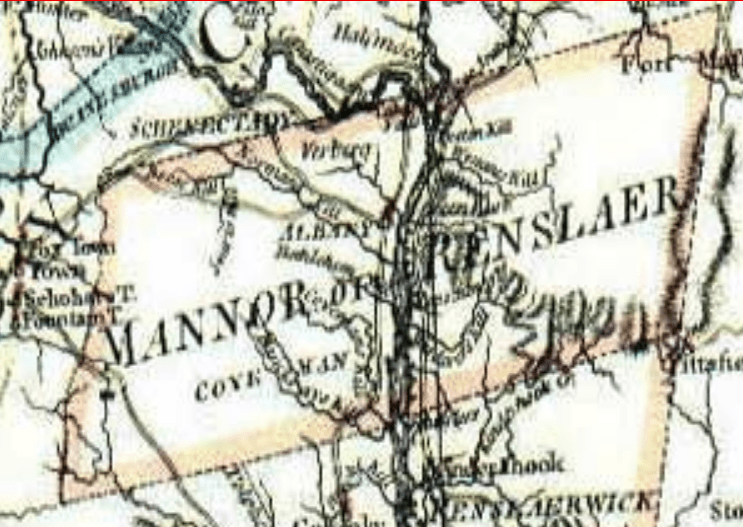
Illustration: Detail of map of the Manor of Rensselaer made by Claude Joseph Sauthier on order of NY Gov William Tryon, engraved and printed in London by William Faden, 1776.
Recent Comments