
 In summer thoughts turn to fun at the beach, pool and in parks. The vertical files of the New York City Municipal Library include a trove of publications describing City government’s role in providing recreational opportunities between 1919 and 1979.
A good portion of the contents are news clippings that track, decade by decade, City residents’ recreational choices. “Eel Season Ending For City Anglers” the New York Times reported in 1967; “People Pushing Horses Out Of Park” the Daily News decried as the Claremont Riding Academy was poised to close in 1970; and the perennial “New York on Next to Nothing” from the New York Post are just a few of the titles.
Other items include reports and communications from City offices which is the focus of this essay.
T he first item of note dates from the administration of Mayor John Purroy Mitchel (1914-1917) titled “the work of the Mitchel Administration for Recreation.”
Of the four “notable things in the field of recreation” touted, the most impactful was increasing the number of playgrounds. There were 283 playgrounds in 1913 “the best of any administration” until the 446 playgrounds opened under the Mitchel Administration.
The report also cites the increased proportion of funds for playgrounds and athletic fields. In closing, the report notes that the administration “laid the foundation for sound future development” as well as increasing the spaces for play.
The 1933 ‘Report on Play Streets’
Fast forward to 1933 and the “Report on Play Streets,” prepared by the Community Councils of the City of New York. With President Franklin D. Roosevelt listed as the “Honorary Chairman” of the Child Welfare Committee, the Councils consisted of private citizens organized in groups in the five boroughs, very similar to today’s Community Boards.
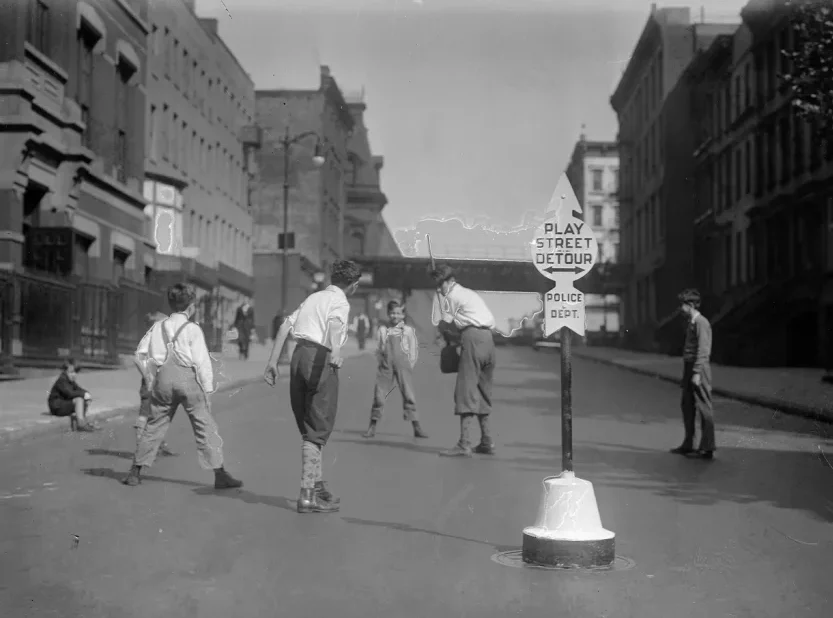
 The Council’s 1933 report described how they operated 40 “play streets” as part of a City-wide summer recreation program that temporarily suspended traffic on 483 streets on weekday afternoons during July and August.
The Council-sponsored streets were sited in Manhattan (28) The Bronx (5) and Queens (3) in neighborhoods with the greatest need for play space. Support for the program was largely provided through the Manhattan Borough President’s Office that supplied a crew to paint and prepare the streets.
Each street was painted, following a diagram that laid out shuffle board courts, paddle tennis courts and a circular area for free play. The crew repainted the lines every two weeks.
The Sanitation Department provided showers, placed in the middle of the streets which were a big draw, attracting “hundreds of children into the play block who may never have come for game purposes.”
Equipment was stored in church basements community centers and the local candy stores. “An appeal strictly from an increased business angle usually sold these merchants,” notes the report.
 Each play street was managed by a supervisor who then identified “block captains” from among the participants. And, the staff was supplemented by “emergency relief workers” from the Greenwich House, the New York University Community Center and the Henry Street Settlement.
According to the report the success of the play streets rose and fell on the type of the supervisor, who had to “first sell himself to the children in his particular block so as to receive their cooperation, making it possible to develop their interest and enthusiasm.”
This was, of course, in the midst of the Great Depression and the play street program provided both recreation to young New Yorkers as well as jobs for the unemployed.
Most of the activities and games are still played, but some have not stood the test of time. “Puss in the Corner,” “Off the Spot,” and “Kaiser Ball,” for example, are three games which have faded into obscurity whereas “Tag” and “Tug of War” still are enjoyed today. Stickball tournaments at Spring and Sixth Avenues were special features that attracted between 500 and 800 spectators!
 Somethings never change: street safety. “Play Street Detour signs mean little or nothing to the average New York City driver” laments the report. Equipment was destroyed by careless drivers and games were disrupted by cars driving through.
There is no mention of any injuries or accidents which must have been just a stroke of fortune. After two weeks of this mayhem, the supervisors were authorized to report license numbers of cars driving onto the play streets and the drivers were sent warnings and summonses.
That still had little effect so the organizers turned to better signage, which had an impact. In future years, the report urged a police officer should be available on the street for the day.
Revenue Producing Facilities
From the same period we have a report from the NYC Parks Department on “Revenue Producing Facilities” between 1934 and 1937, the heyday of Robert Moses.
Although parks, beaches, golf courses, and facilities within the parks such as swimming pools and tennis courts are generally thought of in terms of their value as venues for healthful recreation, this very detailed report shows they also produce revenue that helps defray operational expenses.
Soon after his appointment in 1934, Moses leveraged federal Works Progress Administration (WPA) dollars to fund dozens of park improvement projects — and the success of his program is evident in the numbers.
 Swimming pools, his signature achievement (he famously opened 11 municipal pools in 1936), get top billing in the report and the numbers are impressive: revenue increased from $9,248.78 in 1934 to $255,000 in 1937, and attendance grew from 128,765 in 1934 to more than 2.3 million in 1937.
Another of Moses’ noted accomplishments were the beaches. “On July 25, 1936, Orchard Beach was opened with a bathhouse accommodating 6,800 people, a parking space for 4,000 cars and a newly made white sand beach.”
Adding the numbers of Orchard Beach visitors with beachgoers at with the reconstructed Jacob Riis Park Moses reported attendance ballooning from 500,000 during the summer of 1934 to more than 4.2 million in 1937.
The report carefully notes that revenue from the beaches, “show a profit of $61,900 over operating and maintenance costs notwithstanding the fact that they were not opened until June 25th of this [1937] year, a loss of four weeks operation.”
The report also includes similarly precise figures for increased revenue accruing from the improvements at the tennis courts, Randall’s Island Stadium, and golf courses — he built three and renovated seven more between 1934 and 1937.
Flushing Meadows Park & Commodore Barry Parks
In 1942, the files hold a lovely brochure for the New York City Building in Flushing Meadows Park in Queens which opened to the public in the preceding year.
Built for the 1939 World’s Fair, from 1946 to 1950 the building was the home of the United Nations General Assembly. It is now home to the Queens Museum. NYC Municipal Library.
 The air conditioned building contained both an ice skating rink and a roller skating floor with “ideal skating temperatures.”
A cafeteria with light refreshments at popular prices as well as more formal dining facilities allowed for special programs and skating parties for as many as 250 people.
Two decades later, Robert Moses, in his capacity as Chairman of the Triborough Bridge and Tunnel Authority wrote Brooklyn Borough President Abe Stark to officially announce the building of a “year-round glass conservatory swimming pool for youngsters in the corner of Commodore Barry Park adjacent to the Brooklyn Expressway.”
Promising that the pool would be ready for use in 1968, Moses noted the pool would serve a very congested area. However this grand structure was not to be. Instead, The Parks Department built a summer seasonal pool and kiddie pool in the 1970s, without the benefit of Triborough funding or a year-round structure.
Citizens Summer Committees
As with the summer play streets during the Depression, Mayor John V. Lindsay relied on a Citizens Summer Committee to provide recreational opportunities during his term. A beautifully illustrated report from 1967 lists donations from several businesses that collectively donated $500,000 to support summer programs.
“That New York had a relatively stable summer is due in large part to your efforts, for which I and hundreds of thousands of your fellow citizens are indebted,” Lindsay wrote in thanks.
And yes, there was “Operation Play Street” which by this time was operated by the Police Athletic League and staffed in part by Volunteers in Service to America (VISTA—the domestic Peace Corps).
Other programs include a Soap Box Derby in Central Park, Puerto Rico Sings offering performances by high school and college students in 25 different neighborhoods, the Junior Olympics, a Teenage Film Van that produced a movie and Operation Beat the Heat that provided 2,000 bus trips to beaches, airports, state parks, museums and other “cool” places.
Read more about Recreation in New York State.
A version of this essay by
Illustrations, from above from the NYC Municipal Archives: boys playing stickball on a New York City Play Street in ca. 1916; Mayor John Francis Hylan turning on the water at West 47th Street near 8th Avenue, July 6, 1921; a sprinkler at 85th Street and Lexington Avenue, August 17, 1920; kids play paddle tennis games under adult supervision on a NYC Play Street, ca. 1935; a Play Street and street shower alongside the Queensboro Bridge shown in a detail from a June 22, 1934 photo; at Denis P. Gorman Memorial Playground in Jackson Heights, Queens children grab for greased melon, August 11, 1934; and Orchard Beach, July 25, 1936.
Recent Comments