
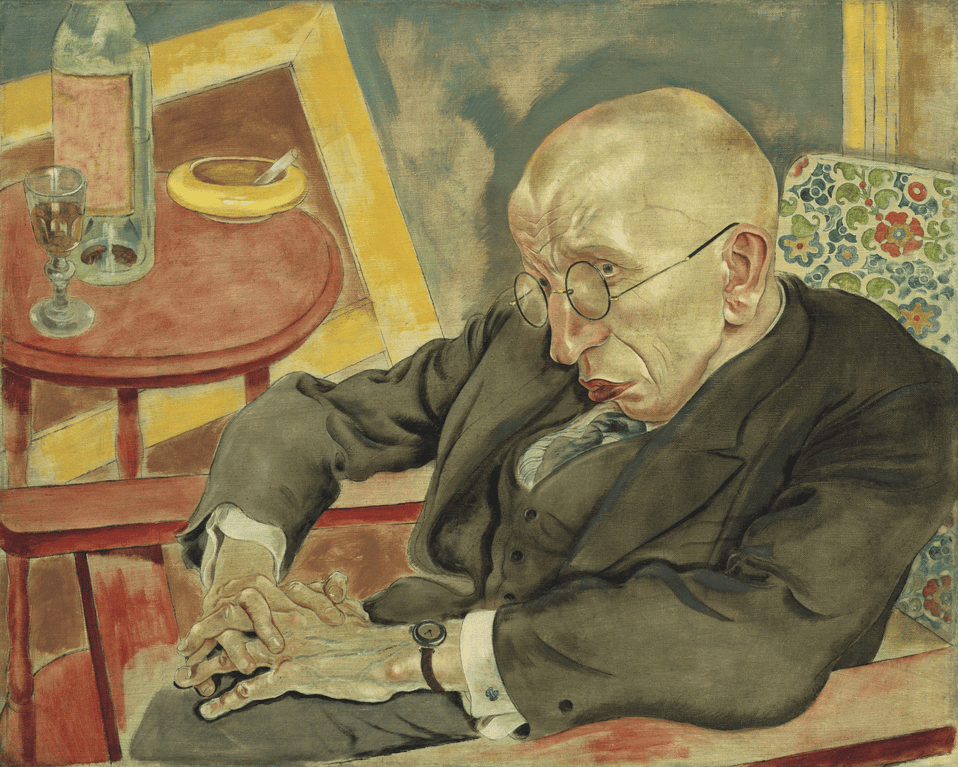
 In April 2009, the heirs of Berlin-born George Grosz filed a restitution lawsuit against New York’s Museum of Modern Art (MoMA) claiming that three paintings by the artist held in the museum’s collection rightfully belong to the family.
The trustees resisted the call.
The contested art works included a portrait of Max Hermann-Neisse (1886-1941). What is the story behind this remarkable painting and how did it end up in Manhattan?
What links the sitter to the socialite Wallis Simpson, Duchess of Windsor, whose Royal Suite furnishings at Manhattan’s Waldorf Astoria Hotel were put under the hammer by Kaminsky Auctions in October 2020?
Painter & Poet
The painter George Grosz (1893-1959) suffered badly from Nazi policies driven by Joseph Goebbels to control cultural manifestations. Party officials confiscated about 300 of his works held in museums and galleries, some were stolen and sold, others burned (seventy paintings vanished without a trace).
 One of the paintings seized by zealots was a stunning portrait of his friend, the poet Max (Macke) Herrmann-Neisse.
Born on May 23, 1886, in Neisse, Silesia (now Nysa, Poland), into a Jewish family of innkeepers, Max Herrmann was a physically disabled child and grew up with a powerful sense of otherness.
Having studied art and literature in Munich, he turned to writing. Influenced by Expressionist authors, Herrmann published poems in various German avant-garde periodicals. In 1914, Fischer Verlag issued his first collection Sie und die Stadt (She and the City).
In May 1917, Max married Leni Gebek. The couple settled in Berlin where they immersed themselves in the city’s vibrant mix of artistic and political activities. From that time onward he added his place of birth to his name.
Mixing in bohemian circles, Herrmann-Neisse was a known figure in the city’s bars, theaters, and seedy cabarets. He was Berlin’s literary version of Toulouse Lautrec, creating an ever-expanding oeuvre of poetry, stories, and cabaret pieces. In 1924 he received the Eichendorff-Preis and three years later the Gerhart Hauptmann Award.
In 1925, George Grosz displayed his first portrait of the poet with hunchback and bald head at the “Neue Sachlichkeit” (New Objectivity) exhibition in Mannheim. Today, this painting is on display at the city’s Kunsthalle (museum of modern art).
Two years later he produced an even more stunning portrait. In 1933, the Nazis purged this painting from Berlin’s legendary Flechtheim Gallery, condemning it as a prime example of “degenerate” art.
They closed the gallery as its founder Alfred Flechtheim was Jewish.
Litany of Bitterness
Two days after the Reichstag (the seat of government) Fire in February 1933, Max and Leni fled Berlin in fear of their safety as a decree had been issued that permitted the regime to incarcerate opponents without charge.
Via Switzerland and the Netherlands, they arrived in London in September that same year. A few months later, the Nazis burned his books.
 Unable to speak English and deprived of German citizenship, his poetry became an expression of utter isolation. He applied for British national status, but his request was denied.
Herrmann-Neisse continued to write. Some poems created in London are among his best, but there were few opportunities for publication.
As a young man he had visited every bar and joint in the streets of Berlin. Socially and psychologically, he was inextricably bound up with the city. The loss was unbearable. “Ein deutscher Dichter bin ich einst gewesen” (I once was a German poet) he wrote in 1934.
Shortly before his death he wrote “Litanei der Bitterness,” a poem that reflects on life in exile, expressing the pain of being dependent on the goodwill of others: “Bitter ist es, das Brot der Fremde zu essen” (It is harsh to eat the bread of foreigners).
In 1936 he published a collection of poems in Zurich entitled Um uns die Fremde (Amongst Foreigners – with a preface by Thomas Mann), a poignant work of exile poetry that explores themes of displacement and alienation. By the time of publication, the poet’s personal life was becoming increasingly bizarre.
From that year onward, he and his wife lived in a ménage à trois with Leni’s lover, the Swiss diamond dealer Alphonse de Sondheimer who supported the couple financially.
They shared his apartment at Bryanston Court in George Street, Mayfair. Unable to earn a living himself and deprived of publication outlets, the poet saw the senseless wealth of one of London’s most opulent residential areas.
Consumed by sorrow, he suffered the agony of physical and linguistic isolation. The virus of displacement hits every migrant at some time to a varying degree – it broke Herrmann-Neisse.
The domestic arrangement in Mayfair lasted until the poet died from a heart attack in April 1941. Buried at East Finchley Cemetery, he rests in a lone grave far from his beloved Berlin.
Leni later married Sondheimer who in 1947 became a British citizen and changed his name to Alphonse Sandhurst. She committed suicide in 1961 after Alphonse had passed away.
Wallis Simpson at Bryanston Court
Bryanston Court is a luxurious Art Deco seven-story red brick block of apartments. Built in the early 1930s, it became home to an international set of affluent residents.
It turned out to be a microcosm of the decade’s chaotic political developments, providing a tale of Royals, spies, and secret agents. It was here that a resident named Mrs. Wallis Simpson first entertained the Prince of Wales.
S ocialite Bessie Wallis Warfield grew up in Baltimore where shortly after birth she and her widowed mother were cared for by wealthy relatives. In 1916 she married US Navy pilot Earl Winfield (Win) Spencer, a heavy drinker with a violent temper. The relationship lasted for a decade.
While in Shanghai in 1925 she had a fling with Count Galeazzo Ciano, who was later to become Mussolini’s son-in-law and Italy’s Foreign Minister. The affair resulted in a pregnancy. An allegedly botched abortion left her with lasting gynaecological problems.
She divorced Spencer in 1927. By that time, she had become involved with Ernest Aldrich Simpson, an Anglo-American shipping executive.
He was also a former officer in the Coldstream Guards, the oldest continuously serving regular regiment in the British Army, famous for protecting the monarch, wearing iconic red tunics, and sporting tall bearskin hats.
He left his first wife to marry Wallis in July 1928 at the Register Office in Chelsea, London. The couple set up home in a three-bedroom apartment at Bryanston Court where they mingled with a well-connected group of residents.
Their friend Lady Thelma Furness was the mistress of Edward, Prince of Wales, the eldest son of King George V. In January 1931 she invited the couple to Burrough Court, her country house at Melton Mowbray, Leicestershire, where Wallis first met the heir to the throne. Prince Edward was at once besotted by her.
Fashion & Fascism
Edward became a regular visitor to Bryanston Court. It was there that Wallis and her husband hosted the glamorous parties that he delighted in. The relationship between Edward and Wallis started in 1933.
Born in September 1891 in Vienna, Stephanie von Hohenlohe was the illegitimate daughter of a Jewish woman from Prague. She would later claim to be of pure Aryan descent.
 A social climber, she gained the title of “princess” by a brief marriage to an Austrian noble. In 1927, she targeted a meeting with Lord Rothermere, the reactionary owner of the Daily Mail. They became lovers.
In 1932, he employed her to orchestrate communications with the Nazi leadership. She gained access to the Chancellery in Berlin. Hitler referred to her as “Dear Princess” and awarded her with the Golden Insignia of the Nazi Party.
Prompted by Rothermere, Stephanie settled at Bryanston Court into an apartment next door to Wallis Simpson and cultivated a friendship with her.
British intelligence kept the building under surveillance, fearing that Stephanie used her proximity to Wallis Simpson and Prince Edward to gain access to British intelligence.
For that reason, MI6 also tracked Wallis Simpson. Her social encounters were monitored as rumors persisted that she had been intimately involved with Joachim von Ribbentrop, Hitler’s ambassador to Britain.
Bryanston Court was a nest of Nazi plotters.
On the death of King George V in January 1936, Edward succeeded his father whilst Wallis Simpson was in legal divorce proceedings. His wish to marry an American woman who had been divorced twice threatened to cause a constitutional crisis.
Refused the union of a morganatic marriage, he abdicated in December that same year and was made Duke of Windsor by his brother and successor George VI.
Wallis married Edward six months later and became formally instated as the Duchess of Windsor (but not Royal Highness).
It was the beginning of a decades-long semi-exile in Europe and Manhattan, marred by friendships and meetings with dubious characters, including a visit to Nazi Germany in 1937 and a private session with Adolf Hitler.
There is little doubt that the couple harbored Nazi sympathies.
 The Windsors made Manhattan’s Waldorf Astoria their primary American home for over two decades. The couple occupied a lavish suite (42R) on the hotel’s top floor with superb views over the city.
They arrived every fall in New York City for the social season, hosting private gatherings for elite guests. In 1950, the Duchess met James Paul (Jimmy) Donahue, the inheritor of the Woolworth department store fortune.
Nineteen years her junior, he was a flamboyant playboy. Gossip about their affair was rife on both sides of the Atlantic, leaving the Duke of Windsor publicly humiliated. In Manhattan, she sacrificed what was left of her reputation.
Washington Principles
Curt Valentin (1902-1954) had been an assistant to gallery holder Alfred Flechtheim in Berlin, and he too was of Jewish background. In late 1936, the Nazis barred him from practicing his profession, but they allowed him to move to Manhattan.
With approval of Hitler’s Reich Chamber of Fine Arts that regulated all visual artists and their representatives, he opened the Buchholz Gallery on West 46th Street (later moving to West 57th Street).
The gallery served as the main American channel for the sale of modern artworks that the Nazis had purged from European museums and private collections. The hard dollars of the proceeds supported the war economy.
Curt Valentin acted as a go-between for Alfred H. Barr, director of MoMA, to handle stolen masterpieces. Transactions were kept secret to avoid a public backlash.
Having emigrated from Berlin to the United States in 1939, Charlotte Weidler was a curator and art dealer who acted as consultant for the Carnegie Institute, Pittsburgh.
 While she initially worked behind the scenes to protect German artists from Nazi persecution, she later took part in selling looted art. She collaborated with Valentin in laundering works that had been taken from their rightful owners.
Weidler was in possession George Grosz’s portrait of Max Herrmann-Neisse, claiming she had inherited the canvas from Alfred Flechtheim’s estate following his death in 1937.
The real story of how she took possession of the painting remains unresolved to this day. In 1952, she handed the work to Valentin who acted as an intermediary to broker its sale to MoMA (then directed by Barr’s successor, René d’Harnoncourt).
The non-binding 1998 Washington Principles on Nazi- Confiscated Art pressed institutions to find “looted” artworks in their collections and settle disputes with the heirs of former owners in a “just and fair” manner.
To this day, museums are reluctant to investigate the origins of dubious holdings. The legal battle between the heirs of George Grosz and MoMA was dismissed on a procedural technicality: the statute of limitations.
The family had waited too long to file their lawsuit after the museum had formally addressed their claims. The process contravened the ethical spirit that the Washington Principles had called for.
Grosz’s portrait of Max Herrmann-Neisse, the poet of Berlin betrayed by fellow Berliners, stays in Manhattan.
Read more about New York’s Arts & Culture.
Illustrations, from above: George Grosz’s “The Poet Max Herrmann-Neisse,” 1927 (MoMA), a second version of his of his portrait of Max Herrmann-Neisse; George Grosz in 1921; Grosz’s “Porträt des Schriftstellers Max Herrmann-Neiße, a first version of his portrait of Max Herrmann-Neisse, 1925 (Staatliche Kunsthalle, Mannheim); Bryanston Court, Marylebone (Mayfair); the Duke of Windsor and Wallis Simpson visiting Hitler, 1937 (BBC); the Windsor Suite at the Waldorf Astoria Hotel; and Germans attending the Degenerate Art Exhibition in 1937.
Recent Comments