
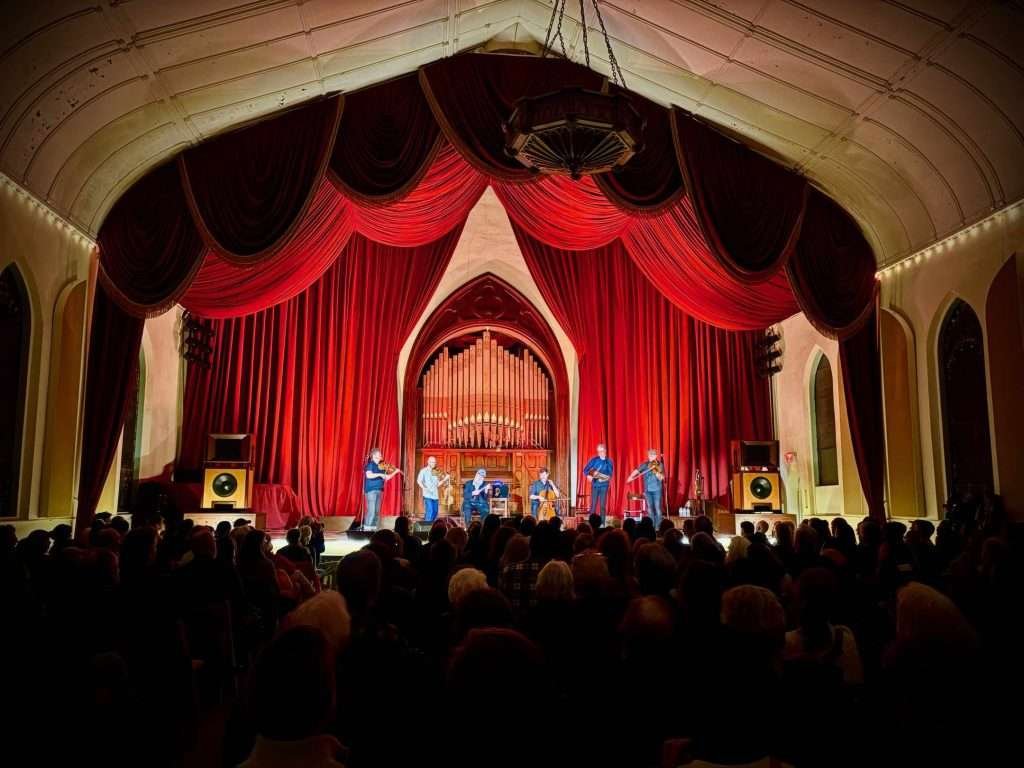
 Due to shrinking congregations and finances, many abandoned church buildings in New York’s Hudson Valley have been reused for other purposes. Some are now apartments or condominiums, fraternity houses, museums, historical societies, businesses and vibrant art venues and community centers.
These can be especially beautiful, with their preserved architecture and stained-glass windows. Protecting and re-using these buildings for events like concerts and art shows helps preserve the history and uniqueness of a community.
It is often local and state preservation societies who advocate for landmark protections and who secure funding for restoration. For example, the Preservation League of NYS has a biennial list of “Seven to Save At-Risk Historic Sites” which can include churches, barns, old opera houses, historic districts and other properties.
Each May the New York Landmarks Conservancy organizes the annual Sacred Sites Open House Weekend, a free statewide opportunity to visit current and former churches of historical interest.
 As restoration is expensive and time consuming, many old church buildings remain abandoned for years and eventually fall to ruin. Driving through any city or small town, one can see abandoned church buildings that once were beautiful sacred spaces, brimming with life and song.
A prime example is the now abandoned Holy Innocents Episcopal on North Pearl Street in Albany, which is in very sad condition.
Fortunately, there are other examples that have been saved. Here is a short list of some which have been transformed into art and community centers, along some brief historical notes:
Hudson Valley
TEMPO Performing Arts Center, Kingston
Formerly Trinity Methodist Church, this large gothic building was constructed in 1867 in the Rondout neighborhood. It has Tiffany windows and now features a weathervane on the steeple with a profile of the Mary Powell, a well-known 19th century Hudson River steamship. In the 2000s the building briefly became a homeless shelter and just this year (2026) became TEMPO. Their mission is to build community through music.
Darkside Records, Poughkeepsie
A former Methodist Church built in 1845, it was expanded by architect Archibald Cannon in 1895 to become a Masonic Temple. Another expansion took place in 2019 which resulted in Revel 32, which was used for weddings, concerts, and fundraisers. Unfortunately it recently closed though Darkside Records purchased and continues to occupy the building.
 The Ellis, Newburgh
A United Presbyterian Church until the 1970s, it later became home to a Spanish speaking Church of God congregation. Today, the beautifully restored building is a venue embracing the arts and entertainment. Their website states that “the story of the Ellis is… about embracing its spirit.” The building features beautiful re-use of the church space including the stained-glass windows
Museum of Crypto Art, Kingston
Formerly the Sacred Heart of Jesus church built in 1884, the building along Rondout Creek served bluestone masons, carpenters, and shipyard workers. The current owner Colborn Bell founded the museum in 2020 to showcase digital art. The gallery contains Tiffany-stained glass windows and timber beams. Part of the building was also renovated for his residence. In a 2023 Chronogram article, Bell says he has been “fascinated by the reappropriation of sacred symbols, and I also like the idea of exploring the third place” – or where people spend their free time. Bell’s idea is to create a “third space” for connection and conversation around crypto art.
The Field Library Building, Peekskill
Originally Second Presbyterian Church, it became the Field Library from 1921-1978. It was then briefly a theater, until landscape artist Larry D’Amico bought it in 1992. With a loan from the city and help from friends he converted it into living space for himself, plus art studios, in a designated historic art district.
Capital District
 Mt. Ida Preservation Hall, Troy
Built in 1869 in the Gothic Revival style this former Episcopal Free Church of the Ascension was known for its stained-glass windows and Meneely Bells. The church closed in the 1990s and was deeded to the Mt. Ida Preservation Association, through a reverter clause which allowed the building to pass to a descendant of a minister, who now sits on the association’s board. The building has been refurbished as a community and performing arts center, hosting concerts, art shows, weddings, and fundraisers. There is also a monthly community brunch, a food pantry and Community Compass – a support service that helps neighbors find food, housing, health and legal services. Additional preservation work is planned.
Oakwood Community Center, Troy
Built around 1860 as Oakwood Presbyterian Church, in 1963 it merged with Liberty St. Presbyterian Church (a former Underground Railroad hub) to become Troy’s first multiracial church. Oakwood closed in 2010 and former members converted the church into a community center. Today, the space includes a food pantry, free meeting rooms, an after-school performing arts program, and the Soul Café – a monthly community meal. The sanctuary is also rented to several small congregations.
Sand Lake Center for the Arts, Sand Lake
Formerly a Presbyterian church built in 1835, it became the town hall and court room from 1972-1999. It then passed to Circle Theatre Players who further refurbished the building through fundraising and much labor from volunteers. It opened in 2003 as Sand Lake Center for the Arts. The center now offers 5 plays per season, plus concerts, gallery exhibits, and arts workshops.
 Sanctuary for Independent Media, Troy
Formerly St. Patrick Church’s original building constructed in 1871 on 6th Avenue in North Troy, a larger church was built nearby in 1912 (that closed in 2011 and is still vacant). The first building was repurposed for a media center around 2005. It is a place “where social justice, science and art meet.” They have their own radio station, performance and production facilities, and conduct classes on a variety of topics.
RISSE (Refugee and Immigrant Support Services of Emmaus), Albany
Formerly Emmaus United Methodist Church and placed on the National Register of Historic Places in 2008, this church closed its doors in 2023 when the congregation could no longer maintain it. It was then acquired by the non-profit RISSE with the help of the church. The organization supports refugees and immigrants through English classes, employment assistance and youth programs.
Grand Street Community Arts, Albany
Formerly St. Anthony’s Catholic, this church in Albany’s South End closed in 1972, and in 2005 became an arts center. However, the building needed extensive repairs, so they sought funding through the American Rescue Plan Act and the Community Loan Fund. Today they offer many community programs, and a monthly lunch.
Universal Preservation Hall, Saratoga Springs
Formerly a Methodist Church, it was built in 1871 and sold to Universal Baptist Church in 1976. By 2000 it was condemned. Fortunately, it was saved by a group of local residents. Renovations began in 2018 and opened in 2020. Opening night featured Roseanne Cash, daughter of singer song writer Johnny Cash. The venue is now an elegant community space for arts, entertainment and events.
 Arts Center on the Hudson, Mechanicville
Built in 1897 as St. Luke’s Episcopal Church, around 2003 the building at 2 South Main Street was deteriorating and the Diocese decided to sell it and build a new church. It was then refurbished and opened in December 2008 in affiliation with Mechanicville Area Community Services Center as a “venue for the arts as well as community gatherings, weddings and benefits.” Then Director James McMillan said around that time “we saw this architectural gem just falling apart. The high arched ceilings are absolutely beautiful to behold. We didn’t want to see it slowly rotting away and we took to saving it.” The original stained-glass windows and organ (minus the console) remain intact.
Read more about historic preservation in New York State.
Illustrations, from above: TEMPO Performing Arts Center (provided); the crumbling Church of the Holy Innocents in Albany, NY in 2011 (courtesy Wikimedia user ); inside The Ellis in Newburgh; Mt. Ida Preservation Hall during an event; the exterior of the Sanctuary for Independent Media; and the Arts Center on the Hudson (all provided).
Recent Comments