
 The word “torpedo” is generally believed to have been first used by New York steamboat pioneer Robert Fulton (1765-1815) around 1800 to describe a device with an enclosed mass of gunpowder which was to be exploded beneath enemy ships.
The word may have been chosen due to the similarity in the way in which the device and the torpedo fish both communicated shock, or simply because detonation of the charge rendered fish torpid.
In any case, the word torpedo was generally applied to all underwater explosive devices through most of the nineteenth century.
Fulton, David Bushnell, (1740–1824, creator of the first combat submarine The Turtle in 1775), Samuel Colt (1814-1862, who made the mass production of revolvers commercially viable) and other early inventors were concerned with stationary torpedoes or what are called mines today.
 The earliest recorded use of a torpedo was in 1801 when Robert Fulton sank a small ship using a submarine mine with an explosive charge of 20 pounds of gunpowder at Brest, France.
Stationary torpedoes were first used on a large scale by the Russian government during the Crimean War (1854-1856). They were used as part of the defense of Sebastapol in the Black Sea, and at Cronstadt and Sweaborg in the Baltic Sea.
In the Baltic, torpedoes were exploded under four English ships. None were destroyed, but all were damaged to some degree.
Various types of torpedoes were employed during the Civil War (1861-1865) with the Confederate Navy having greater success. Twenty-two US ships were sunk and twelve were damaged by Confederate torpedoes, while six Confederate ships were destroyed by US Navy torpedoes.
Offensive Weapons & Origin of the Whitehead Torpedo
The idea of providing mobility to the torpedo, thereby turning it into an “offensive” rather than “defensive” weapon, is generally credited to Fulton, who first proposed using a boom-mounted explosive charge.
 The boom or spar-mounted configuration was employed by both the Confederate and Union Navies during the Civil War. The most notable use of the spar torpedo was the sinking of the Confederate ram Albemarle by Lt. W. B. Cushing, USN, at Plymouth, North Carolina in October, 1864.
Another type of mobile torpedo adopted by most navies in the years from 1870 to 1880 was the towed torpedo. An explosive charge was contained in a case with a fixed rudder to be towed off the ship’s stern or beam.
When towed from abeam, the tow line assumed an angle of about 45 degrees with the ship’s centerline when under way. When the torpedo contacted an enemy ship the charge was detonated either electrically or by impact.
 About the middle of the nineteenth century, an officer of the Austrian Marine Artillery conceived the idea of employing a small boat carrying a large charge of explosives, powered by a steam or an air engine and remotely steered by cables.
Upon his death, before he had perfected his invention or made it public, the papers of this anonymous officer came into the possession of Capt. Giovanni Luppis of the Austrian Navy.
Impressed with the potential of the idea, Luppis had a model of the boat built which was powered by a spring-driven clockwork mechanism and steered remotely by cables.
The Whitehead Torpedo
Not satisfied with the Austrian device, in 1864 Giovanni Luppis turned to Robert Whitehead, an Englishman. Whitehead was then manager of Stabilimento Tecnico Fiumano, a factory in Fiume, Austria (now Rijeka, Yugoslavia) on the Adriatic Sea.
Whitehead was also impressed with the potential of such a weapon and became determined to build an automatic torpedo that could run at a given depth below the surface for a reasonable distance.
 In October 1866, the first experimental model was ready. As designed by Whitehead, the model was driven by a two-cylinder, reciprocating, compressed-air engine, which gave the torpedo a speed of 6-1/2 knots for a distance (range) of 200 yards.
Compressed air for propulsion was stored in a section of the torpedo known then, and still known now, as the air flask, at a pressure of 350 psi.
Austria purchased and conducted experiments with the torpedo during 1867-1869. As a result, in 1869 Austria purchased the manufacturing rights from Whitehead for an unknown price, but permitted Whitehead to sell his torpedoes to other governments.
In spite of the spectacular achievement of the Whitehead Torpedo, two offers to sell the rights to the U.S. Navy, in 1869 for $75,000, and again in 1873 for $40,000, were not accepted.
By 1880 however nearly 1,500 Whitehead Torpedoes had been sold to the following countries: Great Britain, 254, Germany, 203; France, 218; Austria, 100; Italy, 70; Russia, 250; Argentina, 40; Belgium, 40; Denmark, 83; Greece, 70; Portugal, 50; Chile, 26; Norway, 26; and Sweden, 26.
US Torpedo Production
The U.S. Naval Torpedo Station (Fort Wolcott) at on Goat Island in Newport Harbor, Rhode Island, was established in 1869 as an experimental station for the development of torpedoes and torpedo equipment, explosives, and electrical equipment.
Initial efforts were devoted to stationary torpedoes (moored mines) and the spar torpedo (a boom-mounted contact explosive charge). The Torpedo Station was then tasked with building a “Fish” Torpedo, similar to the Whitehead. After some tests with mixed success, this was abandoned in 1874.
 Torpedo development in the United States during the period from then until 1900 consisted of experimenting with chemical, electrical, and rocket propulsion, and surprisingly, guidance and supplying of power by means of a trailing wire was popular.
The first successful US torpedo development was completed in 1889. Largely the work of J. A. Howell (1840-1919, later Rear Admiral) the Howell Torpedo was driven by a 132-pound flywheel spun to 10,000 revolutions per minute prior to launch by a steam turbine mounted on the torpedo tube.
The rotating flywheel created a gyroscopic effect. Deviations in azimuth were adjusted by a pendulum which sensed the heel of torpedo when it deviated from its course and was coupled to the rudder.
This gave the torpedo good directional stability; however, the depth-keeping characteristics were not good. Despite this, the Howell Torpedo was used in service on US battleships until 1898 when it was supplanted by the Whitehead Torpedo.
Early Brooklyn Torpedoes
Around 1891, negotiations for torpedo manufacturing rights in the United States began in earnest between the Whitehead Company and the E.W. Bliss Company of Brooklyn, NY.
 Favorable terms were reached and in 1892, the Navy contracted with the Bliss Company for the manufacture of 100 Whitehead Mk 1 torpedoes at a price of $2,000 each. Thus, some 26 years after the Whitehead Torpedo was introduced, US experts finally got around to this tacit admission of its worth.
This concession was probably inspired in part by a successful torpedo attack on April 23, 1891, against the Chilean insurgent 3,500-ton battleship Blanco Encalada. This ship was sunk while at anchor by a Whitehead Torpedo fired from a gun boat.
Between 1896 and 1904, the Bliss Company made about 300 more Whiteheads of five types for the Navy. The 3.55-meter Whitehead Mk 1, Mk 2, and Mk 3 torpedoes were basically the same. The Mk 1 and Mk 2 versions were also available in the five-meter length.
 The five-meter Mk 1 used the Obry steering gear (gyro) invented by Austrian Ludwig Obry for azimuth control and had the largest warhead of any torpedo of that time – 220 pounds of wet guncotton.
Initially, the gyro was used to keep the torpedo on a course defined by maneuvering the firing ship. The installation of pivoting torpedo tubes in 1893 improved their tactical flexibility.
Finally, curved fire, which used the gyro to control the torpedo on a preset course, was adopted in US Navy torpedoes about 1910. First installed in the Whitehead Mk 5 torpedoes of US Navy manufacture and the Bliss-Leavitt Mk 2 torpedoes, it was intended for use from fixed tubes.
Ultimately it was applied to all straight-running torpedoes, and all torpedo tubes were provided with gyro angle setting capability.
Bliss-Leavitt Torpedoes
In 1904 the Russian–Japanese War caught the attention of the Navy, because both nation’s fleets lost most of their battleships to underwater explosives.
That year Bliss Company engineer Frank McDowell Leavitt (1856–1928) of Brooklyn developed a new torpedo, the Bliss-Leavitt Mk 1. This torpedo was powered by a single-stage, vertical (plane of rotation) turbine which also had a combustion pot, and used alcohol as fuel to heat the air before entering the engine.
The Bliss-Leavitt Mk 1 had one significant shortcoming. The single-stage turbine drove a single propeller resulting in an unbalanced torque which caused the torpedo to roll. This was corrected in subsequent Bliss-Leavitt torpedoes by using a two-stage turbine driving contra-rotating propellers.
 The two-stage turbine was essentially the same used in all US “steam” torpedoes through the Second World War (1939-1945), but in 1907 the Bliss Company could produce only about 250 per year. During World War One (1914-1918), the Navy had almost 300 destroyers that each had 12 torpedo tubes.
About this time Admiral N. E. Mason (1850–1945), then Chief of the Bureau of Ordinance, requested an appropriation of $500,000 from Congress of which $150,000 was for the purpose of establishing a US Navy Torpedo Factory at Newport. Construction of the factory began in 1907.
In the light of establishing a competitor to E. W. Bliss Co., who had enjoyed a virtual monopoly in supplying torpedoes to the US Navy, the climate was probably more favorable for dealing with Whitehead rather than Bliss for manufacturing rights, tooling, etc.
At the same time, an order for additional Whitehead Mk 5 torpedoes was placed with Vickers, in England, perhaps an indication of a strained relationship between the US Navy and the Bliss Company.
Bliss staged a comeback with the Bliss-Leavitt Mk 6 torpedo in 1911 which used horizontally placed turbines. An 18-inch diameter torpedo intended for above-water launching, this weapon could obtain a speed of 35 knots, but a range of only 2,000 yards.
The Bliss-Leavitt Mk 7 torpedo was the next significant step forward in technology. A water spray was introduced into the combustion pot along with the fuel spray and the “steam” torpedo came into being.
World War One
With a range of 6,000 yards at 35 knots, the Mk 7 was introduced about 1912 and was in use for 33 years up to and including World War II when it was used in reactivated World War I destroyers.
At the beginning at World War One, the Bliss Company was supposed to produce about 1,000 torpedoes for the Navy, but production was delayed by demands for artillery shells (which it also produced) and only 20 torpedoes were close to being shipped before the US entered the war in 1917. When war was declared, another 2,000 torpedoes were ordered.
To produce large numbers of torpedoes, the government loaned $2 million to the Bliss Company so it could build a new factory in Bay Ridge, Brooklyn. Although the government had ordered 5,901 torpedoes, only 401 had been delivered by July 1918.
The supply problems prompted the Navy to build the U.S. Naval Torpedo Station in Alexandria, VA, but the First World War ended before that factory was built. The plant produced torpedoes for five years, but was shuttered in 1923.
 The Submarine
In 1900 the US Navy’s first modern submarine, USS Holland (SS-1) was built at Crescent Shipyard in Elizabeth, New Jersey, for John Philip Holland’s, Holland Torpedo Boat Company. An Irish immigrant, Holland was funded by the Fenian Brotherhood and had produced the Fenian Ram in 1881.
Holland arrived in Newport for a demonstration and test in 1901. While carrying three Whitehead Mk 2 torpedoes the Holland was exercised with a Navy crew from the Torpedo Station. Lt. Harry H. Caldwell, who is believed to be the U.S. Navy’s first submarine officer, was in command.
In exercises off the coast of Newport, the Holland closed to within torpedo firing range of the USS Kearsarge (BB 5) without being detected.
The Holland was followed by other US Navy submarines in tests and experiments at Newport. These early “A” type submarines such as the USS Adder and USS Mocassin were equipped with one bow-mounted, 18-inch torpedo tube. Later classes had two or four 18-inch torpedo tubes installed and carried a total complement of four to eight torpedoes.
The exception was the G-3 which had six 18-inch torpedo tubes installed and carried a total complement of ten torpedoes. The ultimate torpedo for these early submarines was the Bliss-Leavitt Mk 7.
Like the surface Navy, submarines were standardized with 21-inch torpedo tubes beginning in 1918 with the “R” class. Submarines equipped with the 21-inch torpedo tubes used Torpedo Mk 10, which had the heaviest warhead of any torpedo up to that time, 500 pounds, with a speed of 36 knots, but a range of only 3,500 yards. This was a developed in Newport, with the assistance of the Bliss Company.
Bliss-Leavitt Torpedo Mk 9 was developed about the same time as Torpedo Mk 10 (1915). It was intended to replace Bliss-Leavitt Mk 3-type torpedoes in battleships. When use of torpedoes in battleships was discontinued in 1922, the Mk 9 was converted for submarine use and was used in the early days of World War II to supplement the limited stock of Mk 14’s.
The last of the Bliss-Leavitt torpedoes, the Mk 9 appears to have been a misfit in the evolutionary process. It was slow, had a short range for a surface ship torpedo, and initially carried a smaller explosive charge and air flask.
During this time period, the U.S. entered World War I. By the spring of 1917, the German U-boat menace had become so great that it overshadowed all other enemy threats.
Torpedo research and development was practically discontinued in favor of the development of depth bombs, aero bombs, and mines, which were the antisubmarine warfare weapons of that era.
The resources of the Naval Torpedo Station at Newport were redirected to this end and played an important role in wartime development, particularly in the development of the depth charge which supplanted the British design.
Brooklyn Electric Torpedo Development
Development of an electric torpedo started around July 1915, with the Sperry Gyroscope Company of Brooklyn.
 The company was incorporated in 1910 by Elmer Ambrose Sperry to manufacture navigation equipment — mostly his own inventions — at 40 Flatbush Avenue Extension in Downtown Brooklyn.
During World War I the company diversified into aircraft components including bomb sights and fire control systems. In their early decades, Sperry Gyroscope and related companies were concentrated on Long Island, especially in Nassau County. Over the years, it diversified to other locations.
The 7.25 inch Sperry electric torpedo had a range of3,800 yards and traveled at 25 knots. It was six feet long and weighed 90 pounds (without its explosive charge).
The propulsion motor of the proposed electric torpedo was to act as a gyroscope to stabilize the torpedo in azimuth. This development was terminated in 1918 with no torpedoes having been produced.
Navy interest in the development of an electric torpedo, prompted by the successful development of one during World War I in Germany, continued after termination of the Sperry contract.
Navy in-house development of an electric torpedo of conventional size continued at the Navy Experiment Station, in New London, Connecticut, but in 1919, the Station was closed as an economy measure, and the development was assigned to the Newport. Development continued sporadically over the next 25 years ultimately culminating with the Mk 20.
End of New York Torpedo Making
World-wide reduction in naval armament during the 1920s resulted in a wave of reduced expenditures for military purposes. Appropriations for torpedo research and development were small, with an allocation of approximately $30,000 per year for the Torpedo Station at Newport during this era.
 In the same wave of economy, development and manufacture of torpedoes at the E. W. Bliss Company was terminated in the early 1920s upon completion of the Torpedo Mk 9 project.
Disputes over patent rights, and also the fact that Newport, with 15 years of experience in torpedo manufacture was considered capable of providing for the Navy’s needs, were cited as factors influencing termination of work with the Bliss Company.
Economy seems to have been the primary motivation, for at the same time, torpedo manufacturing activities at the Washington Navy Yard and the Naval Torpedo Station in Alexandria, Virginia, were halted.
The Newport Torpedo Station became the headquarters for torpedo research, development, design, manufacture, overhaul, and ranging.
Read more New York Naval History.
This essay was largely drawn from The San Francisco National Maritime Park Association’s “A Brief History of U.S. Navy Torpedo Development.”
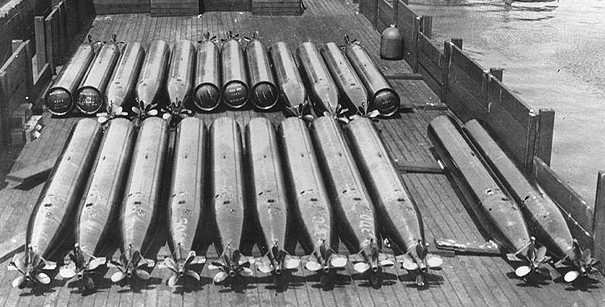
Illustrations, from above: A Brooklyn made Bliss-Leavitt Torpedo Mark 3, 1911; contemporary sketch of Robert Fulton’s Torpedo Boat in operation; Albemarle’s ram sinks Southfield; Harvey Towing Torpedo, n.d. (Royal Museums Greenwich); Whitehead torpedo diagram, 1891; Mk3 Whitehead torpedo fired from East Dock, Goat Island, Newport Torpedo Station, Rhode Island, 1894; Blanco Encalada sinks after a torpedo shot, 1891; Ludwig Obry’s gyroscopic mechanism for steering a Whitehead torpedo, called the “Obry Gear” by the US Navy; E. W. Bliss Company plant, Dumbo, Brooklyn, 1884; USS Holland (SS-1) showing the muzzle door of the bow torpedo tube open (Scientific American, 1898); Sperry Gyroscope Company factory building at 40 Flatbush Avenue Extension in Brooklyn (courtesy Wikimedia user Jim Henderson); and Bliss-Leavitt 21-inch Mark 8 torpedoes (without warheads) intended for USS Farragut and USS Thompson ca. 1925.
Recent Comments