
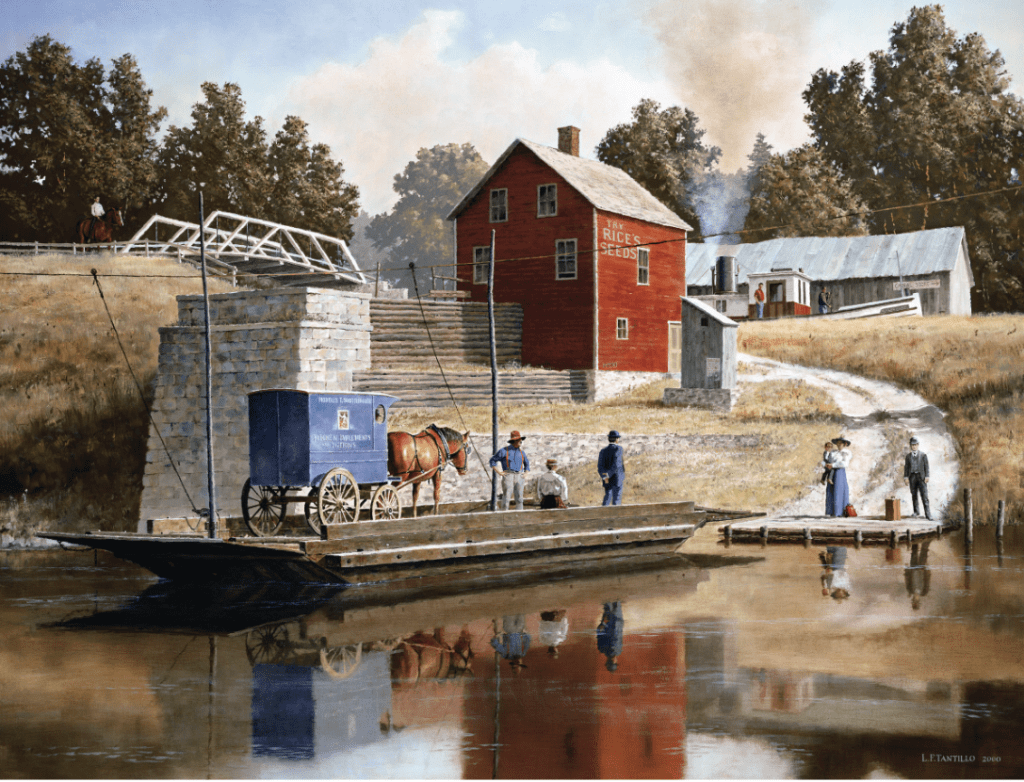
 Early ferry travel across New York’s rivers and large lakes relied on rowboats, scows, barges, or sail ferries, which were vulnerable to shifting currents and bad weather. New York’s horse ferries bridged the gap between this unpredictable transportation and the mechanical age.
Known as “teamboats,” these vessels emerged in 1814 as a direct response to the commercial monopoly held by Robert Fulton and Robert Livingston over steam navigation in New York waters.
Horse ferries used a turntable, treadmill, or circular track hidden below at the center of the main deck. Teams of two to eight horses walked continuously in place, turning a horizontal wheel linked by gears and drive shafts to side paddle wheels.
 Because the horses could be stabled and fed on land between crossings, they were economical to maintain compared to early, temperamental steam boilers. This design was so effective that some operators — like the Juliana on the Hoboken Ferry — pulled their early steamboats out of service to replace them with horse-powered alternatives to bypass the Fulton-Livingston monopoly.
From the East River between the city of New York and Brooklyn the technology rapidly migrated to Upstate New York.
In the 1820s and 1830s horse ferries became familiar fixtures, especially on the Hudson River, servicing growing industrial hubs at Newburgh, Hudson, Troy, and Albany.
Beyond the Hudson and Mohawk Valleys, horse ferries could also be found at dozens of short crossings along Lake Champlain. Notable vessels like the Eclipse ran the three-mile crossing between Charlotte, Vermont, and Essex, NY, starting in 1828, utilizing a treadmill walked by six horses.
(The fragile remains of a turntable teamboat in Burlington Bay is one of the only archaeologically studied horse ferry wrecks in the country.)
Horse ferries could also be found wherever waterways impeded travel, including along the Mohawk River, or in the Finger Lakes.
Decline of the Horse Ferries
Robert Fulton’s steam ferry Nassau, launched on May 10, 1814, was the first steam-powered ferry to operate on the East River and helped secure his later dominance over New York Harbor ferry service.
Then in 1824 the US Supreme Court’s Gibbons v. Ogden decision broke the Fulton-Livingston monopoly removing the primary incentive for horse ferries.
 Concurrently, steam engines came to be seen as safer. They were also more efficient and cheaper to manufacture and as a result, the teamboats were gradually phased-out.
By the end of the 1840s, the era of the horse ferry was ending, though some horse or mule-powered ferries operated on smaller mid-Hudson crossings as late as 1862.
The following articles from 1814 highlight the early history of these unusual watercraft in New York waters.
Long-Island Star, April 6, 1814
NEW FERRY BOATS. On Sunday last the public were gratified by the performance of a new invented Ferry Boat, on the New-Ferry between this village and New-York. This boat was invented by Moses Rogers, Esq. of New-York. It is in some respects similar to the Paulus Hook [Jersey City] ferry-boats, and calculated to receive wagons in the same commodious way; but the water-wheel in the center is moved by eight horses.
It crossed the river twelve times during the day, in from 8 to 18 minutes each, and averaging 200 passengers each time. It makes good was against wind and tides and promises to be an important acquisition. Another boat to go by horses is now building for that ferry; and a Steam-Boat… is nearly ready for the ferry between Brooklyn and Beekman Slip.
[Moses Rogers (1779–1821) was a sea captain, engineer, and maritime entrepreneur who became one of the world’s leading experts on steam navigation and among the first steamboat captains. In 1809, he commanded the Phoenix from New York Harbor to the Delaware River — a recognized as the first ocean-going steam voyage in American waters.]
 Columbian, May 18, 1814
Brooklyn Steam Ferry-Boat. “The Nassau”, The new steam-boat…, which commenced running from Beekman-slip to the lower ferry at Brooklyn a few days ago, carried in one of her first trips, 549 (another counted 550) passengers, one wagon and pair of horses, two horses and chairs, and one single horse.
She has made a trip in four minutes, and generally takes from four to eight; and has crossed the river (in width about three quarters of a mile) 40 times in one day. The convenience and utility of this line of boats to the inhabitants of Long-Island and this city, may be easily conceived.
The boat impelled by horses from the New-slip to the upper Brooklyn ferry, carried at one time 545 passengers, besides some carriages and horses. And a horse-boat is to run soon from Grand-street dock to Williamsburgh. These astonishing improvements in domestic navigation are without equal in the known world…
N-Y Evening Post, June 8, 1814
On Saturday morning was launched, at the ship yard of Mr. Charles Browne, an elegant double boat, intended to ply as a ferry boat, from Corlaer’s Hook to Williamsburgh, Long Island — Bateau allant par Chevaux [Horse-powered boat]. This beautiful boat is called the Williamsburgh, and is to be propelled by horse-power…. She is by far the most spacious [such boat]… — presenting to view an extensive deck of 80 feet by 42 feet wide….
[Charles Browne (1766-1831) was a prominent shipbuilder whose East River shipyard helped anchor the city as a hub of maritime innovation. He was chosen by Robert Fulton to build the hull of the Clermont (originally named the North River Steamboat) which was launched from his yard in 1807, becoming the world’s first commercially successful steamboat.]
N-Y Evening Post, August 4, 1814
Team Boat Williamsburgh. — Trial was made yesterday of the TEAM Boat Williamsburgh, intended to ply as a ferry boat between Corlaers Hook and Williamsburgh on the opposite shore of Long Island. This boat certainly far exceeds any other propelled by horse power.
 She proceeded with only eight horses from Williamsburgh against a strong ebb tide up the East River opposite the New Alms House, from thence to Delancey Slip, and from thence she proceeded down the River, passed the Navy Yard, Long Island and Brooklyn against a very rapid flood tide to the admiration of a numerous assemblage of spectators on the wharves.
Thus in a few years we have witnessed the wonderful improvement from sails to steam, and from steam to animal power, which is calculated in a great measure to supersede the necessity and expense of steam, particularly for these short ferries.
Hudson River Maritime Museum Contributing Scholar George A. Thompson located and transcribed the articles above. John Warren added annotations and also contributed to this essay.
Read More About New York’s Ferry Boats
Illustrations, from above: Len F. Tantillo‘s 2000 historical painting “Vischer’s Ferry”; design and operation of the two-horsepower Burlington Bay Ferry (Lake Champlain Maritime Museum); New York City ferry routes, 1847; an announcement for Cayuga Lake horse ferries, 1819; and the Milton, NY Horse Ferry, 1860 (Hudson River Maritime Museum).
Recent Comments