
 Second President of the United States John Adams held the post of envoy to the Netherlands from 1780 to 1782. He secured the States General’s recognition of American independence in April 1782, the second country in the world to do so, after France; obtained a five million guilders loan (carrying an interest rate of five percent) from a consortium of Amsterdam bankers; and signed a “Treaty of Amity and Commerce” between the two nations. While his wife Abigail remained in America, he had brought his sons John Quincy and Charles with him, living in the heart of Amsterdam at Keizersgracht 529.
Unhappy with the educational progress of his sons, he took them to Leiden because of the city’s academic prestige, low cost, and pure air. In January 1781, the brothers enrolled at Leiden University. Adams wrote to his wife that he had sent the boys to that city to “to pursue their Studies of Latin and Greek under the excellent Masters, and there to attend Lectures of the celebrated Professors in that University.”
 In Leiden, Adams met an American medical student named Benjamin Waterhouse who helped him find lodgings for his sons near to the university at Langebrug 45. Waterhouse interacted closely with the teenage brothers.
John Quincy Adams’ studies were cut short later that year when he was asked to travel to Catherine the Great’s Russia as a secretary and (French) translator for the Massachusetts diplomat Francis Dana when only fourteen years of age (he completed his law degree at Harvard in 1787 and returned to the Netherlands in 1794 for a three-year spell as ambassador).
In August 1781, Waterhouse traveled back home aboard the South Carolina, the largest American warship in operation during the Revolutionary War. Leased from the French and captained by Commodore Alexander Grillon (born in Rotterdam into a Scottish Presbyterian family and fluent in Dutch), the frigate had recently been launched in Amsterdam.
Upon his return, Benjamin would keep a lifelong correspondence with the Adams family. Who then was this medical student and what role did he play in the development of health teaching in America? Why did he choose Leiden University for his studies?
Medical Science in Leiden
Benjamin Waterhouse was born on March 4, 1754, in Newport, Rhode Island, into a Quaker family. After a local apprenticeship in medicine, Benjamin traveled to Europe to continue his studies. Aged twenty-one, he spent time in London and Edinburgh, before crossing the Channel to matriculate at Leiden University on October 28, 1778.
The eighteenth century marked a shift in medical science and the treatment of patients. While traditional therapies relied on purging and bleeding, professional attention moved towards clinical observation and “bedside” teaching. After Carl Linnaeus (1707-1778) had introduced plant classification, naturalists systematically explored medicinal flora, laying the groundwork for pharmacology and clinical practice.
Chemistry became integrated too, advancing the use of mineral-based compounds. Controlled production of powders and ointments improved the consistency of medication. Vaccination experiments tested targeted immunological defense methods over symptom management. Medicine was revolutionized.
 The foundation of Leiden University was a reward by William the Silent (Willem de Zwijger), Prince of Orange, for the bravery of the town’s citizens during the Spanish siege of 1574. The official opening took place on February 8, 1575. Up to that time, Louvain (Leuven) was the only city in the Low Countries to host a university.
Founded in 1426, it was a Catholic institution: each student had to sign a “declaration fidei,” an adhesion to the faith. Leiden had Protestant origins but admitted students of other religions. It became the first “open” university. Students from far and wide flocked to the city to study in its various faculties.
In 1673, the Test Act closed the universities of Oxford and Cambridge to students who did not belong to the Church of England. Protestant dissenters, Jewish and Catholic students had to travel elsewhere for their academic education.
Leiden was a logical choice for many of them. A truly cosmopolitan city, its university (and associated printing and publishing houses) attracted talent from Europe and beyond, united academically by a common Latin language.
Leiden University soon got an international reputation for its medical teaching, overtaking both Padua and Bologna as centers of excellence in the field. The first medical student who matriculated in Leiden in 1578 was Hampshire-born John James, formerly of Trinity College, Cambridge. He would become Royal physician at Queen Elizabeth I’s household in November 1595.
What distinguished Leiden University from its rivals was a commitment to research while most other European universities stuck to teaching textbook curriculums. The university had an anatomical theater, a chemical laboratory, a botanical garden, a well-stocked library, as well as large collections of medical curiosities (later brought together in the university’s Anatomical Museum).
 These distinct parts formed an indivisible whole, a “theatrum sapientiae.” In addition, academics offered students private tutorial sessions (at a fee) to discuss the latest research and carry out chemical experiments or anatomical dissections.
In 1701, the university appointed Herman Boerhaave (1668-1738) to lecture in medicine. Eight years later, at the age of forty-one, he became a professor. Although there was limited space for clinical teaching, Boerhaave demanded that his students attended the clinic for practical and observational training. From that there, he transformed medical education.
His students spread his methods to European courts and capitals, defining the Enlightenment era of medicine. Swiss anatomist Albrecht von Haller, a former pupil, described his mentor as “communis Europae praeceptor” – the teacher of the whole of Europe.
Waterhouse’s Leiden Education
Once his fame spread, English-speaking students arrived in numbers to fill the crowded classrooms and listen to the “Batavian Hippocrates.” More than a third of Boerhaave’s students during his professorship (between 1709 and 1738) came from Britain, many graduating on return to their respective home universities. When Benjamin Waterhouse began his studies at Leiden University’s medical faculty, the memory of Boerhaave’s presence was ubiquitous.
Born in Heidelberg on July 9, 1729, Johannes David Hahn studied medicine at Leiden where he absorbed Boerhaave’s clinical principles. After graduating, he taught at Utrecht University and became Professor of Botany and Chemistry in 1759. He was elected a member of the American Philosophical Society in 1770. His appointment as Professor of Medicine at Leiden University came five years later. He stayed there until his death in March 1784.
Hahn promoted the empirical integration of chemistry, toxicology, and medicine. He argued that understanding chemical reactions was vital for practitioners to diagnose illness and prescribe treatments. Departing from purely theoretical lectures, he popularized public experiments and clinical demonstrations. In his lectures, he stressed “epistemic virtues,” that is, the rigorous observation and notation of medical data.
This intellectual climate Waterhouse absorbed when matriculating in October 1778. Johannes Hahn became his mentor; surviving archival letters prove that the two men remained in touch, building a “transatlantic bridge,” a link between clinical standards promoted at Leiden University and the construction of an early medical infrastructure in America. Benjamin often wrote about the splendid tradition Boerhaave had started.
Harvard Medical School
Having received his doctorate on April 19, 1780, Waterhouse returned to the United States, a well-educated, idealistic, and ambitious academic. In 1782, twenty-nine-year-old John Warren was nominated Professor of Anatomy and Surgery at Harvard University. Former head of the Boston Army Hospital, he introduced its students to their first formal instruction in medicine.
Benjamin Waterhouse joined him to teach the Theory and Practice of Physic (Medicine). Harvard Medical School was officially opened in 1783. What did Waterhouse bring to the school? In how far did his Leiden experience shape Harvard’s development as a medical center?
Harvard adopted educational methods that emphasized observational investigation rather than memorizing dogmatic theories. Its curriculum was modeled after the University of Edinburgh’s Medical School, founded by former students of Boerhaave (including John and Alexander Monro). Waterhouse was the first to deliver lectures on botany and mineralogy.
 Harvard’s early medical professors used Leiden-derived methodologies. Boerhaave’s seminal textbooks, Institutiones medicae (1708; the first of several English translations appeared in 1714) and Elementa chemiae (1732), were mandatory reading for Harvard scholars.
The Elementa was one of the most famous textbooks in the history of chemistry. Translated into English in 1735 as A New Method of Chemistry, it would remain the authoritative manual for many generations of students.
Waterhouse played a key role in the founding of Harvard’s Botanic Garden. Having campaigned (and raised money) for a dedicated natural history department and a living plant collection at the university, Boston-born William Dandridge Peck was named Professor of Natural History and charged with setting up a botanical garden.
Peck traveled to Europe to study university gardens, returning in 1807 to lay out a seven-acre site at Garden and Linnaean Streets. The project was completed in collaboration with Gabriel Thouin, a landscape designer at the Jardins des Plantes in Paris. The garden was in use for over a century before closing in 1948.
Deeply influenced by European rationalism, Waterhouse was a quintessential Enlightenment figure. Embodying the movement’s belief in empirical progress and the promotion of public health, he would become a crusader in the battle for vaccination.
Public Health & Smallpox
Inoculation (known as variolation) was the method of immunizing individuals by scratching live smallpox pus into a healthy person’s skin triggering a mild case. After witnessing the practice in Istanbul where her husband served as English ambassador to the Ottoman Empire (having her own son inoculated}, Lady Mary Wortley Montagu promoted the technique in London during the early 1720s.
Trials were conducted on prisoners and orphaned children with positive results, which led to members of the Royal family having their children inoculated. It caused fierce debate and stubborn resistance.
Driven by scientific principles of inquiry and observation, enlightened thinkers championed inoculation as a triumph of empirical research over superstition, cheering its potential of safeguarding public health. Leiden University played an influential role in spreading clinical knowledge about variolation and smallpox prevention across Europe.
Treating smallpox as a physical contagion that could be managed, Boerhaave contributed to the immunity issue by observing that smallpox infection occurred only once in a lifetime, arguing that a permanent biological change or protective “trace” was left behind that stopped reinfection.
In his famous Aphorisms (1722), he cautiously acknowledged the preventive value of inoculation. As Europe’s prominent medical teacher, his backing helped legitimize the practice across Europe. His students carried these concepts forward, laying the intellectual groundwork for further medical trials leading to the safer method of vaccination.
 In 1799, Waterhouse received a copy of Edward Jenner’s Inquiry into the Causes and Effects of the Variolae Vaccinae in which the latter used his own observations (and those of predecessors) on cowpox to prove that a mild bovine variant triggered immunity.
Eager to start his own experiments, Waterhouse approached the English country doctor requesting some specimens of thread impregnated with the vaccine matter.
In July 1800, he tested those on his own children and servants. Waterhouse published the results of his project shortly after in A Prospect of Exterminating the Small Pox, advocating vaccination to erase smallpox (the “devouring monster”).
Having sent a copy of his publication to Vice-President Thomas Jefferson, the latter celebrated cowpox vaccination as a breakthrough in the battle against a cruel disease.
Waterhouse sent vaccine thread and matter to Virginia. Jefferson coordinated vaccinations for his family and enslaved household members at Monticello, as well as for others in the community. By sharing precise medical observations with Waterhouse, Jefferson helped cement the credibility of the vaccine and its role in American public health.
As the third President of the United States, Thomas Jefferson kept an interest in the practice of medicine, promoting public health measures and encouraging scientific research that was free of political or religious interference (some forethought!).
In 1819, he founded the School of Medicine at the University of Virginia, Charlottesville, drawing heavily from the Boerhaave model of science-based professional education. The legacy had spread across the Atlantic through a direct lineage: from Herman Boerhaave and Johannes Hahn in Leiden to Benjamin Waterhouse at Harvard and Thomas Jefferson in Virginia.
Read more about Medical History
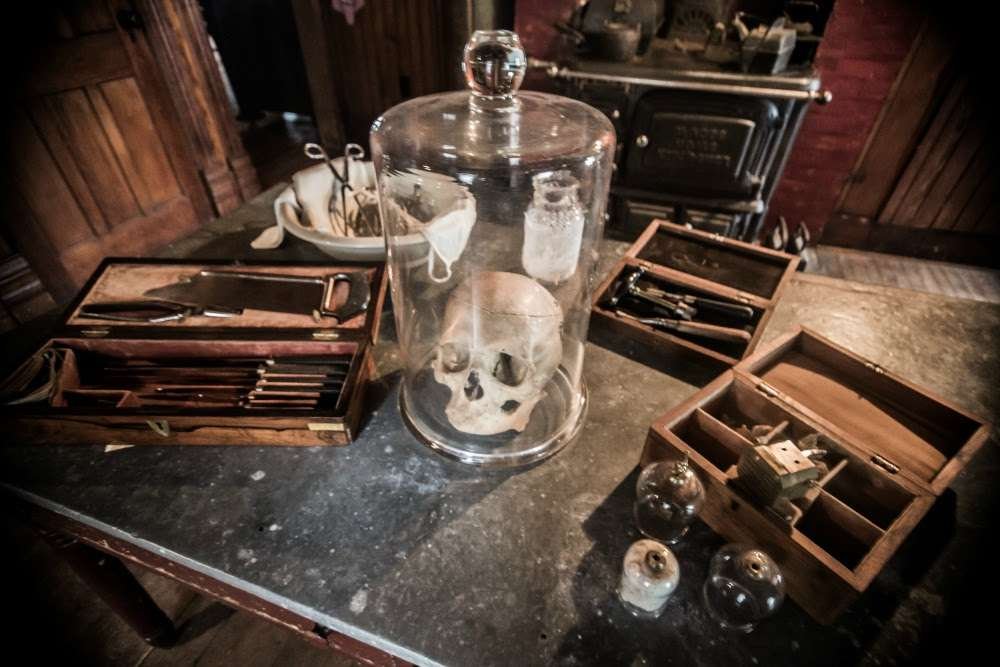
Illustrations, from above: Dr. Best House & Medical Museum on The Haunted History Trail of New York State courtesy AmityPhotos; Portrait of Benjamin Waterhouse by Gilbert Stuart, 1775; Leiden Univeristy’s anatomical theatre, 1610; Arent de Gelder’s “Portrait of Herman Boerhaave,” ca. 1722 (Mauritshuis, The Hague); Harvard’s Botanic Garden in 1873 from the Atlas of the City of Cambridge (G.M. Hopkins & Co., Philadelphia, 1873); and Ernest Board’s “Dr. Jenner Performing His First Vaccination, 1796,” commissioned by Henry S. Wellcome, ca. 1912 (Wellcome Collection).
Recent Comments