
 Picture this: while walking in the woods, a fungal spore lands on your skin, perhaps in a crease at the crook of your elbow.
This particularly infectious fungus invades your body’s systems before busting out all over.
Prior to emerging from your every joint and orifice, the fungus targets your nervous system and hijacks your free will, compelling you to depart the forest floor’s safety for high, exposed branches from which the fungus broadcasts spores to infect your friends and family.
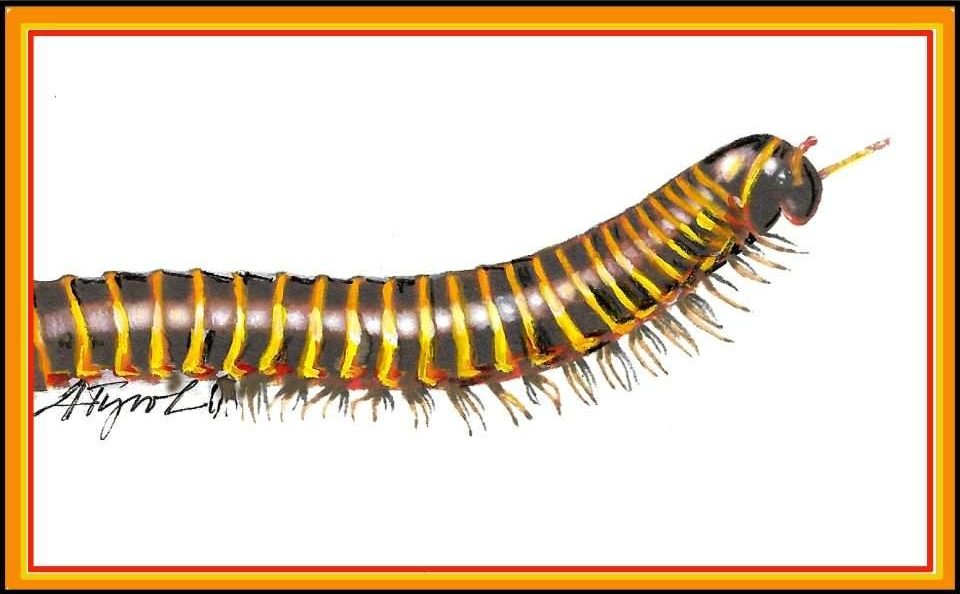
Thankfully, no such fungus infects humans, but in 2017, Professor Kathie Hodge and colleagues at Cornell University described fungi infecting the cherry millipede (Apheloria corrugata) which ranges along the Appalachians west to Oklahoma and Nebraska and northeast to Vermont and Massachusetts.
Millipedes and their faster-moving centipede cousins belong in Myriapoda, a subphylum of arthropods. Millipedes have two pairs of legs per segment while centipedes have one.
Cherry millipedes are flat-backed millipedes (order Polydesmida) and can grow to a hefty (by millipede standards) two inches long.
As their common name suggests, these millipedes are flat on the back surface, distinguishing them from the cylindrical snake millipedes (order Julida).
Arthrophaga myriapodina, the fungus that infects them, translates roughly to mean “joint eater of millipedes.” The fungal infection begins when a spore lands on a millipede and grows internally.
The millipede becomes uncharacteristically bold, abandons its favored leafy food source and habitat, and climbs to an exposed perch above the forest floor where it dies.
The fungus pushes beige pustules out between the millipede’s body segments and forcibly discharges spores that complete the life cycle.
If arthropod zombification by a fungus sounds familiar, it may be because entomopathogenic organisms called “cordyceps fungi” (fungal division Ascomycota) infect insects, including carpenter ants, house flies, and fruit flies.
Infected creatures then behave in ways that favor fungal spread from stalked fruiting bodies to other hosts. These completely unrelated fungi have converged on dramatically similar mind-altering strategies to disperse their tiny zombie-makers.
A paper on fungi-altered house fly behavior was published in 1855, the zombie ant description followed in 1865, and female-mimicking male cicadas under fungal influence were described in 1879.
The cherry millipede infection is surprising in part because it went unnoticed for so long, despite the wide distribution of both species of millipede and fungus.
But Hodge noticed that these millipedes often end up puffy, dead, and in very non-millipede-esque locations, such as fence posts, tree snags, and sunny branches.
If you find one in a similarly surprising location, look for fungus pressing out between and separating body segments.
Eventually, their dried-up husks fall asunder like discarded armor on some macabre medieval battlefield in miniature. Sadly, this grim fate is a common end for these spectacular millipedes.
In studying this fungal infection, Hodge cited millipede specimens from as early as 1886, with additional specimens from herbaria, or plant collections, from the early 1900s; in this second instance, collectors were interested in the fungus, not the millipede.
It is common practice to collect both the fungus and its host to better document fungal biology, so there is evidence of zombified millipedes from more than 100 years ago.
More than just being victims, however, millipedes are tough in their own right. All millipedes in the genus Apheloria are shiny black with bright yellow, orange, or pink markings, signaling danger to would-be predators.
Warning colors are sometimes just bluff and bluster, but the cherry millipede is absolutely not bluffing. It is armed with benzaldehyde and hydrogen cyanide, the scent of which contributes to its common name.
Each millipede’s cyanide content exceeds 30 times the lethal dose for a pigeon-sized bird, although its distasteful nature means that few birds would ever consume one.
It can be a challenge to determine the species of brightly colored and odoriferous millipedes, even with a microscope. Each species has several color morphs, and some closely resemble each other.
More than 50 millipede species across three genera rely on bright colors to communicate the message: “Eat me and you’ll be sick or dead.”
Bright colors, strong smells, and even cyanide, however, are no match for a fungus that lacks eyes, a nose, and apparently eats cyanide for breakfast, lunch, and dinner.
Read More About New York Wildlife
Declan McCabe teaches biology at Saint Michael’s College and is the author of Turning Stones: Discovering the Life of Water. Illustration by Adelaide Murphy Tyrol. The Outside Story is assigned and edited by Northern Woodlands magazine and sponsored by the Wellborn Ecology Fund of New Hampshire Charitable Foundation.
Recent Comments