
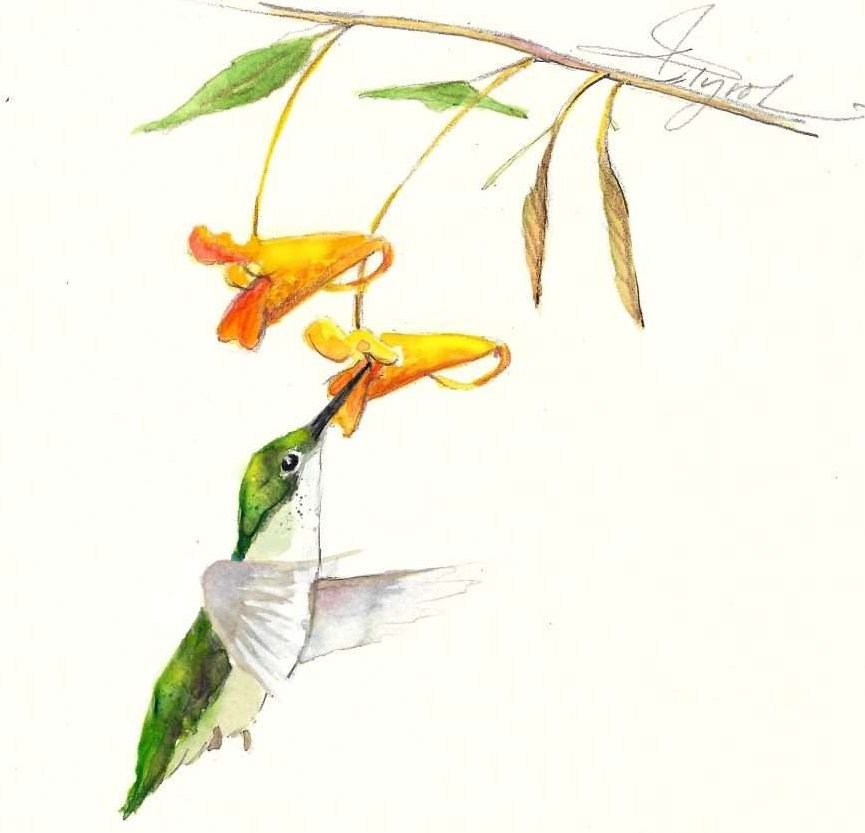
 By midsummer, the deck in our backyard is lined with a profusion of tall orange flowers. Each flower is shaped like a small funnel with a curved spur and hangs from a slender arched stem.
Hummingbirds zip back and forth, hovering in front of the flowers and probing them with their long beaks to sip nectar.
These delicate orange flowers spotted with red-brown are known as jewelweed or spotted touch-me-not (Impatiens capensis). The name jewelweed may refer to the way silvery drops of rain and dew bead up on the bluntly toothed leaves or the way the flowers dangle like earrings.
Jewelweed grows in moist, shady spots in forests, particularly along the edges of streams and wetlands, as well as in disturbed areas, such as roadside ditches. In spring, seeds that have overwintered in the ground sprout.
This annual native plant rapidly grows up to four to five feet tall before it begins to bloom in midsummer. Jewelweed has two types of flowers: open flowers pollinated by insects and hummingbirds and tiny closed flowers near the bases of the leaves that are self-pollinated.
Open flowers benefit the plant by allowing genetic exchange through cross-pollination, but closed flowers take less energy to produce. These often appear in late summer and autumn when there is less sunlight or when the habitat is poor.
Hummingbirds are the most efficient pollinators of jewelweed. In a classic example of co-evolution, scientists believe that jewelweed flowers have evolved their design and high sugar content to attract hummingbirds.
The flowers dangle from long stalks and move with the hummingbird as it inserts its beak and sips nectar with its tongue. Experiments have shown that
the flowers’ movement and the curvature of the nectar spur help to transfer the pollen, daubing it on hummingbirds’ beaks and heads. When the bird visits the next flower, the pollen rubs off onto the female part, fertilizing it.
A 1982 study in Canada found that jewelweed produced more seeds when visited by ruby-throated hummingbirds and insects than when visited by insects alone.
Hummingbirds, in turn, benefit from jewelweed’s long flowering period, which provides crucial late summer nectar when many other plants have finished flowering. Bumblebees are the primary insect pollinators of jewelweed.
However, some bees are nectar thieves; instead of entering the mouth of the flower, they cling to the back and poke a hole in it to access the nectar without pollinating the plant. I have often found little holes in the jewelweed flowers growing around our deck.
Jewelweed flowers mature into green ovate capsules about an inch long. When ripe, they spring open with the slightest touch from a person, animal, or the wind, shooting seeds up to four feet away. Five valves in the walls of the seed capsule coil back to eject the small oval seeds.
This process, known as explosive dehiscence, maximizes the dispersal distance of the seeds. Squeezing ripe jewelweed pods to set off the seeds is a fun activity to do with children.
Another species of jewelweed found in our region is pale jewelweed (Impatiens pallida). It is similar in appearance to I. capensis, except it has yellow flowers instead of orange.
Pale jewelweed also grows in moist, shady areas and along streambanks in forests. It can grow in drier and more calcium-poor habitats than spotted touch-me-not, which prefers moister soils with higher calcium content.
The succulent stems and leaves of jewelweed are consumed by some mammals, including black bears. Birds such as ruffed grouse feed on the large seeds. Amphibians take shelter in moist stands of jewelweed.
Humans have used jewelweed sap from a crushed stem to relieve itching from poison ivy, stinging nettles, and other skin irritations. The sap also has anti-fungal properties and has been used to treat athlete’s foot.
The plant makes a lovely addition to a shade garden, though it can be aggressive. It will maintain itself through reseeding and the flowers will attract hummingbirds and other pollinators to your yard.
Last summer, at least two hummingbirds visited our jewelweed daily into September when they departed for their southbound migration.
Read more about New York’s Native Wildflowers.
Susan Shea is a naturalist, writer, and conservationist based in Vermont. Illustration by Adelaide Murphy Tyrol. The Outside Story is assigned and edited by Northern Woodlands magazine and sponsored by the Wellborn Ecology Fund of New Hampshire Charitable Foundation.
Recent Comments