
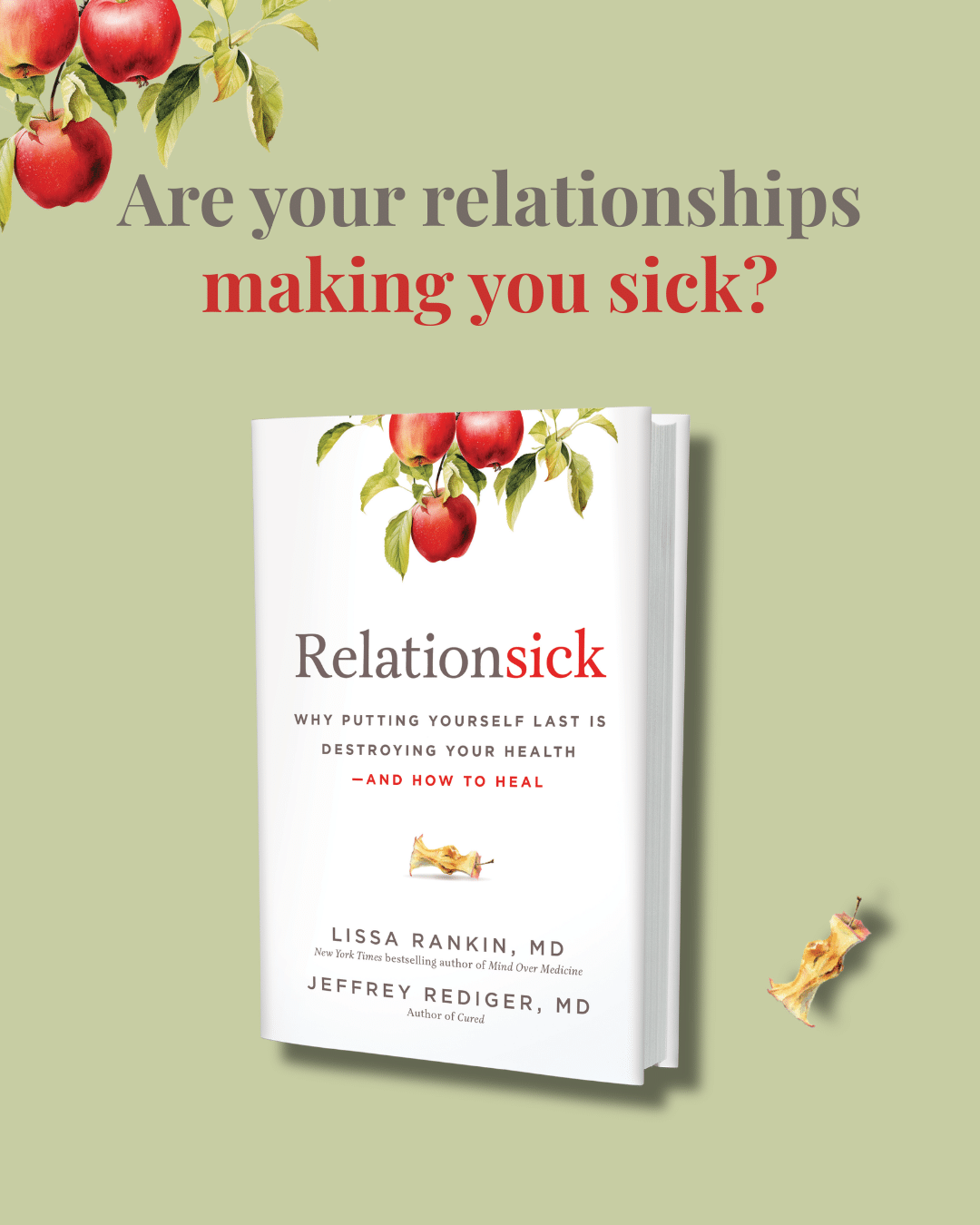
I’ve been writing a lot lately about corruption in the spirituality, wellness, and energy healing spaces, something I figured out about a decade ago, when I quietly shifted my health care and healing work towards more ethical, grounded, and non-bypassing psychotherapy, trauma healing, and trauma-informed medicine spaces. I still have a lot to say about that world, including how I’ve tried to both distance myself and continue to contribute to ways of approaching illness through the lens of trauma, relationships, and what it takes to live a life that allows you to optimize your health outcome, given your genes, your lifestyle, your unique makeup, and your health habits.
Since many of you are new to my work here, I wanted to give you a little back story to help you understand how I went from an academically-trained conventional OB/GYN physician to an integrative medicine doctor to a full time writer, online educator, workshop leader, and community space holder for healing, transformation, trauma recovery, and disease prevention and treatment.
Why Were Health Nuts In Marin County So Damn Sick?
When I first started my integrative women’s health practice in tony Marin County, I was struck with how my patients should have been the healthiest people on the planet, and yet, they were burdened with many chronic illnesses, often at a very young age. They were doing everything right—eating organic vegetables, drinking green juice, working out with personal trainers, avoiding bad habits, taking yoga classes, meditating, and taking handfuls of carefully curated herbs and supplements. They had seen the best doctors at elite academic centers, along with naturopaths, acupuncturists, herbalists, and energy healers. And yet, their medical charts were thick with diagnoses like fibromyalgia, chronic fatigue syndrome, chronic pelvic pain, chronic Lyme, autoimmune disorders, dermatologic conditions, neurological symptoms like migraines, irritable bowel syndrome, and other mysterious, hard to treat syndromes that did not respond to even the most cutting edge care.
At first, I did what I had been trained to do. I ran more tests, optimized hormones, adjusted supplements, refined diets, referred to specialists. I kept searching for the missing biochemical puzzle piece that would explain why these women were not getting better. Then I had a medicine dream, the kind the shamans talk about, and it gave me a clue to what I hadn’t tried yet. Acting on a hunch, I went back to the drawing board and revamped my intake form. I started asking different kinds of questions, not just medical and family history, but questions like:
What would it take for you to live a life your body will love?
What do you need in order to finally heal?
What is the real diagnosis underlying your health problem that you already know but won’t let yourself say out loud?
What intervention that you’re too scared to take might help your symptoms go away?
If there’s a relationship that’s making you sick, tell me more…
The common denominator among many patients was one factor: they were giving too much to another adult who was not giving enough in return.
The narcissistic workaholic spouse.
The controlling, demanding, hypercritical mother-in-law.
The intrusive, invasive, boundary-violating sibling.
The tyrannical “Devil Wears Prada” boss.
The elder parent who had abused them throughout childhood and now was demanding to be cared for in old age.
They were The Giving Tree, offering up their apples, branches, and trunk to entitled people who had no problem taking without adequate reciprocity, and their nervous systems and bodies were paying the price. One of the most heartbreaking aspects of what I witnessed was how many of these women blamed themselves for not getting better. They believed they were not trying hard enough, not thinking positively enough, not following protocols strictly enough, not strict enough in their raw, vegan diet, not meditating deeply enough. They doubled down on self improvement while remaining in relational environments that continued to dysregulate them.
In other words, they were trying to heal in the very conditions that were contributing to their illness, but no drug, diet, exercise regimen, or supplement protocol could overcompensate for the chronic nervous system dysregulation, immune system damage, chronic inflammation, and epigenetic influences caused by chronic over-giving and relational trauma.
The Selfish Bitch Project
Harvard psychiatrist Jeffrey Rediger observed the same phenomenon when he spent 17 years studying people who were cured from “incurable” medical conditions, wondering what they’d done and what changes they attributed their radical remissions to. Time and time again, when faced with their own mortality, the gravity of their situations would jump start some spark of life force inside them, and they’d finally stop giving to depletion and start prioritizing their own health, their own life force, their own needs.
One of them called it her “Selfish Bitch Project,” not because she became cruel or uncaring, but because she stopped betraying herself in order to maintain relationships that were making her sick. She began saying no when her body couldn’t afford to keep paying the price of admission to those kinds of relationships. She began telling the truth when silence had been her habit—choosing herself, not from self-absorption, but from a fierce commitment to staying alive and reclaiming her vitality.
Many women like her didn’t have language for it, but when Jeff and I started labelling this pattern as “relationsickness,” and when we started prescribing a Selfish Bitch Project, many of them knew exactly what we were talking about, without us needing to explain it. While writing the book, collecting case studies of patients we’ve worked with and explaining not only the science behind how this happens but also the relational recovery tools that can help people heal, I discovered that talking about this book led to surprising reactions from total strangers.
Some Men Need Selfish Bitch Projects Too
I was making myself a coffee at a co-working space I’d joined, when a young man in his late twenties asked how my day was going. I told him I was making progress, finishing up a book called Relationsick about the health implications of narcissistic abuse. Right away, his eyes filled with tears, so we took our coffees to a sofa in a quiet place, and he told me his story. He’d just been released from Stanford Hospital after being there for two weeks.
He’d gotten sick right after he declared bankruptcy because his yoga teacher girlfriend had been loading up his credit cards with luxuries she demanded but that he couldn’t afford. Faced with caring for him during a health crisis, and in the wake of his financial disaster, she bailed on him and hooked up with his boss, who then fired him for missing work because he was in the ICU. When he’d called her in a panic, begging her to reconsider, she called him a loser and refused to come visit him, mocking him and telling him he should call him Mommy.
He had to pause, to cry, in the retelling of this part of the story. He’d felt so humiliated, confused, bewildered, abandoned. Prior to the onset of his symptoms, he’d been running on the hamster wheel, trying to please her ever-increasing demands for more status, more luxury goods, more earning potential, more hobnobbing with rich and powerful people, more attention to serving her every need. As a UC-Berkeley trained engineer, he’d been working at a mid level position in a Silicon Valley biotech startup and had a promising future ahead of him. But she wanted him to maximize his potential immediately and threatened to find someone more suitable if he didn’t have the discipline, work ethic, and drive to succeed that she required in a man she’d consider for marriage, family, and future happiness.
All that forced ambitious striving and lack of kindness and relational reciprocity left his immune system shot, and he’d collapsed into septic shock over a tooth infection that should have been easily treated by any good dentist, if he’d let himself slow down long enough, if he’d prioritized his own needs attentively enough to get his tooth fixed. He felt embarrassed that he’d let himself get pulled so off center by a woman who didn’t even care enough to support him through his health crisis. On top of all that, he’d just lost his health insurance because his girlfriend’s new lover, his boss, had fired him, seeing him as a threat to his new love affair. He was going to have to file an unlawful termination lawsuit to fight for his rights, but he wasn’t sure he had it in him. He admitted to thinking about suicide but didn’t want to hurt his family, who lived on the East Coast and who he’d become estranged from because his girlfriend made him choose between her and them. He felt ashamed that he’d made the wrong choice and didn’t want to go crawling back to them with his tail between his legs, but he needed help.
After all this spilled out of him, he apologized for monopolizing my time when I was on a book deadline, but I told him it was actually helping me, validating the pattern Jeff and I had observed over and over. I told him it might be high time for his own version of the Selfish Bitch Project, and he liked that invitation, the idea that we could add a dash of humor to a heaping helping of self care, self love, self protection. He saw it as a welcome permission slip to say no to and set boundaries with selfish people who were using him, exploiting him, hanging their star to his and pushing him to achieve something he didn’t even care that much about.
We hugged and my heart went out to him. He said he felt like I was an answer to prayer, a gift from the Universe dropped out of the sky to deliver a framework for what had just happened to him in a way that felt like a relief, even though it was painful to face the harsh reality of how delusional he was in that toxic relationship with someone he was convinced really loved him, when she’d actually been using him to climb the status ladder for herself. I told him to look up researcher Jennifer Freyd and “betrayal blindness” if and when he felt like he wanted to understand more. I didn’t give him any resources to learn the psychoeducation of narcissistic abuse, not quite yet. I trust that he’ll find his way, or maybe he’ll read Relationsick one of these days. (Please preorder it here if this resonates or if you want to help give Relationsick a jump start! We have special bonuses to incentivize preorders.)
The whole thing felt like one of those Love 2.0 moments that researcher Barbara Fredrickson studies, about the micro-moments of positivity and heart connection we can experience with strangers we may never see again, and how those moments can be nourishing to everyone involved.
When We Give So Much, We Assume We’re Earning Loyalty…But Maybe Not
I’d seen it before—the over-functioning codependent who assumes that, at the very least, the people we’re pretzeling ourselves to please will be there for us, should we ever need help. But way too often, the other person’s loyalty is to money, power, status, fun, luxury, ease—not the person who’s killing themselves to please them. I saw it especially in spiritual circles, where illness was perceived as some sort of spiritual failure, as if their “low vibe” sickness might be contagious, even when it’s not an infectious disease. One of my friends lived in an intentional community and had committed herself to a life of serving other community members…until she got sick and could no longer be productive.
When I went to the hospital to visit her, she said that not one of the people in her intentional community had visited her, sent cards or flowers, or even called her on the telephone. Instead, she felt shunned, as if she’d suddenly put a wrench in their toxic positivity and they were afraid they were going to manifest getting sick if they put themselves anywhere near a hospital. All that service, all those “friends”…out the window the minute she actually needed something in return.
I remember meeting one woman at a Mind Over Medicine workshop I was leading at a retreat center, who was diagnosed with stage four cancer, and yet, after years of giving too much to dozens of people at her church, in her family, and in her workplace, found herself driving herself to chemo and getting abandoned by her husband. These folks often fail to realize, until it’s too late and they’re relationsick, that their relationships are one-way transactions that are as fragile as a gossamer spider’s tendril in a hurricane. As long as the giver is fulfilling expectations, giving to depletion, to the benefit of the receiver, the relationship looks stable, even though it doesn’t feel good to the over-giver.
But as soon as the giver has legitimate needs, as soon as the receiver is expected to caregive in return, they’ll drop the giver like a hot potato, like they’re poisonous, with a level of callousness that leaves the giver stunned and in denial, kicking up wounded inner child parts that feel like they’re disgusting, soiled toilet tissue that’s just been thrown away with a wrinkled nose.
Empaths Are At Higher Risk Of Relationsickness
Many of the most conscientious, empathic, generous people are the ones most at risk. We are the ones who can feel others so acutely that we override our own signals. We are the healers, the therapists, the mothers, the non-profit volunteers, the ones who were often trained, explicitly or implicitly, to prioritize harmony over authenticity, attachment over truth, and caregiving over healthy boundaries and self care. We become exquisitely skilled at fawning—anticipating needs, smoothing over conflict, and maintaining connection at any cost.
But the body keeps an honest ledger, and it doesn’t give extra credit points for good intentions.
When there is a chronic mismatch between what is true and what is expressed, between what is needed and what is given, between what feels safe and what is endured, the nervous system begins to register that something is wrong. Over time, that signal does not stay confined to the realm of emotion. It becomes physiology. Inflammation rises. Hormones become dysregulated. The immune system becomes confused. The gut becomes reactive. Sleep becomes elusive. Pain takes up residence in muscles and joints. Fatigue settles into the bones. Natural self-repair mechanisms go offline. The body becomes the spokesperson for a life that is out of alignment, incongruent, out of balance.
Relationsickness is what happens when the cost of staying in certain relationships exceeds the body’s capacity to compensate. Pointing out this pattern is not about blaming sick people for their suffering, and it is not about pathologizing every difficult relationship. It’s also not an explanation for every kind of illness. Some are genetic. Some are because you’re living next to a toxic waste dump. Some are the result of poor health habits or a diet that fails to nourish.
But we see it too often to ignore how patterns of over-giving, chronic depletion, invalidation, and boundary erosion take a measurable toll on health over time. This is meant to be empowering, not ableist, hope-inducing and relief-generating rather than retraumatizing. But in my experience clinically, it can also be too hard to face, too destabilizing, too impactful, so much easier to just hope for a pill to make it all go away.
What Does Your Body Need In Order To Heal?
When I began gently reflecting these patterns back to my patients, there was often a moment of recognition that was both relieving and terrifying. Relieving because it named something they had long sensed but could not quite articulate. Terrifying because it implied that healing might require changes that felt risky, destabilizing, or even unthinkable.
Leaving a marriage.
Setting limits with a parent.
Confronting a sibling.
Changing careers.
Saying no to someone who is accustomed to an easy yes.
Standing up for yourself instead of going along to get along.
These are not small interventions. They are seismic shifts. And yet, for many, nothing else had worked.
In both my practice and Jeff’s, we witnessed individuals begin to experiment, not always with drastic ultimatums, but with small acts of truth. A boundary here, a confrontational conversation there, a slight pause before saying yes, a willingness to disappoint someone else in order to stop disappointing ourselves, the courage to say “ouch” and hold someone accountable when they get defensive or pull DARVO (Deny, Attack, Reverse Victim & Offender.) Way too often, the other person’s outsized reaction to a very quiet and reasonable “no” brought the truth that had been too hard to face to a head.
Many of these people were deeply afraid of what would happen if they stopped overgiving—sometimes for good reason, and other times, because of what had happened in the past but might not happen in present time. There were parts that believed love had to be earned through sacrifice, parts that feared abandonment, rejection, or retaliation, parts that equated healthy boundaries with selfishness or danger, parts that didn’t believe they were worthy of love or attractive to anyone unless they were over-giving.
These parts needed care, not coercion, patience rather than pushing.
The Healing Arc Of Relationsickness
Not always, but often enough that it caught my attention and Jeff’s, these shifts resulted in symptom improvement or even laboratory, radiological, or vital sign evidence of recovery or even full remission. These were not miraculous, overnight cures, although occasionally those did happen, but more often, the changes were slow and steady. Sleep improved. Pain decreased. Energy returned. Flares became less frequent. There was a sense of coming back into oneself, of inhabiting a body that no longer felt like an adversary.
Every journey is unique, so there’s no proven path, but we did our best to lay out a recovery map in our upcoming book Relationsick: How Putting Yourself Last Is Destroying Your Health—And How To Heal. If you preorder now, you can join us for our book launch party, get free months of LOVE SCHOOL, or even bring us to your neck of the woods for an in person event.
Preorder or learn more about your bonus options here.
The framework we introduce in Relationsick is an invitation to widen the lens of healing. It asks us to look not only at drugs, surgeries, diet, exercise, spiritual practices, and supplements, but also at boundaries, truth telling, attachment patterns, accountability, relational repair, and the capacity to create relational safety. Many people who find ourselves in chronically dysregulating relationships are not there by accident. We carry attachment wounds, often from early life, that shape what feels familiar and even what feels like love. We may have learned to equate self sacrifice with worthiness, or to seek approval in ways that override our own needs.
Healing from relationsickness is not about abandoning medical care or ignoring holistic health habits; it’s about integrating them with a deeper understanding of the relational context in which health or illness unfolds. It’s about recognizing that we cannot fully heal in isolation from the environments that shape our daily experience. It’s also about reclaiming a truth that has been overlooked in modern medicine, which is that love, safety, and authentic connection are not luxuries. They are biological necessities.
If you recognize yourself in this pattern, you are not alone. And you are not imagining the impact your relationships may be having on your health. Your body is not betraying you. It is communicating with you. The question becomes whether you are willing to listen, and what you might discover if you do.
That truth can be disruptive. It can challenge long held beliefs about loyalty, love, and identity. But it can also be liberating. Because when we begin to align our lives with what our bodies have been trying to tell us all along, healing is no longer something we have to force. It becomes something we allow.
To comment, please join the conversation on Substack here.
*For deeper support, join us for LOVE SCHOOL every other Monday. Learn more and register here.
Recent Comments