
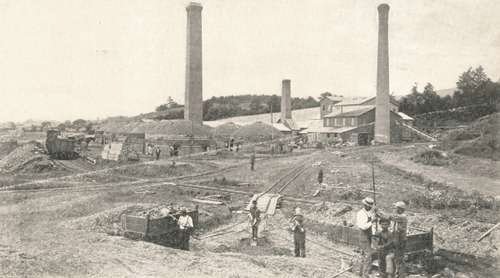
 When Holyoke, Massachusetts investors sought New York State’s permission to build a large power dam and paper mill in Mechanicville, in eastern Saratoga County, NY, in 1882, one thing they knew they would need was tons of bricks.
Brickmaking was among the oldest trades in America, almost as widely distributed as town-building. But certain places blessed with superior clays, inexpensive fuel supplies, and shipping facilities to nearby markets became centers for the brick industry.
Mechanicville was one such area where all of these factors came into play.
When Horace Medbury opened the first kiln there in 1883, he intended the facility to serve only temporarily as a source of supply for the nine pulp mills, boiler houses, and store houses of the Hudson River Water Power and Paper Company, which would be centered around the company’s newly built power dam.
Medbury oversaw forty men who turned out 40,000 bricks a day before operations were discontinued. However, the firing of the first kilns made obvious the abundance of clay and lime in the area and, combined with canal and rail connections to large market areas, it wasn’t long before other, more permanent yards began to tap the potential demonstrated by Medbury.
In 1886, the Mechanicville Brick Company won the contract to supply the building of the New York City Aqueduct with 12 million bricks.
To say that this was an early example of venture capitalism would be an understatement: the company was not even incorporated until Much 2, 1887, almost a year after its first contract was awarded.
The trustees included Massachusetts investors as well as Oscar Warner and A.J. Harvey, a Mechanicville lawyer and banker, respectively.
In 1890, the firm opened a second yard when it won the contract to supply the new Edison Company of Schenectady with 5 million bricks. A third yard would be created by the firm in 1895.
[In 1886, inventor Thomas Edison relocated his Edison Machine Works manufacturing facility from Manhattan to Schenectady to escape high land prices and labor costs. Edison purchased a 10-acre property with two vacant, uncompleted factory buildings originally built for the McQueen Locomotive Works in June 1886. Production began that October with 300 employees.]
[Edison Machine Works merged with Edison’s other companies to create Edison General Electric in 1889, and in 1892 that company merged with rival Thomson-Houston Electric Company to form the General Electric Company (GE), with its global headquarters at the Schenectady site.]
Other local investors, thinking they knew a good thing when they saw it, formed the Best Brick Company in 1894, and like its predecessor, it expanded its capacity within a few years.
By the turn of the century, the Hudson Valley had become the center of the brick industry, with Mechanicville one of the leading production sites.
Within a decade, six new companies (the Cory, Halfmoon, Stuyvesant, Hudson Valley, and Duffney firms) opened kilns, taking advantage of the demand for building and paving bricks in New York, Boston, and other population centers easily accessible because of Mechanicville’s rail and canal connections.
Capitalization of these ventures ranged widely from $10 to $100 thousand, revealing the speculative nature of some of the firms.
Raw materials were inexpensive, and the availability of cheap immigrant labor made start-up costs attractive. However, as often happens in a rapidly expanding industry, competition invites consolidation, and by 1900, the so-called “New England Brick Trust” swooped in and bought out all local concerns, save the Champlain Brick Company yard.
 [Organized by William H. Duffney the Champlain Brick Company plant in Mechanicville began operating in the spring of 1897. It utilized modern machinery from the Potts Company and quickly doubled its production capacity to 85,000 bricks per day due to soaring demand.]
The New England Company, headquartered in Boston, controlled thirty-four yards throughout the northeast, but it bit off more than it could chew and went into receivership in 1904.
Mechanicville Mercury editor Farrington Mead, ever sensitive to local control issues, blamed the bankruptcy on the loss of hometown supervision of the yards as employment at area kilns declined from 500 to less than 100 men by 1905.
The industry was subject to the ups and downs of building booms and busts throughout the Northeast, and the demand for common red building and yellow paving bricks fluctuated wildly at times.
When things were booming, profits could be huge for investors; workers’ annual wages averaged only $251 per year, a low figure even for the standards of the day. But, “value added,” that is, the ratio of profits to costs, was five to one, much higher than that of most industries.
In the expansive era prior to World War I, Mead estimated that 900 to 1,100 workers were employed making bricks at Mechanicville, a number equal to nearly 10% of the industry’s entire statewide labor force according to census reports.
What gave the industry a unique character was its workforce, almost all of whom were Italian immigrants. Because of the area’s long winters, brickyards were open at most ten months a year, sometimes as few as six.
The area around Naples, Italy, was economically devastated in the late 19th and early 20th centuries, causing potential workers to look far afield for employment, even while they were reluctant to leave their homeland permanently.
Many of these men migrated for part of each year to places like Mechanicville, returning home each winter as “birds of passage.” The wives they left behind were often referred to as “white widows,” women whose husbands were absent for most, but not all of the year.
Locally, this phenomenon was so regularized that round-trip passages between Mechanicville and Naples could be purchased every day from local banker A.J. Harvey, or from immigrant banker Joseph della Vigna.
 Each of these men was heavily involved in the brick industry. Harvey had helped found the first local yard in 1886, while Della Vigna (also known as Joseph Vett) attempted to keep the lagging industry going in the 1920s by organizing the Mohawk Brick Company with fellow immigrant investors.
The availability of cheap fuels for firing brick, new clay deposits, and inexpensive transportation in the West however, encouraged the migration of the industry away from the Northeast after the end of First World War in 1918.
Vett’s attempt to revive the industry in Mechanicville in 1922 wound-up toppling not only the Mohawk firm, but also the immigrant bank which financed the company. The brickyard declared bankruptcy in 1924, while the assets of the Banco delta Vigna were attached by the state and finally liquidated by the Banking Commissioner in 1928.
By that time, even though 300 local workmen still listed their employment as “brickmaker,” this was less than one-third the number so employed at the industry’s peak in 1910-11.
The onset of the Great Depression in the 1930s marked the end of the industry for all practical purposes.
Today, there are few vestiges of this once flourishing industry other than one of the original yards of the Champlain Brick Company opened in 1897, and a water pipe connecting the city water mains with the old Ferris-Duffney yards dating back to the beginning of this century.
Read more about Italian Americans, or Mechanicville, or New York’s Brickmaking Industry.
A version of the this essay was first published by the late Mechanicville City Historian Dr. Paul Loatman, Jr. It has been lightly edited for clarity and annotated by John Warren.
Illustrations: Two Mechanicville brick yards, ca. 1880-192, and Champlain Brick Company bricks.
Recent Comments