
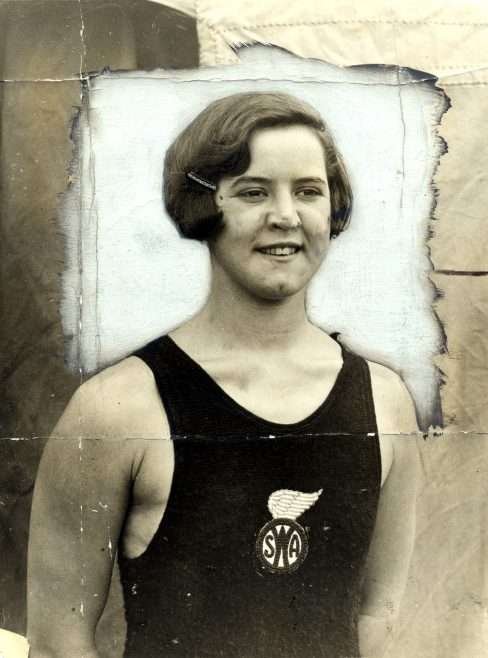
 Gertrude Ederle led a long and amazing life. Born in New York City in 1905 to German immigrant parents who ran an Upper West Side butcher shop, Ederle became an Olympic swimming champion at age 19 in 1924, and in August 1926, a century ago this month, became the first woman – and the fifth person – to successfully swim the English Channel.
Henry Ederle promised his daughter a red roadster if she did it, and in a companion boat he and Trudy’s sister shouted reminders about the car as encouragement on the turbulent route from France to England.
At the behest of New York Mayor Jimmy Walker, her hometown soon honored Ederle with a ticker tape parade attended by an estimated two million delirious Gothamites. “City Booms Welcome to ‘Trudy’” blared The Brooklyn Citizen.
Grover Whelan, longtime chair of the city’s reception committee, recalled that “After the official ceremony Mayor Walker escorted Trudy to the front steps of City Hall in response to the request of the press for a picture.
“They did not tarry there long, however. A tidal wave of citizenry burst upon them. One burly patrolman rushed to Trudy’s rescue, lifted her bodily, and carried her back inside City Hall.
“Two other policemen ran interference for the slim Mayor, one on either side of him, and finally got him back into the building.”
 Trudy’s record for speediest women’s channel swim, at 14½ hours, stood for a quarter century. But the adored national hero drew a different kind of speed-focused attention less than two years after her ticker-tape triumph.
In February 1929, hurrying to a doctor’s appointment, presumably in her bright red Buick roadster, she was ticketed for going 35 miles an hour on Riverside Drive, at a time when city speed limits were generally 15 miles an hour.
The problem? The “Queen of the Waves” failed three times to appear in court to answer the summons, resulting in issuance of a warrant.
According to the contemporary New York Times account, Trudy explained in traffic court that she knew nothing of the warrant, learning of it only when she read about it in the newspaper the previous evening at a friend’s Highlands, Jersey Shore home, where she was recuperating from an illness.
According to the Times, she told Magistrate Abraham Rosenbluth that “traffic had been light at the time, her speedometer had not registered the thirty-five miles an hour and that she had been in a hurry to see her physician… She added that her hearing had been defective since she swam the Channel.”
Stature apparently outweighed excuses, and Rosenbluth issued a suspended sentence, due to “your plea of guilty and because you did so much for your country.” The Times reported that the courtroom erupted in applause, though a court attendant was forced to shout at Trudy to make her understand the judge’s decision.
Just months later, the nautical and land-based speedster was in trouble again. This time, she was cited for traveling 50 on Riverside Drive. Her attorney, saying Trudy was “indisposed” at her Bronx home, entered a guilty plea on her behalf, resulting in a fine of $50 (about $970 in 2026).
 Gertrude Ederle toured the vaudeville circuit, including a stint in Billy Rose’s Aquacade, a swimming, dance, and music show, but health issues continued to dog her. A 1933 fall down the steps of her apartment building resulted in a twisted spine, leaving her
bedridden for several years.
Poor hearing remained an issue stemming in part from swimming and childhood measles, and by the 1940s, she was mostly deaf. Trudy spent decades as a swimming instructor for deaf children, and in 1975 dedicated a park in her own name in Highlands, where she had summered since youth.
Never marrying, Gertrude Ederle lived to age 98, dying in 2003. In 2013, a newly expanded recreation center on Manhattan’s Upper West Side, featuring an indoor pool, was named in her honor.
The center is just two blocks from the site of her former doctor’s office, the destination she’d been rushing toward 84 years earlier.
Read more stories about New York History.
Illustrations, from above: Gertrude Ederle in 1925; a signed 1931 portrait of Trudy Ederle given to a Dr. Clarence C. Rice; (Museum of the City of New York); and Ederle and Bebe Daniels in a poster for the Paramount film Swim Girl, Swim (1927).
Recent Comments