
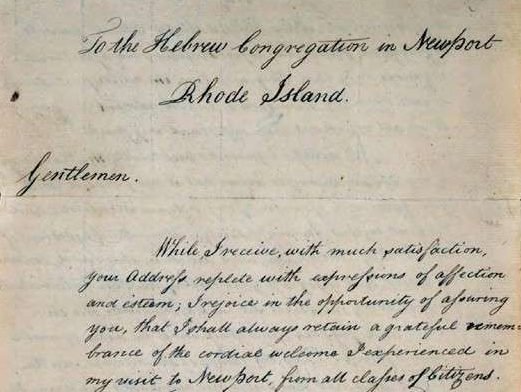
 On August 21, 1790, President George Washington composed a letter to the Hebrew Congregation of Newport, Rhode Island, and to its leader, Moses Seixas (1744–1809). Seixas had written a letter to Washington four days earlier.
Washington responded with the brief letter below, expressing America’s enduring commitment to the principle of tolerance and the freedom of conscience.
In Seixas’ letter he described the benefits that his community received under the new Constitution and expressed his “deep sense of gratitude to the Almighty” for “a Government… erected by the Majesty of the People,” committed to the “liberty of conscience,” and “deeming every one, of whatever Nation, tongue, or language equal parts of the great governmental Machine.”
Washington, who was inaugurated on the balcony of Federal Hall in New York City on April 30, 1789, responded as follows:
Gentlemen.
While I receive, with much satisfaction, your Address replete with expressions of affection and esteem; I rejoice in the opportunity of assuring you, that I shall always retain a grateful remembrance of the cordial welcome I experienced in my visit to Newport, from all classes of Citizens.
The reflection on the days of difficulty and danger which are past is rendered the more sweet, from a consciousness that they are succeeded by days of uncommon prosperity and security.
If we have wisdom to make the best use of the advantages with which we are now favored, we cannot fail, under the just administration of a good Government, to become a great and a happy people.
The Citizens of the United States of America have a right to applaud themselves for having given to mankind examples of an enlarged and liberal policy: a policy worthy of imitation. All possess alike liberty of conscience and immunities of citizenship.
It is now no more that toleration is spoken of, as if it was by the indulgence of one class of people, that another enjoyed the exercise of their inherent natural rights.
For happily the Government of the United States, which gives to bigotry no sanction, to persecution no assistance, requires only that they who live under its protection should demean themselves as good citizens, in giving it on all occasions their effectual support.
It would be inconsistent with the frankness of my character not to avow that I am pleased with your favorable opinion of my Administration, and fervent wishes for my felicity.
May the Children of the Stock of Abraham, who dwell in this land, continue to merit and enjoy the good will of the other Inhabitants; while every one shall sit in safety under his own vine and figtree, and there shall be none to make him afraid.
May the father of all mercies scatter light and not darkness in our paths, and make us all in our several vocations useful here, and in his own due time and way everlastingly happy.
Go: Washington
The First Amendment to the United States Constitution, adopted on a little over a year later on December 15, 1791, prevents Congress from making laws respecting an establishment of religion; prohibiting the free exercise of religion; or abridging the freedom of speech, the freedom of the press, the freedom of peaceable assembly and the right to petition the government for redress of grievances.
You can read more about the this exchange at the website of the George Washington Institute of Religious Freedom.
Read more about Jewish History in New York State.
Recent Comments