
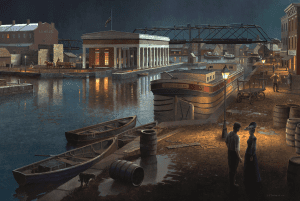
 The NYS Department of Transportation (DOT) has granted a permit for an archeological excavation to confirm the location of historic Lock One of the Erie Canal in Albany’s downtown Warehouse District.
This according to a recent message to supporters of The Albany Waterway’s project to uncover the old lock, buried for a century, and transform the site. The lock was once connected to a boat basin, an associated weigh lock, and the Hudson River.
The dig will be in a green space between the Modern Press offices and the river, adjacent to Water Street. “Our goal is to confirm magnetic imaging which located portions of the original lock,” BJ Costello wrote to Albany Waterway supporters.
A SUNY Poly Archaeological Field School led by research professor in anthropology Denis Foley and assistant professor of civil engineering F. Andrew Wolfe, both of Union College, will conduct current archaeological excavation.
Albany Waterway is covering the cost of equipment, scholarships for participating students and a professional archeologist, Costello said. They expect the work will begin around August 3, 2026, and continue for the month.
 A large adjacent billboard will display content by Albany historic artist Len Tantillo. A news conference, tours and signage are planned according to Costello. A fence will surround the dig which will feature illustrations to educate the public about this site.
In 2003 Wolfe and Foley excavated an area adjacent to the Modern Press building, located near the former Central Warehouse building. They discovered that a portion of the building was located on a small section of the former Lock One.
When The Albany Waterway, Inc. was formed in April 2022 they oversaw magnetic imaging to locate the lock, boat basin and former weigh lock.
Now the archeological effort is seeking to excavate the Water Street site to determine other aspects of the Lock’s granite structure and its level of preservation. Costello said the dig would would be documented with an eye to a future short film about the site.
Public Support & Timing Good
We continue to generate much public excitement for our vision,” Costello told supporters, writing:
“During June we appeared before significant groups focusing on the need to implement our vision, beginning with historic Lock One. Individuals are informed that Albany was once the ninth largest city in America. This was mainly due to its historic significance (often forgotten), waterfront and Lock One, generating travel on the Erie Canal, a pivot point for our capital City, and earning New York the title of Empire State.”
“Some even remember stories of the lumber district, the Albany Basin and the Albany Yacht Club where thousands gathered on its man-made island (just east of the SUNY Building) to enjoy the Hudson River or board the Day Liners for a trip to New York City,” he wrote. “These are now all gone due to I-787 which erased so much of the history that made Albany great!”
The organization has studied the old Erie Canal lock location using a grant from Albany County. The project has also been included in a recent DOT study laying out three options for development in downtown Albany.
It was also positively highlighted in Governor Kathy Hochul’s Downtown Albany Strategy, a revitalization plan that is part of the $400 million Championing Albany’s Potential (CAP) Initiative.
The Strategy’s plans for a Warehouse District Gateway include a Lock One boat basin project, and redevelopment of the site of the long-abandoned Central Warehouse. That building, built by the New York Central Railroad in 1927, is set to be torn down.
The plan has generated much enthusiasm from city, county and state elected leaders and from the press organizers say, noting that the demolition of Central Warehouse makes the timing especially good for the project.
 Eminent Domain & Canalside
One remaining obstacle is that while some of land over the lock and boat basin is publicly owned, some is not, according to Costello.
“We understand that there have been negotiations to secure private land, but these have faltered, despite offers of payment and relocation of the business,” he said.
“We have requested that negotiations continue in good faith but, failing to reach agreement, eminent domain be employed to secure rights to this land to realize the public benefit of uncovering the lock and developing the surrounding area.”
Eminent domain is a legal process providing ostensibly fair compensation, by agreement or by court order, to the landowner.
In Buffalo, there is a similarly-acquired western terminus of the Erie Canal, now known as Canalside, most recently the location of several events surrounding the Seneca Chief, a replica of the canal boat that officially opened the Erie Canal in 1825.
Transforming the Buffalo lock and basin site to Canalside has resulted in retail, jobs, and housing opportunities, providing millions in public revenues and attracting thousands of tourists annually.
“This is a test of whether Albany can deliver something real, on purpose and for the people who live here,” Costello said about Albany’s version.
“We are not asking people to believe in a dream but asking to understand that this is a belief worth building as a regional asset, a visible win without years of disruption and a certain return on the investment.
“This is a sequenced infrastructure strategy that begins with a real documented historic asset – historic Lock One – and uses it as a bounded test case for reconnecting downtown, improving safety and walkability and anchoring future decisions with evidence rather than renderings.”
A Call To Action
Costello thanked supporters for their efforts so far and made a call to more action:
“It is critical that you assist now by writing to public elected leaders, urging them to acquire this relevant land by agreement, or if
necessary, by eminent domain.”
You can learn more about the overall Albany Waterway project, support their efforts and find ways to answer their call to action at their website, albanywaterway.org
Read More About Albany History.
Illustrations, from above: Len F. Tantillo’s “The Weighlock, Albany, NY, 1880,” 2024; The Entrance of the Erie Canal, from the Hudson River, at Albany, N.Y.” from Frank Leslie’s Illustrated Newspaper, 1856. Depicting the first lock, at the head of the Erie Canal. Lumber can be seen stacked at either side of the entrance to the lock; and the Lock One Albany Basin Historical Marker.
Recent Comments