
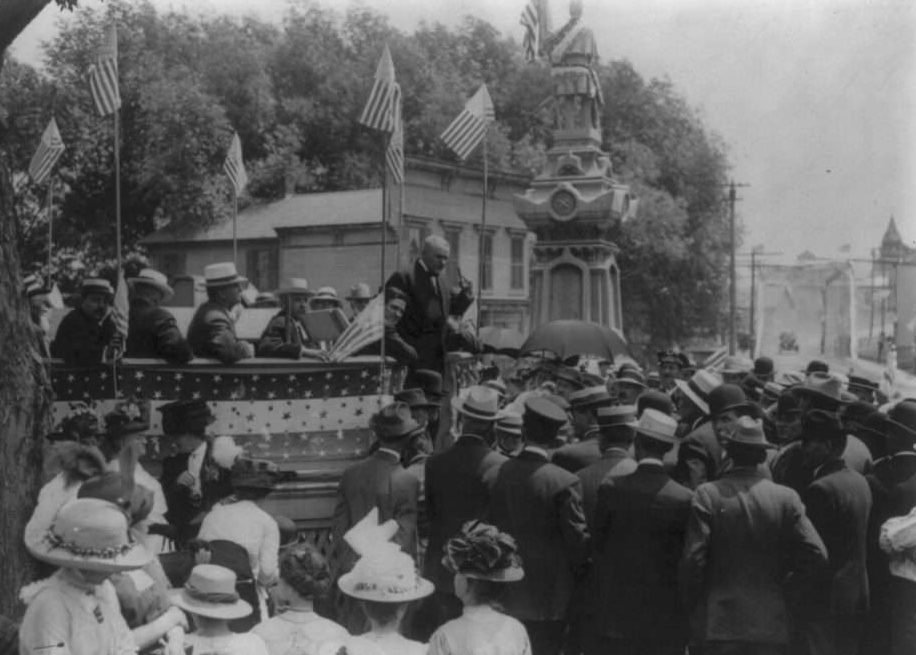
 New York State was a leader in progressive reform in the 1900-1920 period, enacting a broad array of measures to abolish child labor, improve factory working conditions, regulate business, and advance public health.
Theodore Roosevelt, governor in 1899-1901, went on to lead progressive reform as US President in 1901-1909.
New York’s progressives are well documented in history books. But at the same time, and much less well known, there were also important conservative voices in New York. They concentrated on opposing or trying to slow down reform and asserting that government’s intrusive policies were undermining personal liberties.
One conservative was William Barnes, Jr. (1866-1930), longtime Albany Republican leader and state party chairman, 1911-1914. Another was Charles F. Murphy (1858-1924), a political boss of the powerful New York City Democratic organization Tammany Hall from 1902 to 1924. But Barnes, Murphy and other political conservatives did not write much about their views.
Three conservatives who did write – a politician and two university presidents – are worth revisiting because of their influence at the time and because their views articulate the undertone of conservative thought.
 Job E. Hedges: Progressives Are Idealistic
Job E. Hedges (1862-1925) was a Republican leader and judge in New York City and an assistant attorney general. Hedges was popular and best known as a humorist and after-dinner speaker at banquets. His conservative political philosophy was set forth in a 1910 book, Common Sense in Politics.
He argued that laws should fit how people actually behave, not some idealized vision – that was just common sense.
Reform should reflect real conditions and public opinion, not models contrived by progressive reformers which were impressive in theory but ineffective in practice.
“It is possible for men in public life, conscious of their own mentality and confident in their integrity, to persuade themselves that their views should be accepted as final by people generally,” he wrote.
“The wisest plan is to study human nature as it exists, to endeavor to uplift it, to legislate for actual conditions, and not to put upon the statute books any law which does not reflect the real consensus of public opinion.”
Hedges secured the Republican nomination for governor in 1912. Democrats jibed that the Republicans had “shuffled the deck and pulled out the joker.”
Hedges ran on a bland platform of honest, competent government, business and economic stability, and improving existing political institutions rather than wholesale reform.
His speeches were laced with generalities, e.g., “if elected I shall improve every opportunity for the betterment of the people of his state” and “there is no problem so simple that it can be avoided and no problem so great that it must be dodged.”
He lost the election to progressive Democrat William Sulzer.
 Nicholas Murray Butler: Progressives Are Radical Reformers
Nicholas Murray Butler (1862-1947) was president of Columbia University, 1902-1945. He built up the university and established it as a major research institution. Butler was a prolific writer on speeches, essays, articles and books on education, political philosophy, American government, and international relations.
A prominent Republican, he became the party’s vice presidential nominee in 1912 after the death of Vice President James S. Sherman of Utica at the end of the election.
Butler favored constitutional government, individual liberty, private enterprise, and personal responsibility. He opposed political movements and reforms that he believed threatened established American institutions.
In True and False Democracy (1907), he asserted that reformers mostly ignored or disregarded the nation’s historical experience.
“If knowledge is power, surely there are times when ignorance seems more powerful still. No lessons are so little learned as those of past human experience in politics,” he wrote.
“In each succeeding generation men come forward who are rash or foolish enough to attempt any experiment, no matter how discredited, and vain enough to attack any tradition or institution, no matter how fully justified and established.
“They [reformers] foment disturbing change and prevent progress… human nature has been pretty much the same since history began, and human strength and human weakness have been exhibited and tested in almost every possible way.
“Yet we are constantly asked to forget or overlook the teachings of all this experience, and to act politically as if the past political actions of human beings had left no mark”.
Butler doubled down on the themes of restraint and continuity in his 1912 book, Why Should We Change Our Form of Government?
Here he expressed skepticism about proposals for “direct democracy” such as the initiative, referendum and recall. He titled one chapter “The Revolt of the Unfit,” referring to political agitation driven by resentment, impatience, or insufficient understanding of constitutional government.
According to Butler, political progress requires ability, knowledge, and respect for institutional experience. Stability matters. Changes should be based on practical experience, not driven by reformers’ enthusiasm.
“There is under way a persistent, determined, and highly intelligent attempt to change our form of government. This attempt is making while we are speaking about it. It presents itself in many persuasive and seductive forms. It uses attractive formulas to which men like to give adhesion” he explained.
“But if it is successful, it will bring to an end the form of government that was founded when our Constitution was made and that we and our fathers and our grandfathers have known and gloried in.”
That does not mean preserve the status quo at all costs, he insisted. “It is not necessary for those who believe in a representative republic to say that it has no shortcomings. It is not necessary for us to take the position that everything goes on in a way which is beyond criticism,” he wrote.
“We should admit the limitations of ourselves and of other human beings; we know the deficiencies and defects that constantly present themselves in our governmental administration, whether national, state, or municipal. But…need we destroy fundamental principles in order to correct temporary infelicities? Need we pull up our institutions by the roots because they do not grow quite fast enough to please us?”
 James R. Day: Progressive Attacks on Business Threaten Prosperity
James Roscoe Day (1845-1923), Chancellor of Syracuse University from 1894 to 1922, led a major university expansion, including several new divisions and schools and a dramatic increase in student enrollment.
He carefully noted that he was speaking and writing as “an American,” not a university leader, when he expressed political views.
Day was a strong defender of traditional constitutional principles and an opponent of unwarranted reform movements. He was sympathetic to business interests and defended their right to operate without government interference.
He opposed president Theodore Roosevelt’s initiatives to regulate large corporations and expand presidential authority. He was particularly critical of the Justice Department’s campaign to break up Standard Oil as a monopoly in restraint of trade, begun in 1906 and completed in 1911 when the Supreme Court ordered the company’s dissolution.
Day wrote a number of articles and a book, The Raid on Prosperity in 1907.
In the book, he advanced the argument that corporate enterprise was the wellspring of national prosperity. Government should encourage and support it. Government reforms and regulation were a threat to the enterprises themselves and therefore also to the public.
Despite progressives’ attacks, big business was really public spirited, Day explained. “Business has been taking on gigantic proportions. Individuals have joined together brains and moneys and formed themselves into corporations because they could make more for themselves and save more for the people, and serve more the mighty interests of their country.”
Business prosperity benefits everyone he argued. “In these days, manufacture and commerce are the patron saints of philosophy, art, and letters, of war, peace, and religion, of invention, discovery, and politics. Love of money is the root of all evil; but lawful money-making, the right use of money and the wisdom of the money-makers are the roots of all practical good—or at least the practical application of all good.”
Politicians like Theodore Roosevelt are too hostile and critical of business Day said. Their motto seemed to be “we will discredit them and embarrass them by every law we can invent… we will brand every aggregation of capital and corporate wealth as an octopus or a criminal corporation; we will talk of ‘predatory wealth,’ [one of Roosevelt’s terms] a silly jingle of words; we will urge upon careless-thinking people that wealth is grinding them and that cooperation is synonymous with tyranny, oppression, and gigantic theft.”
“There is nothing more dangerous than centralized government, especially when the government gathers authority into itself,” he maintained.
It was time to change the national conversation, said Day.
“Talk of nothing for a year but the great and glorious things of America. Talk of the thousand varieties of handy and cheap forms into which meats and fruits and vegetables, and all edibles, are being put for men in all places and pursuits, from the day laborer to the North-pole explorer. Talk of the difference between kerosene at fifteen or twenty cents a gallon and kerosene at one dollar a gallon.
“Talk of unnumbered forms of manufacture, those most active agents of civilization which must be credited to our great land. Talk of the railways which from opposition in their inception to persecution throughout their history, have pushed on, opening up States, filling the nation with teeming millions… and taking to the tidewaters for the markets of the world the products of our fields, and the work of our shops and factories…. We have had pessimism enough, socialism enough, and investigation enough.”
This brief review of conservative sentiments reminds us of the complexity of New York politics – and New York history generally. This is one of many areas in New York history that could use more research and publication.
It shows there is always a tension between leaders who want to make change and those who are satisfied with the status quo, a tension still at play today.
Read More About The Progressive Era in New York
Illustrations, from above: Job E. Hedges speaking at political rally, 1917; Hedges in ca. 1917; Nicholas Murray Butler in 1916; and James Roscoe Day, ca. 1910 (Syracuse University Archives).
Recent Comments