
 During a television interview broadcast in March 1964, Malcolm X famously said “If you stick a knife in my back nine inches and pull it out six inches, there’s no progress. If you pull it all the way out, that’s not progress. The progress is healing the wound that the blow made. And they haven’t even begun to pull the knife out, much less heal the wound. …They won’t even admit the knife is there.”
His statement rings true today; he could be discussing the Trump Administration’s campaign against Diversity, Equity, and Inclusion initiatives that try to rectify past injustices and the Justice Department charging that these programs discriminate against white people.
The hostility of white government officials to efforts to combat racism has deep roots in the United States.
After the Civil War and the end of Reconstruction the Supreme Court declared unconstitutional laws passed to protect the rights of formerly enslaved Black Americans and cemented in place racial segregation with its Plessy v. Ferguson “Separate But Equal” decision.
In its 1883 consolidated Civil Rights Cases decision, the Supreme Court declared the federal 1876 Civil Rights Act that banned racial discrimination in racial public facilities unconstitutional.
These cases included the United States v. Singleton; Samuel Singleton was charged with denying William R. Davis, an African American man, admission to in the Grand Opera House in the city of New York in 1879.
It was not until passage of the 1964 Civil Rights Act and a supportive Supreme Court ruling that discrimination in public facilities was again declared illegal.
More liberal government officials often tried to avoid addressing the intensity of racism in the United States out of political expediency, including during the Kennedy Administration. A May 24, 1963 exploratory meeting between Attorney General Robert F. Kennedy and leading Black Civil Rights activists ended up as a hostile confrontation because of this.
The meeting was arranged by James Baldwin with Kennedy’s office and held at a Kennedy family apartment at 24 Central Park South in Manhattan.
Participants included Baldwin, Kennedy, Burt Marshall, a Kennedy aide, Harry Belafonte, Dr. Kenneth Clark, Lorraine Hansberry, Lena Horne, the Education Director of the NACCP, the Director of the Chicago chapter of the Urban League, Civil Rights lawyer Clarence Jones who was an advisor to Reverend Martin Luther King, Jr., Rip Torn, a young white actor who was a Civil Rights activist, Jerome Smith, a Freedom Rider and member of CORE who had been badly beaten and jailed in Mississippi.
The meeting was supposed to be kept secret, but two weeks later the New York Times reported on it in a column by James Reston.
Prior to the meeting, Baldwin had sent a telegram to Kennedy blaming the Justice Department for failing to protect Civil Rights workers in the South and accused Kennedy of “moral treason.” Kennedy invited Baldwin to breakfast at his home in Virginia where they planned the Manhattan meeting.
The Manhattan meeting opened badly with a prolonged statement by Burt Marshall justifying what was essentially federal inaction and blaming the Civil Rights movement for moving to fast in its effort to achieve racial equality.
Kennedy’s claim that as an Irish American he had also been oppressed and that his family had succeeded through a “boot-straps” mentality was scornfully dismissed. Both President John F. Kennedy and his brother Attorney General Robert F. Kennedy inherited family wealth from their father Joseph Kennedy Sr. who was involved in somewhat shady business and political dealings.
The Manhattan meeting became heated when Kennedy claimed the Justice Department was supporting the Civil Rights Movement. James Smith responded, “I’ve seen you guys stand around and do nothing more than take notes while we’re being beaten.”
According to James Baldwin, Smith, who had suffered traumatic brain injuries when he was beaten, “stammered when he talked to Bobby and said that he was nauseated by the necessity of being in that room. I knew what he meant. It was not personal at all….
“Bobby took it personally and turned away from him. That was a mistake because he turned toward us. We were the reasonable, responsible, mature representatives of the Black community. Lorraine Hansberry said, ‘You’ve got a great many very, very accomplished people in this room, Mr. Attorney General. But the only man who should be listened to is that man over there.’”
According to historian Arthur Schlesinger, Jr., in his book Robert Kennedy and His Times (1978), Kennedy and Smith began to argue over issues including the escalating U.S. involvement in Vietnam and the meeting went downhill from there.
After three hours, the Civil Rights activists were convinced that Kennedy was incapable of understanding the frustration of Black Americans and they walked out. For his part, Kennedy accused the activists of being “possessed.”
Schlesinger, a Kennedy family loyalist, believed that as a result of the meeting, Robert Kennedy began to “grasp from the inside the nature of Black anguish.” Kennedy was later instrumental in drafting major Civil Rights legislation.
In 1964, Robert Kennedy was elected to the Senate from New York State and in 1968 he entered the Democratic Party Presidential primary as a champion of poor people “desperate and filled with despair” while living “in this country, as wealthy as we are.”
He called the situation “intolerable.” Kennedy was assassinated on the night of June 5 in Los Angeles after being declared the winner of the California Presidential primary.
In 1968, Jerome Smith co-founded an organization that sponsored academic, sports, arts and civic engagement programs for New Orleans children.
In a 1988 oral history, he remembered “sitting here and Robert Kennedy sitting there and seeing him tremble from the impact of what that struggle gave to me to bring to him.” Smith died on August 21, 2026.
Read More About the Civil Rights Movement
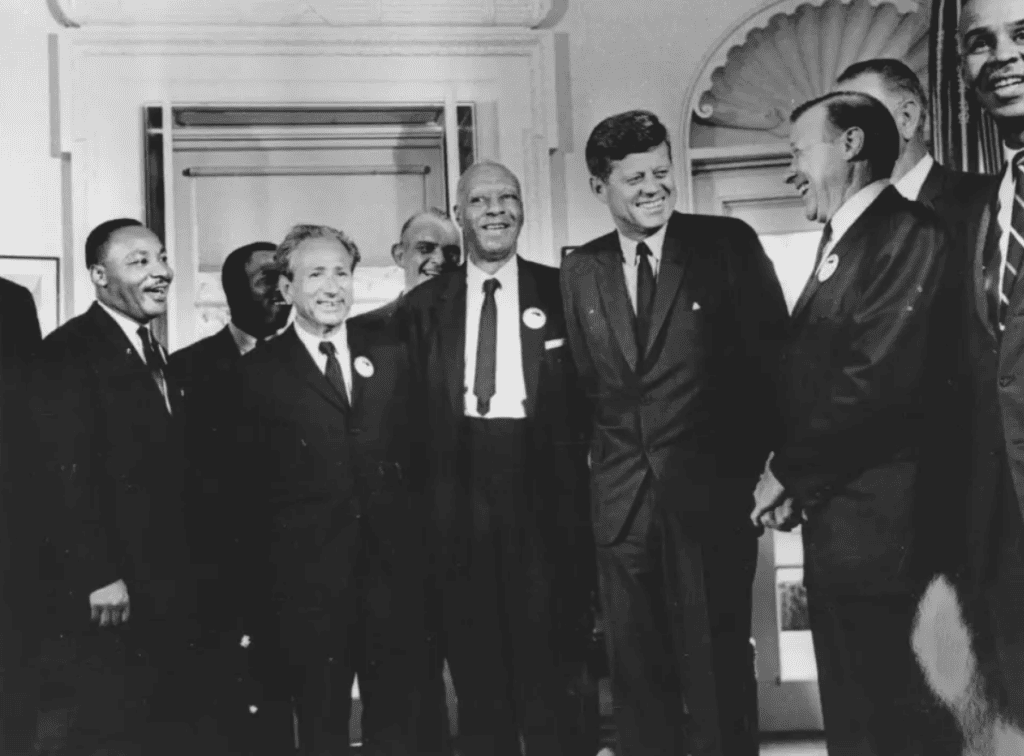
Photo: John F. Kennedy in the White House with civil rights leaders of the March on Washington, August 28, 1963. From left are Whitney Young, Martin Luther King, Rabbi Joachim Prinz, A. Philip Randolph, President Kennedy, Walter Reuther and Roy Wilkins; Vice-President Johnson stands behind Reuther.
Recent Comments