
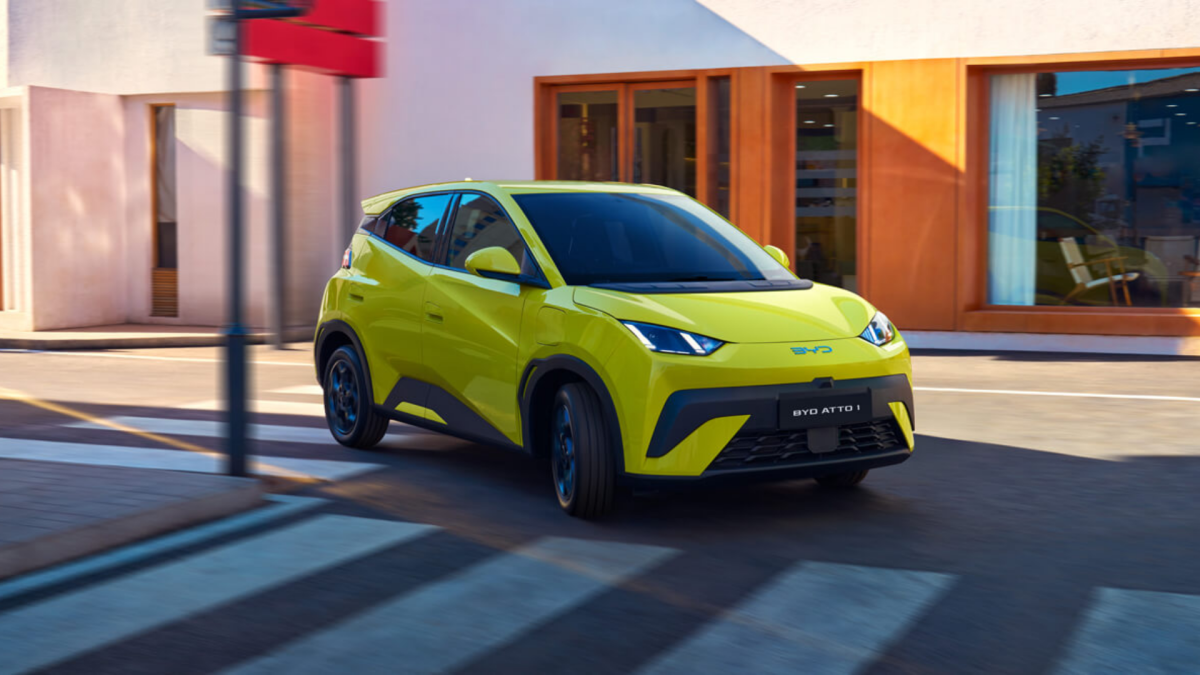
It’s now cheaper to buy a brand new EV than a petrol car in Australia. Chinese EV giant BYD has slashed the Australian price of its entry-level 2026 BYD Atto 1 Essential, cutting it from an already affordable $AU23,990 down to a mere $AU19,990 inclusive of all additional fees. At the current conversion rate, that’s a reduction from approximately $17,000 to a little over $14,000.
The BYD Atto 1 made headlines at its Australian debut last year, when its $AU23,990 launch price made it the cheapest EV in the country at the time. This new price reduction has now made BYD’s budget EV the cheapest car in the country overall, inclusive of EVs, hybrids, and petrol-powered vehicles.
Previously, Australia’s cheapest new car was the manual 2026 Kia Picanto Sport, a petrol vehicle with a base price of $AU19,190 (around $13,500). Adding mandatory on-road costs easily pushes the Picanto Sport’s cost beyond the Atto 1 Essential, whose new $AU19,990 price tag already includes such fees.
BYD’s Atto 1 Essential does technically share the title of Australia’s cheapest new car with MG’s petrol-powered MG3 Vibe, whose current $AU1,000 cash back offer prices it at $AU19,990 inclusive of fees. However, this deal is set to end soon on Sept. 30. Once it expires, and barring any further challenges, the BYD Atto 1 Essential will stand alone as the most affordable new car in Australia.
Unfortunately, the Atto 1 Essential’s new $AU19,990 pricing isn’t permanent either, only available for three months as a limited time offer from Sept. 15 until Dec. 15. Even so, it’s an encouraging signal regarding the increasing affordability and uptake of electric vehicles across the globe. Also known as the Dolphin Mini in Latin America, Dolphin Surf in Europe, and Seagull in China, the BYD Atto 1 has been known to retail for as little as ¥56,800 (around $8,400) in its home market.
Mashable Light Speed
Australians get cheaper EVs, while Americans get left behind

Credit: BYD
EV sales recently overtook petrol car sales for the first time in Australia, accounting for 24.9 percent of all new vehicles sold in August. Up 171 percent compared to the same time last year, EV sales individually outstripped petrol, diesel, hybrid, and plug-in hybrid car sales across the country. BYD was also Australia’s second most popular automaker, following Toyota but edging ahead of Tesla.
“Australians have seen through the scare campaigns and are voting with their wallets for cars that are cheaper to run, cleaner, and reduce their exposure to international petrol prices shocks,” said Australia’s Minister for Climate Change and Energy Chris Bowen, calling the milestone a “landmark moment.”
Yet while Australians are enjoying cheaper EVs, U.S. drivers’ options remain considerably more limited. The U.S. government’s high tariffs continue to block Chinese vehicles from import, with former president Joe Biden previously stating that the effective ban is partly due to other automakers’ inability to compete with China’s “unfairly low prices.” The Trump administration’s elimination of EV tax credits last year has also increased prices on the smaller pool of vehicles that are available. As such, EVs in the U.S. continue to come at a hefty cost.
Earlier this year, U.S. automaker Slate announced that its upcoming two-seater Blank Slate electric pickup truck will cost $24,950 excluding fees (around $AU35,000) — a notable increase compared to its initial goal of a sub-$20,000 price tag. Upgrading it from two doors to four will further bump up the price to at least $29,950 (around $AU42,000).
The most affordable EV currently available in the U.S. is the 2027 Chevrolet Bolt, which starts at $28,995 excluding fees (around $AU40,000). That’s more than double the Atto 1 Essential’s Australian price, even without BYD’s current offer. The Bolt may not be available for long either. General Motors previously announced that it was retiring the Bolt in 2023, intending to replace it with a new lineup of EVs. Though the automaker quickly reversed its decision due to popular demand, this is only a temporary stay of execution, as the latest 2027 Bolt is a limited run that’s scheduled to end less than two years after launch.
After the Bolt, the next most affordable EV in the U.S. is the Nissan Leaf S+, which starts at $29,990 before fees (around $AU42,000). While Nissan announced plans to release a cheaper model in the U.S. last year, this has since been delayed, with no official word regarding if or when it might now arrive.
Topics
Electric Vehicles
Cars
Recent Comments