
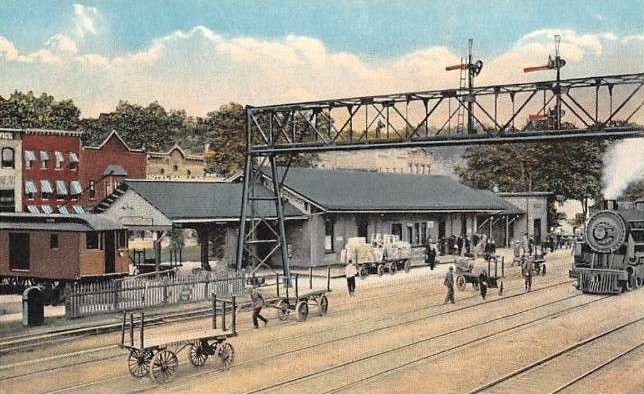
 During the summer of 1869, four men would occasionally meet at Dutcher’s Boarding House in Troy, New York. All were experienced railroad men; Charles Conklin was a baggage man with the New York Central Railroad, while brothers George and William Harrison were railroad hands. The fourth man, William Allen, who had a room at the boarding house, had once been a railroad brakeman.
During one of these gatherings, the conversation turned to robbery, and more specifically, the idea of stealing the gold and silver often carried in the American Express car on Conklin’s express train.
In the weeks that followed, the group prepared for the robbery. William Allen purchased clubs and materials for gags and, together with the Harrison brothers, dug a deep hole to bury the loot in a secluded spot at Power’s Grove, at the north end of Green Island.
On the evening of Monday, August 9, Allen and the Harrison brothers boarded a train heading west out of Albany. Disembarking in Fonda, the three made their way to a cornfield where they hid until well after dark.
At Midnight, they emerged and climbed onto one of the last cars of the eastbound express train as it pulled out of the Fonda station.
They then made their way to the rearmost baggage car and, using a key they had with them, unlocked the door and entered. They quickly attacked the two men in the car, baggage master Charles Conklin and John Beatty, an express messenger. After blinding them with hot pepper powder, the two were clubbed to the ground, bound, and gagged.
Using a key taken from Beatty during this assault, the attackers opened a safe and removed several bags of gold and silver. With this part of the robbery accomplished, the men proceeded to an adjacent baggage car where they subdued and robbed baggage man John Sells of twenty-two dollars.
As part of this well-planned robbery, when the train stopped in Schenectady, one of the thieves took Charles Conklin’s place at the side door, dropping off and picking up baggage.
He even responded when the station conductor asked if he had much to drop off, saying, “Yes, slews of it.” As they approached West Albany, the thieves applied the brakes on the baggage cars, and as the train slowed, they jumped off, making their escape.
From here, they made their way along the west side of the Hudson River for six miles to Power’s Grove, where they buried their loot in the hole they had dug earlier. The three later went back and divided the money, with the largest amount going to William Harrison, as he took charge of the portion set aside for Charles Conklin.
Both police and railroad detectives moved quickly to solve the crime, and after only four days, two men were arrested in Schenectady. However, this soon proved to be a false lead, as the two, who had brought suspicion on themselves for being “Englishmen,” had an alibi and were soon released.
From the very start of the investigation, Charles Conklin was thought to have been a participant in the crime. In September, he was arrested and held while the police tried to assemble a case against him.
After being held for nearly a month, he was set free as there was no evidence against him beyond unsubstantiated suspicions. At this time, Conklin returned to his position as a baggage man for the railroad.
 The big break in this case came in early November, three months after the robbery, when rumors began to circulate of a poor laborer named William Allen who was suddenly flush with money. For days, he was shadowed by railroad detectives until enough evidence was collected to convince authorities of his guilt.
When arrested, Allen initially denied any involvement in the crime but was soon convinced of the advantage of cooperating and confessed. With this, he revealed the rest of the gang, George and William Harrison, as well as two of the railroad men they had accosted in the baggage cars, Sells and Conklin.
While Sells was quickly dismissed as a suspect, the Harrison brothers were picked-up by railroad detectives and taken to an Albany hotel, where they were interrogated.
When all three of these men implicated Charles Conklin, he was arrested again. All four were then taken to the Fonda jail in Montgomery County, where their trials would be held.
The take from the robbery was initially reported as $20,000, then rose to $140,000, and then again to $200,000. In the months that followed, estimates often reached as high as $800,000. Although exactly how much was taken from the express car was never reported, nearly $70,000 was recovered.
Five thousand dollars of the loot was found hidden under a barn floor at the farm of William Allen’s stepfather in North Adams, Massachusetts. Of the Harrison brothers’ take in the robbery, twenty-seven thousand was found at 96 George Street in Green Island, and another thirty thousand was found hidden behind a pile of railroad ties on their mother’s property.
While William Harrison stated that some of the stolen money in his possession was Conklin’s share, he admitted that the man had made no effort to collect it.
William Allen and George Harrison were convicted of Burglary in the 3rd degree for the robbery of the Central Railroad Express train and sentenced to ten years at Dannemora Prison in Clinton, New York.
William Harrison, who had earlier pleaded guilty to simple burglary to avoid the stiffer penalty brought against the other two, also ended up in Dannemora.
The jury acknowledged that Conklin was implicated in the crime, and despite his plea of not guilty, he was sent to trial. The only witnesses called by the prosecution were the three already convicted, with each in turn pointing to Charles Conklin as a participant in the crime. However, the jury was not convinced, and they returned a verdict of not guilty.
Though acquitted, when released, he was immediately arrested again, this time charged with burglary and grand larceny. After a total of eleven months in jail, in October of 1870, a Montgomery County Grand Jury decided not to bring charges against Charles Conklin, and he was set free.
Two people did end up benefiting from this robbery. One was William Downing, of North Adams, Massachusetts. He received a $2,600 reward for information that led to the recovery of the money hidden under the barn owned by Luther Walker, William Allen’s stepfather.
Though Walker was not part of the robbery, he also benefited from the proceeds, as in the weeks following the crime, he received from his stepson presents of
a team of horses, a wagon, and furniture.
Illustrations from above: The New York Central Railroad’s Fonda Station, ca. 1890s; and an article announcing the arrest in the Hudson Daily Star, Nov. 8 1869.
Read more about New York’s Railroad History.
Recent Comments