
 In March 1902, eighty-five-year-old Alvah Dunning traveled from the Adirondacks to New York City for a sportsmen’s exhibition. By then, photographs and newspaper profiles had made his white beard and weathered face familiar. Visitors were not meeting an unknown woodsman.
They were being introduced to “Uncle Alvah,” a man presented as one of the last survivors of the Adirondacks before railroads, hotels and private preserves changed the region.
On his return north, Dunning stopped at the Dudley House in Utica. He was found dead there on the morning of March 11. Contemporary newspaper reports attributed his death to illuminating gas escaping from a partly open fixture and treated it as accidental.
The guide who had survived severe winters, remote camps and difficult water had died in a hotel room while traveling home from an exhibition built partly around the kind of life he represented.
The circumstances encouraged a simple ending to a simple legend. Dunning had outlived the old wilderness and then died in the modern world. His actual life was more complicated, and the contradictions make him a better guide to nineteenth-century Adirondack history than the harmless hermit of popular memory.
The Guide Before “Uncle Alvah”
Dunning was born in 1816 near the Lake Pleasant and Piseco country in Hamilton County. The exact details of his early life remain uncertain because he left no known diary or autobiography.
Later accounts describe him learning to hunt and trap while young, but his adult reputation is clearer. Ministers, sportsmen, scientists and surveyors relied on his ability to handle boats, locate game, choose camps and travel through country that remained poorly mapped.
Early Adirondack guiding required more than pointing out a route. A guide carried supplies, cut firewood, cooked, managed boats and judged weather, water and distance for clients who often had little experience in the interior.
The work placed a local woodsman in an unusual position. A wealthy visitor might possess money and social standing, but once the party left the settled road, the guide’s judgment could determine whether the journey succeeded.
Dunning’s later hermit image can obscure that working life. He was not cut off from society. He accepted clients, stayed at hotels, joined organized expeditions and formed lasting friendships with some of the people who entered the Adirondacks from outside. He also had a settled life near Piseco before moving deeper into the forest around 1860.
Later accounts place that departure after a serious assault on his wife. The surviving record does not establish every detail, and her own account has not been found, but the violence should not disappear behind the romantic story of a man who merely preferred solitude.
Carrying a Barometer to Mount Seward
One of Dunning’s most consequential journeys began at Raquette Lake in October 1870. Verplanck Colvin, a twenty-three-year-old surveyor from Albany, intended to reach and measure Mount Seward. Dunning was fifty-four and had spent decades learning the waterways and forests Colvin hoped to describe scientifically.
Colvin did not name his companion in his published account of the expedition. He called him an elderly, muscular and energetic guide who had been “born and bred a hunter” and was skilled in woodcraft. Later Adirondack histories identify the man as Dunning, but the omission in the original report is worth preserving. Colvin recorded the labor of the guide while giving the scientific observer the name and public authority.
The men traveled by way of Forked Lake and the Raquette River to Long Lake, where Colvin consulted the Abenaki guide Mitchell Sabattis and others about the route. On October 13, Colvin and his guide began forcing a boat against the rapids of Cold River. When the water became too difficult, they concealed the boat, extra supplies and Colvin’s rifle in thick cover and continued on foot.
Their loads showed how the work was divided. Dunning carried three days of provisions, blankets and a hatchet. Colvin carried a mercurial barometer, maps and a sketchbook. The instrument had been compared with the standard at Albany’s Dudley Observatory. If it broke before the summit readings were taken, the main purpose of the expedition would fail.
They spent the first night in an abandoned lumber shanty. Sparks from the campfire caught in its roof, and the men extinguished the flames before the fire reached their equipment. The next day brought fog, drizzle and saturated ground. After they left the old logging trace, Dunning chopped a blaze into a tree every fifty or one hundred feet so they could find the route on their descent.
The mountain revealed itself as a succession of ridges, wet depressions and false summits. The men pulled themselves up steep slopes by small birches and traveled through moss that held icy water. Colvin wrote that they were soaked as high as the waist and could see their breath. They camped below the summit on October 14, with Dunning cutting wood through the night because he had neither coat nor blanket.
An aurora spread across the sky above them. Colvin described a crimson belt and silvery light moving with the wind. Dunning told him that the faint sound they heard was the “noise of the northern light.” The brief remark is one of the few moments in Colvin’s report when the guide’s own interpretation enters the scientific narrative.
At eight the next morning, after pushing and chopping through dwarf balsam, they reached the summit. Colvin took the readings that allowed George W. Hough of the Dudley Observatory to calculate an elevation of 4,462 feet, a period estimate later revised by more accurate surveys.
The barometer broke during the return journey, but the observations had already been recorded.
 A Guide Inside the Preservation Story
Colvin’s report did more than describe a difficult ascent. Near its conclusion, he warned that cutting the Adirondack forests would dry the mountain mosses, accelerate runoff and damage the rivers and canals below. He called for an “Adirondack Park or timber preserve” and argued that the region should be protected for commerce, navigation and posterity.
Dunning’s part in that history was practical rather than rhetorical. He carried the supplies, marked the route, maintained the fire and helped bring the instrument safely to the summit. His knowledge allowed Colvin to turn one mountain into measurements and a published argument.
The guide who knew the country beyond maps assisted work that would help extend mapping, regulation and state authority into it.
That result matched the contradictions of Dunning’s later life. He guided the visitors whose growing numbers he resented. He depended on the tourist economy while moving whenever hotels, private estates or railroads reached his camps.
Long Lake town records show that voters elected him game constable in 1878, yet he later condemned game laws that restricted local hunters while wealthy sportsmen continued to kill for recreation. He opposed waste, but he had also lived by hunting and trapping through the decades when Adirondack wildlife sharply declined.
The Man Becomes an Image
By the 1890s, Dunning was increasingly valuable as a public character. Seneca Ray Stoddard photographed him, helping establish the familiar face of “Uncle Alvah.” Surgeon and artist Arpad G. Gerster later made an etched portrait from a Stoddard photograph. According to Alfred L. Donaldson’s A History of the Adirondacks, Gerster sold proofs to raise money for a gold watch after Dunning lost an earlier watch while fishing. The resulting object remained among Dunning’s possessions when he died.
The portrait and the watch reveal more than a colorful anecdote. Dunning’s image could be reproduced, sold and used to turn admiration into material help. They also show that the supposed hermit remained connected to a network of sportsmen, artists, hotel-keepers and friends. Solitude was part of his life, but complete isolation was part of the legend.
When Dunning appeared at the New York sportsmen’s exhibition in 1902, he stood at the end of that transformation. The working guide had become an exhibit representing a vanished world.
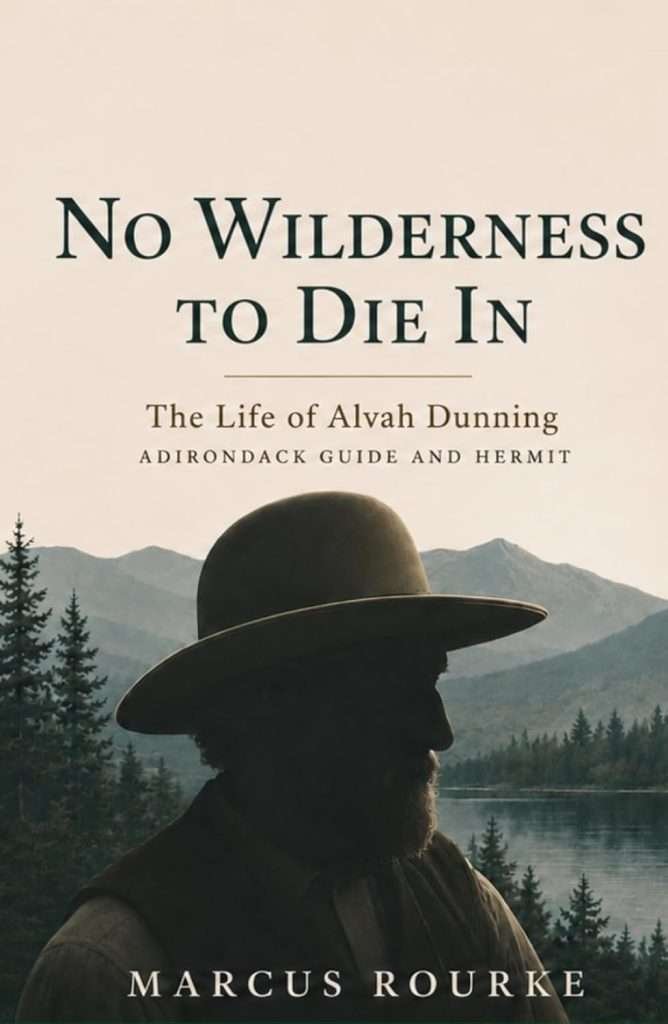
The documented guide and the later public character are the subject of No Wilderness to Die In: The Life of Alvah Dunning, Adirondack Guide and Hermit. Remembering only the exhibit leaves too much out.
Dunning was skilled and violent, independent and dependent, suspicious of outsiders and useful to them. He helped open the Adirondacks to the same forces from which he repeatedly withdrew. His life matters because those tensions belonged not only to one difficult man, but also to the changing Adirondacks around him.
Read more about Adirondack Guides.
Marcus R. Rourke is an independent researcher and writer who lives in the Adirondacks. His work focuses on regional history, wilderness culture, early guide traditions, and the people who shaped northern New York. He is the author of No Wilderness to Die In: The Life of Alvah Dunning, Adirondack Guide and Hermit (2026).
Book Purchases made through Bookshop.org support both your local independent bookstore and New York Almanack’s mission to report new publications relevant to New York State. Purchases via this Amazon link also support the Almanack.
Illustrations, from above: Alvah Dunning in Arpad G. Gerster’s etched portrait, “The Hermit of Raquette Lake,” based on a photograph by Seneca Ray Stoddard (Doris Ulmann Collection, University of Oregon Libraries); and Verplanck Colvin, ca. 1872–1882, anonymous photomechanical print (Rijksmuseum, the Netherlands).
Recent Comments