
 On November 14, 1902, the Trustees of the Church of the Holy Cross in Utica, New York, purchased four lots on the northwest shore of Twitchell Lake in Big Moose in the Adirondacks. The grantor on the deed was William Thistlethwaite, an Old Forge real estate mogul.
This gave the church 24 acres of woodland which ran a full half mile back to the State’s Forest Preserve and 400 feet of pristine lakeshore lined with ancient red spruce and towering white pine.
This church followed six people who purchased lots from Adirondack railroad builder William Seward Webb, establishing camps on the lake. Two of these became famous early hotels. Three were clergymen attracted to the fishing and hunting, in addition to a rustic retreat from urban ministry.
When Webb’s railroad access across the Adirondacks to Montreal opened in 1892, this trip from Utica took four and a half hours, but the 2.5-mile road from Big Moose Station to the lake was by horse-drawn buckboard over a bed of boulders. That would not change until 1907 when a contract was funded to grade a smoother dirt road.
Holy Cross would go on to cherish its Twitchell investment for 50 years. What drew this church men’s club to settle in such a wild setting and how they employed and maintained their Twitchell retreat makes a fascinating story.
 One Church Silhouetting the Utica Skyline
In 1900 Utica was a booming industrial powerhouse with a rapidly growing population of roughly 56,000; the city was a major manufacturing and transportation hub. The community was known for its textile mills, clothing factories, and metalwork.
A stop on the New York Central Railroad and the Erie Canal and a home of many immigrants, its bustling downtown featured elegant department stores, early electrified trolleys, and a robust brewing industry.
Memorial Church of the Holy Cross was one of five churches in Utica belonging to the Episcopal Diocese of Central New York. A history of the church marks its 1871 origin “to minister to the growing population of East Utica, a working-class industrial neighborhood attracting immigrants and laborers during the late 19th century.”
A central figure in this story is the Rev. James J. Burd, ordained deacon in 1886, priest in 1887, and congregation rector in 1890. He led the parish progressively for 37 years, guiding it through this formative industrial era, and taking regular vacations and many Men’s Club visits to Twitchell Lake.
He was also active in the diocese seminary in Syracuse, St. Andrew’s Divinity School, where he was elected Vice President in 1909.
The Holy Cross Men’s Club
One of Rev. Burd’s proudest achievements was the founding of the Men’s Club in 1896 with nine members, part of an earlier kind of men’s movement dubbed “Muscular Christianity.”
 Industrialization in cities like Utica separated a mass of men from their earlier agrarian roots, the ideal of gentility captured by the Victorian gentleman with his stopwatch, came to be seen as a weak norm for masculinity. A study of this movement expressed it in this way:
“As the public sphere grew more masculine, the home blossomed more feminine. Men left the religious instruction of children to mothers. The business world became the man’s; the Christian world was left to women, children, and soft-sounding clergy.”
Within just a few years, the Holy Cross Men’s Club outnumbered all the other groups in the church combined, including the Sunday School, Choir, Trustees, and Women’s Guild and Auxiliary.
By 1902 the names of 100 men were listed on the club’s roll. Men from other churches and denominations were welcomed into membership if they shared the organization’s goal, “to promote the religious, moral, intellectual and social welfare of its members.”
Weekly meetings stretched from the first Tuesday in October to the first Tuesday in June. Bible passages were discussed every other week, the opposite weeks featuring debates, book-reviews, papers, and talks on relevant topics by professional or businessmen.
An April 1903 debate pitted three affirmative against three negative speakers on “Resolved: That it is to the interest of labor unions to incorporate.” The three judges gave the debate prize to the affirmative team.
 In May of 1904, Holy Cross joined two other church men’s clubs in the city for a talk by the proprietor of McKinnon Woolen Knitting Mill titled “Apply Business to the Church.”
Employing over a thousand people, Robert Mackinnon discussed the impact of key inventions like the printing press, iron horse, telegraph, steamboat, telephone, trolley, daily papers and periodicals, and good roads, noting that the most conservative of all organizations, the church, needed to adapt and change, while remaining true to its Gospel.
One of the things men found most attractive about the club was its spirit of unity and democracy. During the club’s eighth annual banquet in 1904, an Irishman offered his “Toast to an Englishman,” publicly proclaiming that “we are all brothers, trying to live a pure true life and in that attitude, I address you not as an Irishman, or one who has become ashamed of his country.”
The Women’s Guild served a multiple-course meal at each Men’s Club banquet, the chapel lavishly decorated in the club’s colors with bunting and flags – that of the US but also those representing the city’s diverse ethnic makeup.
Cigars were passed out with desert and numerous toasts offered. Each annual banquet held on the last Tuesday of the season closed around midnight with singing of “The Star-Spangled Banner,” “America” (the club song) and “Auld Lang Syne.”
The Men’s Club had a role for everyone, forming sub-organizations for mission, service, and entertainment, including a reading club, whist, pedro and checkers clubs, a band and orchestra, and an outing club.
Very popular before contract bridge replaced it, Pidro in its Scandinavian version, Pedro was a trick-taking game played by teams of two, the five of trumps or “Pedro” worth five points. One “progressive pedro party” held in a rented auditorium in January of 1901 sold 350 tickets for play at sixty tables, ladies in charge of game sections.
 Election of club officers took place at the first meeting each year, in October, several industrial leaders occupying the key positions in the first ten years.
Edward B. Brandegee served as president until he retired to Massachusetts, taking up residence in the famous Faulkner Farm of Brookline.
The Crouse & Brandegee company produced fancy tailored clothing for men and was one of the most prominent clothing manufacturers in the Mohawk Valley. Richard Briesen, a prominent Utica butcher, held the vice presidency in the early years.
Frederick J. Roemer occupied the important secretary-treasurer role for many years. In the 1918 Brewer’s Handbook, Roemer is listed as Vice President at the West End Brewery, then a community anchor.
The Men’s Club also appointed a librarian, captains for the other sub-groups in the club, and governors for 18-month terms to plan out the weekly meetings.
Special club programs were run periodically using the state-of-the-art stereopticon projector pictured here. Also called a “magic lantern,” one program in March of 1901 focused on the travels of Christ, another December 1911 program on the wonders of California.
The Outing Club
Between The Utica Daily Observer and The Utica Daily Press – the city’s main daily news sources – a reader could obtain detailed information and reports on men’s club activities.
In a notice published on May 17, 1899, it was reported that Holy Cross Men’s Club made an important decision at its regular Tuesday meeting the night before:
The club would make an annual camping trip with a view to establishing a permanent retreat in the Adirondack wilderness just to their north.
The article mentioned “Cool’s Mountain Home,” which initially turned-up in the research as a famous and historic rustic Catskills hotel in Tannersville, NY.
Further digging however found Byron Cool – founder of that legendary Catskill resort – advertising in both Utica papers a “Cool’s Mountain Home in the Adirondacks, on North Lake,” with these details:
 “Good fishing, grand scenery, daily mail; P.O. in hotel, terms $6 per week. Take A. & St. L. Railroad to Forestport, where stage connects daily at 8:30 a. m. As a special inducement to guests that are to remain at least one week, I will pay stage fare one way.”
Six dollars a week was a bargain in 1899 and more than a few of those 25 club members took advantage of that half-price stagecoach ride that summer, to inaugurate their annual Adirondack outing.
The round trip from Utica to North Lake may have dissuaded them from returning for the next season. From the Forestport railroad station, riders had to endure a bumpy four-hour ride by horse-drawn carriage over 16 miles on primitive roads winding along Woodhull Creek.
As the new millennium dawned, Twitchell Lake became the exclusive mountain destination for the Holy Cross Men’s Club. It may even have been that club members were at Twitchell Lake when the club booked Cool’s Mountain Home at North Lake. The railroad trip to Big Moose was longer but the grueling buckboard ride six times shorter.
A Short Timeline
*Summer 1899- Holy Cross Men’s Club formed an Outing Club from the members who camped at Twitchell Lake “who hope to go the coming year to a camp on the site which the Men’s Club proposes to purchase on the shores of Twitchell” (Utica Observer).
*August 1900- Four Men’s Club members spent two weeks at Twitchell Lake, with the anticipation of others from the club joining them on their retreat (Utica Observer).
*Summer 1901- Club members continued to receive permission to camp on Dr. William Seward Webb’s Nehasane Park Association land, with this news:
“A boat purchased and considerable camp material accumulated… and found it a most delightful place. Number of fine lakes in easy distance, plenty of streams with good trout” (Utica Observer).
*November 14, 1902- a deed was signed by a Church Trustee for purchase of four lots from William Thistlethwaite, although club members continued to camp during the 1902 summer under Webb permission.
“[The Club] erected a very comfortable camp on the site. It is of fair size and is clapboarded and shingled, so that it will provide a dry and comfortable place for ten or fifteen people in wet weather. The building was erected by several members who went into the woods and took two carpenters with them. Later in the season they expect to occupy the camp a couple of weeks …
 “It is expected that in the near future a more pretentious building will be erected by the club on the tract, and then the smaller camp can be used for a kitchen or a storehouse” (July 9, 1902, Utica Observer).
The two Herkimer County deeds here present a legal mystery, as the Holy Cross purchase at Twitchell Lake dated November 14th was a full month before Thistlethwaite’s purchase of the same lots from Webb on December 10th.
Thistlethwaite however, had once been Webb’s personal secretary, so the Holy Cross Men’s Club had a site for its Adirondack retreat, with permission to erect a small cabin before the purchase was finalized.
John Ueltschi, a prominent member of the Swiss Benevolent Society in Utica, was appointed Captain of the Outing Club in 1902, and he was one of the men taking an active interest and role in that club’s Twitchell Lake activities right from the start.
The following six years of Holy Cross ownership would see growing vacation usage, along with special Fourth of July celebrations.
The Annual Pilgrimage to the Holy Cross Camp
It would not be until 1909 that the club carried through on its hope and plan to have a full summer camp built, their current one-room cottage then incorporated as the kitchen.
In the meantime, the Twitchell Holy Cross retreat received almost continual use from the start of fishing season to the close of hunting season.
Their boat became a busy ferry service from the public landing to their northwest shoreline. More boats soon had to be added, with storage along the shore of the boat landing.
The Utica Daily Press reported on April 1, 1903, that “quite a number of the members are going to Twitchell Lake as soon as the fishing season opens. They will be under the captaincy of Robert Barlow.”
 Even before that fishing party arrived, an outing club “committee on rules for the government of the camp” read its report at a regular club meeting and made it publicly available for further consideration. Clearings for tent sites along the shore were added with a suggested contribution to the camp fund by those making the trek.
Three club officials, including Vice President Harold Briesen, took a two-week vacation there in 1903 during the last week of May and first week of June.
The captain of the Outing Club gave this glowing tribute and invitation to the 125 members and their guests at the eighth annual banquet of the Men’s Club in 1904:
“He said he never knew what a delightful time was to be gotten at the camp until he went there a fortnight ago. He told of the beauties of the place, and said it was only a short walk from the railroad. As it is owned by the club he urged its use by members, all of whom should take any opportunity of visiting the place.”
It is interesting that the religious language of pilgrimage was eventually adopted, as indicted by the sixteenth annual banquet of the club:
“On the 29th and 30th of this month [June] the members of the club are to make their annual pilgrimage to their Adirondack camp on Twitchell Lake near Big Moose.” This was a July Fourth extravaganzas which became an annual tradition.
“How the 4th Was Observed by Some Uticans in the Woods,” in the July 8, 1908 Utica Observer described this pilgrimage in detail:
“One of the most enjoyable parties the camp has ever had is assembled there at present, and the 4th was celebrated by them in a fitting style. There were several interesting events arranged for the day.
“The first prize was offered for the one who caught the first fish, and it was won by Harry Teeling. There was also a prize for the largest fish and Isaac Willlams distanced all competitors by catching a trout measuring 22 inches.
“The prize for the greatest number of bites was carried off by R. H. Wilson, who got most of his in the neck. W. W. Terrell was awarded the prize as the fastest wood chopper. The most Interesting as well as the most exciting race was the tub race, and after two dead heats it was won by Isaac Williams.
“During the day the Holy Cross drum corps played several selections and in the evening the orchestra was listened to with great pleasure. The party have been honored by visits from several friends during their stay and are enjoying all the privileges afforded at the camp.
“Many members of the club are making plans to spend their vacations at the camp, which will make a busy summer and add to the popularity already gained for it.”
This large event, part fishing contest and part woodsman’s festival, certainly attracted attention from other Twitchell lakers at the time.
On another Fourth of July pilgrimage in 1911, 70 club members made the trek to camp in tents along the shoreline, two club members preceding the group to help pitch the tents. In addition to fishing and boating contests, with woodsman skills, these participants were to “enjoy long tramps into the surrounding forest.”
As early as 1905, attention was being focused on building a new camp that would better serve the varied functions of Holy Cross Camp.An overly optimistic report that June represented the beginning of plans for the new camp said a committee was revising the plans for a new club house “within the next few weeks and the building will probably be erected during the autumn.”
Expanding the Holy Cross Camp
At a regular meeting of the Men’s Club in April 1907, President Brandegee continued their series of talks under the title “Heroes in Hero Worship,” offering to the 50 men present, and especially the young men. Examples to emulate included George Washington, Abraham Lincoln, and Theodore Roosevelt.
Brandegee presented each member in attendance The Many Sided Roosevelt, George William Douglas’s 1907 campaign-esque collection of anecdotes about the life, work, and personality of then President Theodore Roosevelt.
The Outing Club closed the meeting with its plan for an enlargement of Holy Cross Camp: “The camp at present is too small to accommodate the members, and it will be made about twice the size.”
In late May, the 190 men attending the eleventh annual Men’s Club banquet received much the same message.
A year and a half later, in October of 1908, the treasurer of the Outing Club made a report at a Men’s Club meeting showing a good balance in the treasury, with the proposed camp consisting of “a kitchen, living room, and the four bedrooms. The plans are in the hands of the committee.” “Several members told of the delights of the woods at the lake,” it was reported.
Then finally the news the club was waiting for, two years after the initial proposal in June, 1909 – a date for starting the new construction, announced to the 100 members attending the thirteenth annual banquet.
Work on the club’s new camp was to start the following week, with a new dirt road making transportation of people and equipment much easier:
“Two members, George Turney, a mason, and Ben Kiser, a carpenter, are to do the work. The new building will be of spit-log construction and 18 by 30. It will be done off interiorly in rustic style and handsomely furnished. The contractors will also erect a boat house on the lake, 12 by 20 feet. The present camp house on the club’s property will be turned into a kitchen.”
Men’s Club officials like Brandegee, Briesen, and Roemer established good working relationships with early settlers at the lake like Earl Covey, whose sawmill supplied this building crew with their half logs, and the new camp generally following the Covey design. Stonework by member and mason George Turney would likely have come by rail from White Lake, where Earl Covey obtained his granite for fireplace construction.
(Interestingly, reporting on the clergy who took many of the prizes in a 1916 Twitchell Lake Regatta – Eugene Noble, Stephen Herben, and George Stockdale – don’t mention Holy Cross club participants, suggesting that these two groups (Episcopal and Methodist-Episcopal), kept to their own activities.)
A July 17th article added several details, that the building project was to be completed within a week and this important notice:
“The new camp will easily accommodate 20 persons. While some furnishings will be sent up within a few days, it is not the intention of the club to complete the furnishing this year. Several members of the club have already visited the new camp, and many others will do so before the season closes.”
Memorial Church’s Rector James Burd and his son James booked a vacation week in August 1911.
Holy Cross Men’s Club at its Zenith
It is quite remarkable that The Holy Cross Club Camp continued as a place of pilgrimage right up to 1953 when it was purchased by the son of a long-standing club member.
It is possible to assign a zenith to the men’s club in terms of attendance at its annual banquets, the annual July Fourth celebration at the club camp, and the continuing influence and presence of charter members such as Brandegee, Briesen, and Roemer.
Annual Men’s Club banquets for the Memorial Church of the Holy Cross mention attendance of 125 to 190 men before the First World War. The eighteenth annual banquet and dinner of 1914 certainly illustrate a club zenith in pomp and circumstance, the chapel decorated in club colors and multiple flags, charter members present to offer toasts, the club band playing evening selections, and a seven-course meal served by the Women’s Guild.
An entertainment committee of four arranged for the talks and toasts to follow the dinner, desert, and cigars. Commencing at 9pm, Walter Crocker presided as toastmaster, calling attention to the coming excursion to Twitchell Lake.
After singing “America,” their club song, Rector Burd responded to the toast “Our Pastor,” calling on the men “to look after their laurels,” a challenge well before its time.
He was referring to the social status quo in which a woman’s place was assumed to be in the home, not in politics:
“It seems to me that the men have a responsibility too, and if we have not taken our share of the burden we are to be blamed. The father who leaves the government of the children to the mother alone is unjust to the children. The men of this club could not express their faith in a better way than to serve as examples to the children of right living.”
 Three toasts followed, Brandegee taking “Our Club,” Roemer “Our Secretary,” and T. L. Wilder “Our Camp,” the latter talk commending the many features that made the camp on Twitchell Lake a delightful place for a vacation.
Between toasts, the club band led in singing “Abide in Me” and “Auld Lang Syne.” Then more about the Holy Cross Camp at Twitchell, with a closing song popular during the Civil War, “Tenting on the Old Camp Ground”:
Robert Wilson also spoke entertainingly of the advantages of such an outing. He read some poems that centered about the camp and these pleased the men greatly. “Billy” Bantham was called to sing “Tenting on the Old Camp Ground,” the men joining in the chorus.
The closing comments at midnight looked forward to their coming gathering at Twitchell Lake, to celebrate Fourth of July.
A Utica Daily Press reporter summed-up the evening by saying “it was a whole-souled, hearty lot of men who gathered at the big tables and their warm friendliness was apparent in everything that was done.”
A Memorial to the Last Charter Member
Press reports on the Holy Cross Men’s Club drop off dramatically with the coming of World War One, and was further eroded during the Great Depression and Second World War – dark events that impacted all lake families and residents. Attendance for club banquets also declined during those turbulent years.
The camp and its property did continue to be used both for Men’s Club functions, fishing and hunting outings and congregation members’ vacations. Two points of continuity persist through these later years – the leadership role of the secretary and treasurer Fred Roemer and the active presence of Outing Club member John Ueltschi.
 Annual banquets from this period highlight the presence of charter club members, until there was only one left, Fred Roemer. The motion to raise money and place a memorial plaque on the shore of Twitchell Lake in front of Holy Cross Camp came almost immediately after Fred’s death in 1942.
Club members and their children were serving overseas, the attention of this ultra-patriotic church men’s club was focused on the war effort, and honoring their last and recently-deceased charter member galvanized the whole club membership to act on this proposal.
Fred’s name is mentioned in just about every annual banquet covered by Utica papers – reading his detailed reports, raising money for the building fund, summarizing the club’s progress, recounting the history of the club, reporting statistics showing the relation of the club to the church, and highlighting club visits to Twitchell Lake. Fred was beloved and he was the longest-standing and last charter member.
The mounting of the plaque took only a dozen or so bags of cement and readily available stones. The plaque, still standing, was dedicated at one of the club’s July Fourth celebrations in the 1940s, only a few years before the sale of the property.
Holy Cross Camp Becomes Swiss Family Lodge
After exactly 50 years of club ownership, the sale of the Holy Cross Men’s Club became public in 1953. Mr. & Mrs. Jacob Ueltschi emigrated from Switzerland in 1870, settling in Utica and celebrating a Golden Anniversary with nine children and four generations in 1915.
The family participated in all the activities of the Swiss Benevolent Society in Utica, John taking up leadership for the Outing Club. John included his son Karl in camp activities early on.
It was no surprise then that Memorial Church of the Holy Cross sold their four lots on Twitchell Lake, with the existing camp and boathouse, to Karl on November 2nd “to have and to hold the premises herein granted unto the party of the second part, his heirs and assigns forever.”
The renamed Swiss Family Lodge became an important part of the Twitchell Lake community for many years, Karl and his family are remembered as kind, interesting, and helpful neighbors.
Tribute to the Club Founders
The Holy Cross Camp story is an interesting one, this city church in Utica holding an important place in the social history of Twitchell Lake.
Contemporary readers can certainly blink at some of the assumptions held early in the last century by men’s club members. But blue-collar industrial workers and leaders of East Utica formed an important bond, uniting women, men and children from all corners of the world in a united camping adventure that lasted 50 years.
The standing memorial to Fred Roemer is a fitting reminder of that special bond, Rev. Burd and the other charter members deserving much of the credit for their vision and leadership.
The language of pilgrimage in a beautiful wild lakeside setting is also a tribute to their faith. The chorus to “Tenting on the Old Camp Ground” serves as a good benediction to this story:
Many are the hearts that are weary tonight, Wishing for the war to cease,
Many are the hearts that are looking for the right, To see the dawn of peace,
Tenting tonight, tenting tonight, Tenting on the Old Camp Ground.
Read more about the Adirondacks
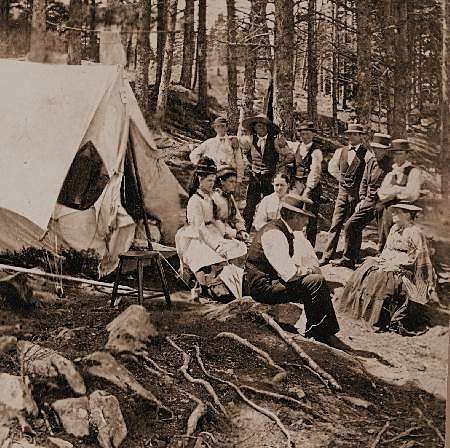
Illustrations, from above: Tent Camping in the Adirondacks, ca. 1910 (Source Unknown); Memorial Church of the Holy Cross in Utica; Robert McKinnon Knitting Mill in Utica (ca. 1910); advertisement for men’s clothing manufactured by Crouse & Brandegees in Utica; Twitchell Lake’s public landing, ca. 1910; Holy Cross Camp lodge, ca. 1910; the Holy Cross Club Boat House, ca. 1910; “Tenting on the Old Camp Ground” by Walter Kittredge, 1863; memorial to charter member Fred Roemer; and an illustration of the Swiss Family Lodge sign mounted on the old Men’s Camp boathouse.
Recent Comments