
 Carl Chandler of Corinth, NY, enlisted in the United States Army on July 21, 1948. He was assigned to company B of the 32nd infantry regiment and after basic training shipped out to Korea where the 7th Infantry Division was winding down its post-World War Two occupation of that country.
In December Carl and his unit were reassigned to Camp McGill in Japan. On January 15, 1949, Carl wrote a letter to his sister Florence and brother Harry back in Corinth. He was 18 years old:
“I received a nice letter and card from you and the pictures were really nice. I liked getting them as it makes it seem like I was closer to home. I am beginning to like it here, and would really like it if I could have some of the family here with me, but I guess that is part of manhood, and I guess I can say I am a man now, at least I have a man’s job.”
His letters that followed during two tours in Korea and Japan, mostly addressed to his parents, Cortland and Solpha, display the close family relationships in the Chandler family.
Carl’s military service didn’t end with his return home when he left Japan. He was discharged in March 1950 and joined the Reserves. Little did he realize that he would be called back to active-duty six months later upon the outbreak of the Korean War (1950-1953).
As an experienced veteran he reported to Ft. Lewis in Washington State for an accelerated refresher training course before shipping out in Company G of the 38th Regiment. Preparing to leave, he finally had time to write to his parents:
“I am sorry I haven’t written before this, but I have been terribly busy as we are only having 6 weeks of Basic and I am studying the biggest share of the time. Say Harry, [his brother] if you want to join up think it over a lot first because army life is nice. There isn’t anything better if you know what to expect from the Army and what the Army expects from you.”
 Carl returned to Korea in December 1950 and soon was able to write a “safe arrival” letter:
“Well here I am, and still in one piece, although it is still pretty cold up here. Boy, it was sure a fast trip wasn’t it? It didn’t take long at all for me to get up here. You should see me up here eating Korean eggs around a fire and sleeping in beat up buildings we captured. I sure hope they end this pretty shortly as it is certainly a lot different over here than I figured it was.”
In the next few months, he would find out just how different it was. In January the Chinese People’s Volunteer Army launched their New Year’s Offensive and the 38th regiment was in the thick of the fighting. It was Carl’s first battlefield experience, and he described how it affected him:
“It’s a funny thing. You’re all excited and scared stiff, and when it gets rough you suddenly forget about being scared and a calm comes over you and you start to function the way you should. That is the way it went.”
The combined United Nations forces slowed that offensive, but the Chinese struck again in February.
The massive Chinese counteroffensive broke through United Nations command, communication and supply lines. The 38th Infantry Regiment along with Support Forces and Republic of Korea units were ambushed, surrounded, and cut off as they attempted to withdraw through a narrow mountain pass north of Hoengsong.
The devastating losses and heavy equipment abandonment suffered by the retreating forces led the Marines to dub the location “Massacre Valley.” The 38th established a defense perimeter around Wonju in South Korea.
In a March 21 letter home Chandler describes his regiments participation in the American Army’s counteroffensive, named Operation Ripper, that led to his own profile in courage four days later:
“We have really been moving north lately as you must know by the papers. It is very mountainous – that’s all you can see for miles around. I haven’t much time to write tonight as I need to get a little sleep in case they should happen to attack tonight, which I hope they don’t.”
One of those rugged hills Sergeant Chandler referred to was code named Hill 821. It was not a hill. It was 821 meters, 2,694 feet high.
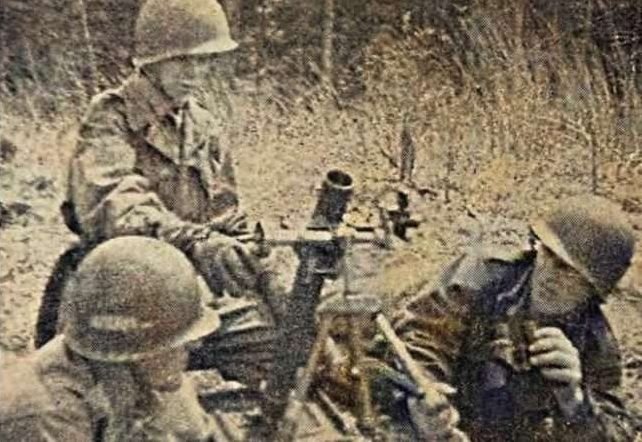
On March 25 Carl’s Company G, led by Lt. Dale G. Hollingsworth, attacked entrenched enemy forces on the mountain. Carl Chandler was the mortar forward observer. His Silver Star commendation issued May 27, 1951, tells the rest of the story:
“When in the course of the attack, communications with the mortars in the rear were severed by enemy fire, Sergeant Chandler, as mortar forward observer, voluntarily joined a rifle platoon in an assault on the hill.
“After the first assault was slowed down, he organized and personally led a second charge against the entrenched enemy. Inspired by his exemplary courage, the platoon succeeded in gaining the objective in this second effort.”
Carl’s next letter to his parents after his ordeal was four pages long. He didn’t elaborate on his role in capturing Hill 821, but was pleased to report that “we stopped them and are pushing them back now.” He did reflect on his own future and that of his brother Harry:
“I think I have done my share of fighting and done it well, and am ready to come home and stop stretching my luck. Harry thinks he will be over here in a little while, and is anxious to come, but I hope he doesn’t have to come over. He doesn’t know what he is getting into.”
Harry had served in the US Navy toward the end of the Second World War and was recalled to active duty in June 1951, and did come over again, serving in a Tank and Tractor Battalion in Korea.
The 38th regiment remained in the thick of the fighting after the capture of Hill 821. The Chinese launched their spring offensives in human-wave assaults during April and May and the 38th was awarded the Presidential Unit Citation for their efforts in slowing and eventually halting their advance.
As the months wore on, Carl’s letters reflected his pride in his accomplishments, which brought with it both challenges and unpleasant duties:
“I guess I told you I jumped to First Sergeant. It is a better job but more headaches in a way as you have to keep track of where every man is at all times.
“The worst of this deal is that I had to write letters to the mothers of the 3 men in the patrol who were killed and explain to them how their sons we killed and it’s really a hard job.”
By August Carl was looking forward to coming home, noting that he was second on the rotation list and “may be going home soon if I can sweat out the next 3 or 4 days.”
Rotation stateside was determined by both time and the intensity of the soldier’s service. For combat frontline positions, Chandler was awarded four points per month. With 36 points required, he was closing in on nine months wartime service, making him eligible for rotation.
In one of his last letters from Korea, he reflected on his accomplishments and his plans:
“Now I am Master Sgt and have reached the top round for enlisted men, and I was offered a Battlefield Commission if I would stay. But there are too many chances, and maybe I am wrong, but I think I have done my job of fighting, for awhile anyway.
“I am ready to come home now and settle down. Will sign off now. Lots of Love & God’s Guidance. Your Son, Carl”
Carl returned to his parents’ home in Corinth in October 1951, worked at the International Paper Company, married Beatrice Millington in 1956 and raised a family of six children.
He continued his public service as Captain of the Corinth Emergency Squad for many years. Carl A. Chandler died January 22, 1984, at the age of 53.
Read More About New York & the Korean War
Carl Chandler is the father of Debra Richmond, the author’s sisters-in-law, who provided the letters highlighted in this article. This essay is presented by the Saratoga County History Center.
Illustrations, from above: Carl Chandler with mortar team in Korea in 1951; and back home in Corinth.
Recent Comments