
 Major League Baseball’s annual all-star game (taking place Tuesday in Philly) invariably fosters debates. Who’s the more worthy first-baseman, Vladimer Guerrero Jr. or Ben Rice? Should Aaron Judge be on the roster if he hasn’t played in over a month? Why is Cody Bellinger starting in the outfield over Randy Arozarena?
Baseball fans love arguing these sort of questions every year as the midsummer classic approaches. They lead naturally to questions about who was the greatest of all time. Babe Ruth? Ted Williams? Barry Bonds?
I don’t have the answers, but I would like to recognize a class of players who are often overlooked in these debates: the nineteenth-century greats.
Baseball evolved in the Northeast, so it’s not surprising that many of the early players came from New York State. Following are my selections for an all-star team made up of native New Yorkers who played primarily in the 1800s.
Catcher: James “Deacon” White
Born in 1847 in Caton, a small town in Steuben County in the Southern Tier. James White was widely regarded as the best catcher in baseball in the 1870s – an era when catchers did not wear gloves.
Later he primarily played third base. He played all five seasons of the National Association (1871-75), the first professional league, and 14 seasons in the National League.
He finished his major-league career, at age 42, with Buffalo in the rebel Players League in 1890. In 1877, he hit .376 to lead the NL.
His career average was .303. He was nicknamed Deacon because of his honesty and clean habits. Elected to the Hall of Fame in 2012, his younger brother Will, a pitcher, is also in the Hall.
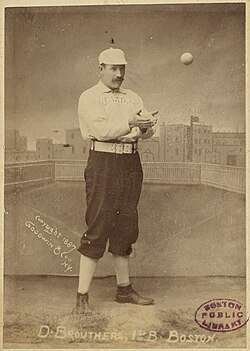
First baseman: Dan Brouthers
Born in Sylvan Lake in Dutchess County, Dan Brouthers was one of the most feared sluggers of the 1800s.
He debuted with the Troy Haymakers in 1879 but didn’t make much of an impression until he joined the Buffalo Bisons in 1881. That year he batted .319, the first of 14 straight seasons with an average above .300.
He won five batting titles – three in the National League, one in the rival American Association, and one in the Players League, which existed only in 1890. He batted .342 over his career. His .519 slugging average, figured retroactively, was the highest of the 19th century. He was elected to the Hall of Fame in 1945.
Second baseman: Bid McPhee
John Alexander McPhee was born in 1859 in Massena on the St. Lawrence River, but his family moved to Illinois when he was seven.
As a kid, he picked up the nickname Biddy, later shortened to Bid. He joined Cincinnati of the American Association in 1882 and stayed with the team until retiring after the 1899 season (Cincinnati joined the National League in 1890).
Baseball historians regard him as the finest second baseman of the 1800s, often leading the league in putouts, assists, double plays, and/or fielding average. He refused to wear a glove until 1896. That year, at age 36, he posted a .982 fielding average, a record that stood for almost three decades.
His 6,652 putouts over his career is still the record for a second baseman. Though not exceptional at the plate (career .272), he was good enough to bat lead-off often. He also was a good base-runner. Elected to Hall of Fame in 2000.
Third baseman: John McGraw

Born in 1873 in Truxton, in Cortland County, about 25 miles south of Syracuse. John McGraw is best known as the fabulously successful manager of the New York Giants, leading them to 10 National League pennants and three World Series championships. His teams finished second in 11 other pennant races.
Before managing, McGraw was a hard-nosed third baseman for the Baltimore Orioles of the 1890s, a team notorious for its aggressive and sometimes disreputable play.
An offensive dynamo, McGraw hit .337 over his career, stole bases, and drew walks. His .466 on-base percentage lags only Babe Ruth and Ted Williams. He swiped 436 bases and was the first to steal second, third, and home in the same inning.
In 1899, his best season, he batted .391, scored 140 runs, and walked 134 times in just 117 games. The umps ejected McGraw the manager from 121 games, a record later broken by Bobby Cox. He was elected to Hall of Fame in 1937.
Shortstop: George Davis
Born in 1870 in Cohoes, a city north of Albany. George Davis played only one year of semipro ball in Albany before signing with the Cleveland Spiders at age 19.
In 1890, his rookie season, he played every inning of every game, mostly in centerfield. After his trade to the New York Giants in 1893, he batted over .300 nine seasons in a row.
In 1897, one of his best seasons for New York, he batted .353, stole 65 bases, and led the league with 136 RBIs. He also was among the top fielding shortstops. Davis continued to excel after signing with the Chicago White Sox in the nascent American League.
In 1906, he led the “Hitless Wonders” to the pennant, finishing among the AL leaders in RBIs and continuing his stellar play at shortstop. Over his career, he hit .295 and stole 619 bases.
When he retired, his 2,665 career hits were the most by a switch-hitter, a record broken by Frankie Frisch in 1933. One baseball encyclopedia ranks him as the top fielder, among all players, for the period 1893-1900. Elected to the Hall of Fame in 1998.
Outfield: Wee Willie Keeler
Born in Brooklyn in 1872. William Keeler played semi-pro ball in and around New York City as a teenager. He joined Binghamton’s professional team in 1892 and made his major-league debut that fall, hitting .321 in 14 games for the New York Giants.
The next season, after he broke his leg sliding into second, he was sold to Brooklyn. The following year he and Dan Brouthers were traded to the Baltimore Orioles, one of the best clubs of the 1890s.
In his first full season, Keeler batted .371 while stroking 219 hits. He batted over .300 in each of the next 12 seasons, leading the league twice. For the first seven of those seasons, he had more than 200 hits.
In 1897, his best season, he led the league in batting (.424), base hits (239), and on-base percentage plus slugging (1.003). He also stole 64 bases, the fifth-best total in the league. That year Keeler hit in 44 straight games, an NL record that Pete Rose tied in 1978.
At 5-foot-4, Wee Willie was not a power hitter. Rather, he wielded a small bat and choked up to punch the ball past infielders. He told a Brooklyn sportswriter that he “hit ‘em where they ain’t,” a quote that has entered baseball lore.
He batted .341 over his career (17th best). Elected to Hall of Fame in 1939.
Outfield: Mike “King” Kelly
Michael Joseph Kelly was born in Troy in 1857, but as a child he moved with his family to Washington, D.C., and then to Paterson, N.J., where he played amateur ball.
In 1878, after a season in the minors, he joined the Cincinnati Red Stockings, hitting .283 in 60 games. The next year he batted .348 and by one sabermetric calculation was the National League’s top offensive player.
After the club disbanded, he signed with the Chicago White Stockings, staying with them for seven seasons. In 1886, King Kelly led the league in hitting (.388) and on-base percentage (.483) and again, according to one calculation, was the top offensive player.
Nevertheless, he was sold to the Boston Beaneaters for the unheard-of sum of $10,000. In his three seasons with the Beaneaters, he batted .326.
In 1890, he jumped to the upstart Players League, managing the Boston entry to the title and batting .326. Over his career, Kelly hit .308. He also was an aggressive base-runner who popularized, and perhaps invented, the hook slide.
When the ump wasn’t looking, he sometimes dashed home without touching third. Kelly was baseball’s first national superstar. He acted in vaudeville, wrote an autobiography, and was the subject of a popular song, “Slide, Kelly, Slide.” Elected to Hall of Fame in 1945.
Outfield: Mike Griffin
Born in Utica in 1865. Mike Griffin began his major-league career with a bang. In his first at-bat for the Baltimore Orioles of the American Association, he hit a home run off Philadelphia’s Ed Seward. For the day, he had three hits in four tries. For the season, he would hit .301 and score 142 runs, a rookie record.
In 1889 Griffin led the American Association with 152 runs scored. He played for Philadelphia of the Players League in 1890 and for Brooklyn of the National League the following eight seasons. With Brooklyn, he batted .300 or better five times and scored over 100 runs six times.
He also was one of the finest center-fielders of the era. In 12 seasons, he led all outfielders in fielding percentage five times and finished in the top five 10 times. He finished in the top five for putouts six times.
In almost every season he also finished among the leaders in range factor, a modern stat figured retroactively. Though still near the top of his game, Griffin quit professional baseball after the 1898 season over a contract dispute. He is the only player on this list not in the Hall of Fame.
 Pitcher: Old Hoss Radbourn
Charles Radbourn was born in Rochester in 1854 but grew up in Illinois. He’s best known for his remarkable 1884 season for the Providence Grays in which he won 59 or 60 games, depending on who’s counting, and lost only 12.
He started 73 games and finished them all, threw 11 shutouts, and amassed 441 strikeouts. His 1.38 ERA was less than half of the National League average.
A master of the change-up, among other pitches, Radbourn had put up excellent numbers before this, having posted records of 25-11 in 1881, 33-19 in 1882, and 48-25 in 1883. Many considered him the best pitcher of his era.
After his extraordinary year, he went 28-21 in 1885, but he finished the following season with his first losing record. Though now in decline, he bounced back with two solid seasons in 1889 (20-11) and 1890 (27-12).
Radbourn, who also played outfield, was not much of a hitter, but he is credited with a notable feat in 1882: in the bottom of the 18th inning he ended a scoreless game with a home run.
The nickname “Old Hoss” alludes to his workhorse-like labors. Over his career, he won 68% of his games (310-194). Elected to the Hall of Fame in 1939.
Pitcher: Mickey Welch
Born in Brooklyn in 1859. Mickey Welch started his major-league career in 1880 with the Troy Haymakers, going 34-30. It was the first of five seasons in which he would win more than 30 games.
After the Troy team disbanded, Welch became the ace of the newly formed New York Gothams (later Giants) in 1883, winning 25 games. The next year he finished 39-21. In 1885, perhaps his best year, he won 17 straight en route to a 44-11 record.
He continued to put up winning records for five more seasons, but in 1891, he fell to 5-9. Welch got into only one game in 1892 before the Giants released him. Elected to the Hall of Fame in 1973.
Read more about New York’s Baseball History.
Photos, from above: Dan Brouthers, John McGraw, and Old Hoss Radbourn.
Recent Comments