
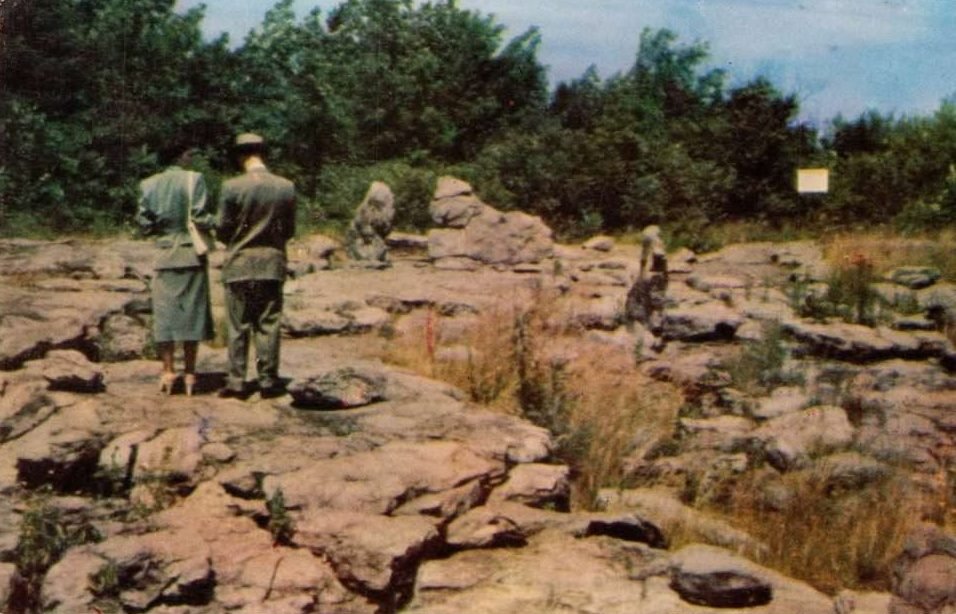
 Recently, while driving west on Route 29 just beyond the Saratoga Springs city limits, I passed Petrified Gardens Road. Instantly, childhood memories flooded back: unusual stone formations named the “Petrified Lion,” family picnics beneath the pines, and carefully choosing a souvenir from the rock shop.
I pulled off the road and called my older sister. “Do you remember the Petrified Sea Gardens?” I asked. We both remembered it fondly, but neither of us knew what had become of the place we had loved as children. How did this little attraction outside Saratoga become nationally significant — and why did we remember it so vividly?
The backstory of this property, which received both a National Natural Landmark designation (1967) and a National Historic Landmark designation (1999), captivated me.
It began 500 million years ago, when a vast inland sea covered our area.
Fast forward to the early 1920s, when amateur geologist and professional stonemason Robert Ritchie bought 20 acres for a summer camp.
He leased some of the pasture-like land to a neighboring farmer for his cows to graze. One day a cow fell into a deep crevice alongside the pasture.
Local author Sandra McClellan wrote, “Ritchie pulled away some of the sod around the crack and discovered a stone ledge patterned with strange-looking concentric circles.”
 Curious about his discovery, Ritchie sought the advice of the New York State Museum. Museum experts identified the unusual formations as fossilized stromatolites — layered structures created nearly 500 million years ago by colonies of algae, among the earliest forms of life on Earth.
(Winifred Goldring (1888-1971), a prolific scientist who overcame prejudice to become the first female New York State Paleontologist at the New State Museum, was an expert on stromatolites.)
As scientists studied Ritchie’s discovery, their interpretations of the formations evolved.
In a 1974 feature, former Saratogian reporter Shelley Riley explained, “Several cryptozoon (algae which secreted lime and built apartment houses in cabbage-style formations) were cut off from the massive reefs by glaciers that cut across our area during the Ice Age. The rocks embedded in the glaciers smoothed over the reefs and cut holes in some areas.”
Ritchie soon realized the exposed fossil reef was extraordinary. The concentric-circle patterns were unlike anything he had ever seen; comparable formations were known from only a handful of places in the world, including Manchuria and what is now North Korea.
Inspired by his discovery, Ritchie transformed the property into a 30-acre tourist attraction called The Petrified Gardens. Browsing one of the attraction’s earliest brochures, I was struck by his sense of wonder and his gift for inviting others to share it.
He enticed visitors with the promise: “As you walk from the Entrance Lodge toward the area of the petrified ledges, each footstep brings you closer to the beginning of our world.” Ritchie continued, “Everywhere are the clusters of plants-turned-to-stone, the ancient ‘Cryptozoons’ that flourished here when the world was young.”
The elder Ritchie continued working at his masonry company, Ritchie Brothers, while helping run and promote the seasonal attraction. In the 1950s, his son, Robert A. Ritchie, and his wife, Phyllis, left their successful gift shop business in Nantucket, Massachusetts, and returned to Saratoga Springs to take over operation of the family attraction, sometimes called “Ritchie Park.”
Under their stewardship, the gardens continued to evolve. In the late 1950s, the couple added the Dowd Time Garden and Sundial Museum in honor of Saratoga native Charles Dowd, whose proposal for standardized time helped shape the nation’s system of time zones.
 Recognition of the site’s importance grew: in 1967, Petrified Sea Gardens received National Natural Landmark designation, and by 1999, it was also designated a National Historic Landmark.
But family circumstances changed. Robert’s wife became ill, and medical expenses mounted. He felt forced to make the difficult decision to sell the property.
Although a national landmark designation sounds permanent, it doesn’t guarantee public access. A privately owned landmark can still be sold, and the designation itself doesn’t require a future owner to keep it open to visitors.
And so, the Petrified Gardens, once a familiar Saratoga County roadside attraction, is no longer accessible to the public.
Robert Ritchie did, however, leave a piece of the Petrified Gardens in Congress Park. In 1922, Ritchie and his brother, well-known stonemasons, built the Katrina Trask Memorial staircase, which provided an entrance from the former Katrina Trask House, a community center for women, to Congress Park.
Today, if you enter the staircase from the Holiday Inn parking lot, look for three dark, concentric-circled fossils embedded in the stairs: two flank either side of the first step, and a third sits at the center of the overlook. Ritchie included them as a personal signature of his work.
For those longing to see similar geological formations, drive a mile north on Petrified Sea Gardens Road to Lester Park, where visitors can view comparable limestone formations along the roadside.
And for the countless students who once wandered those paths on school field trips, marveling at the swirling formations in the rock, I hope they still treasure the memory of the small stone souvenir they picked out at the gift shop.
Perhaps the most important way the Petrified Sea Gardens survive is in the memories of the people fortunate enough to have experienced it.
Read More About Fossils in New York State
Carol Godette is a Saratoga Springs native and retired elementary school teacher who is a regular contributor to Simply Saratoga magazine and has published a book On This Spot: Saratoga Springs about local mom and pop businesses.
This essay is presented by the Saratoga County History Center.
Illustrations: Postcard views of Petrified Sea Gardens and a brochure from the attraction.
Recent Comments