
 The New York Provincial Congress was one of the first revolutionary bodies to outline a new inter-colonial program to finance the Revolutionary War.
On May 26, 1775, only two weeks after the Second Continental Congress met at Philadelphia, the Provincial Congress wrote to New York’s delegates that it was “clearly impossible” to raise by taxes a sum “adequate to the public service” and that it was equally certain that the existing paper money of the various states could not obtain ‘”universal circulation.”
[The existing “paper money” in pre-Revolutionary New York consisted of Provincial “bills of credit” denominated in the New York pound (pounds, shillings, and pence), which was valued well below the British sterling pound.
[To fund Queen Anne’s War in 1709 paper notes were authorized to serve as legal tender and were meant to be redeemed or retired using future tax revenues. Under the British Currency Act of 1764 paper notes were limited as legal tender for private debts only. In 1770 they were allowed for use in public debts and taxes.
[These notes were authorized by the colonial assembly and printed by prominent local figures like Hugh Gaine on thin paper.]
Consequently the Continental Congress would have to issue “an universal paper currency.” A committee was appointed by the New York Provincial Congress to consider “the expediency of emitting a continental paper currency,” and the Continental Congress was advised to await the committee’s report. Meanwhile, The Siege of Boston was underway.
Continental Currency
When it was issued on May 30, 1775 the New York Provincial Congress’s report on continental currency stated that since gold and silver were so scarce in New York, the money needed for the war would have to be paper. Since the danger of depreciation was so great the paper money must be issued in small quantities.
The best plan was to have the Continental Congress “strike the whole sum” and then apportion it to each colony, using some distinctive device to show each colony’s bills. After debate the report was adopted unanimously and forwarded to the Continental Congress.
This New York “plan for raising money” pleased the New York delegates at Philadelphia who promised to use their “endeavors to carry it through.” Although they realized that “for want of money” the New York Provincial Congress was facing “difficulties” in war preparations, still they urged that body to forward 5,000 barrels of flour to the army at Boston on the credit of the Continental Congress.
James Duane (1732-1797) wrote on June 17th that the “great complaint of the want of money” would soon be removed by an emission of continental paper money based on the New York plan. There can be little doubt that New York deserves credit for having suggested the monetary system that was used to finance the Revolution. The plan seems to have been formulated by Gouverneur Morris (1752-1816).
 The Second Continental Congress, on June 22, 1775, voted to issue $2,000,000 in “bills of credit,” for the redemption of which “the twelve confederated colonies” gave their pledge. These paper bills bearing the name “Continental Currency,” were issued in denominations of from $1 to $8, equally distributed, and a smaller amount in $20 notes.
The standard of value was the Spanish milled dollar in gold or silver. James Duane of New York was a member of the committee of five appointed to have plates engraved, to secure paper and to arrange for the printing.
To superintend the printing of the bills a new committee of three was named on July 21st. Four days later the Continental Congress ordered the issuance of an additional $1,000,000 in $30 bills, and authorized any two members of a committee of twenty-eight to sign bills, which were carefully numbered.
Each person who signed and numbered bills was paid $1,331/3 for every 1,000 bills after he had made a report of his work to the treasurers. On several occasions Congress had to urge greater speed in signing bills.
On July 29, 1775, the Continental Congress appointed two “joint treasurers of the United Colonies” and resolved:
1) That each colony should choose a treasurer (which New York had done three weeks before).
2) That each colony should arrange to pay for that portion of the continental money assigned to it on the basis of population.
3) That out of the $3,000,000 New York’s share was $248,139, which was the same as that of Connecticut, North Carolina and South Carolina, and the fifth largest sum.
4) That each colony should repay to the Continental Congress its share in four equal installments annually, the first being due on November 30, 1779.
5) That continental money should be accepted in the colonies for taxes on a par with gold and silver.
It was reported in the New York Provincial Congress on August 5, 1775, that a warrant had been issued for the assignment of $175,000 in continental notes to New York for money advanced and debts contracted in the public service.
First Continental Notes in New York
Arrangements were made to bring the money to the colony of New York, and on August 23d Egbert Dumond reached the city of New York from Philadelphia with the $175,000. The money was delivered to Peter Van Brugh Livingston, who on July 8th, had been made the “Treasurer of the Provincial Congress” and not to Abraham Lott, the colonial treasurer.
With this paper money New York in large part financed its war activities during the early months of the struggle. By an arrangement with Congress, New York was assigned an additional $50,000 from Pennsylvania, and on December 18, 1775, two men were sent to Philadelphia to get it.
 Other issues of continental currency followed the first one of $3,000,000. After making an estimate of the public expenses up to June 10, 1776, Congress on December 26, 1775, authorized a like amount in bills running from $1 to $8. Each colony received a share based on the number of inhabitants, and was to repay its quota in four equal annual payments beginning November 30, 1783.
The states were expected to raise the money by taxes, which might be paid in “Continental bills” as well as in gold and silver. This second issue was numbered from one upward in ink of a different color to distinguish it from the first. The same method of signing was used.
A table of the values of current silver and gold coins in continental paper money was approved on September 2, 1776. The next issue of $4,000,000 on February 17, 1776, consisted in part of fractions of $1, and these bills needed but one signature.
By November 2, 1776, $20,000,000 had been issued, and all but something over $3,000,000 put into circulation. Meanwhile the need of stabilizing the currency was so great that states were urged “to avoid as much as possible the further emission of paper currency” and to pay their quotas of the continental paper.
From 1777 issue followed issue in rapid succession until the country was fairly flooded with paper money. It is estimated that the forty issues from 1775 to 1779 amounted to about $242,000,000. Of the $32,200,000 issued by Congress between 1778 and 1782, New York’s allotment totaled $1,679,950.
New York’s Financial Struggles
In the year 1780, New York’s total apportionment of continental loans was given as $16,285,143, of which only about one-third or $5,785,143 had been repaid, leaving a balance due the United States of $10,500,000.
In addition, Congress had levied $416,445 against New York in “special taxes” of which only $24,825 had been paid. There was also a “current account” in which New York still owed a balance of $652,980. On the other hand, what the United States owed New York, was not known, and “large sums” were still due individuals in the State from the national treasury.
Robert Morris, July 25, 1781, urged Governor George Clinton to hurry up New York’s payments. Alexander Hamilton was appointed by Robert Morris “receiver of the continental taxes within the State of New York” in conformity with an act of November 2, 1781, no doubt with the expectation that he would obtain larger payments.
In this position Hamilton obtained experience that was invaluable to him in his later public services.
On July 30, 1782, Morris told the Governor that Congress had ordered the collection of State and national taxes separately, and complained that in the previous collections state taxes had been given precedence over continental. New York, he said, was in arrears for every state tax since 1776 and was applying continental taxes for the payment of back state taxes.
 The Governor was urged to find a remedy. It should be remembered that New York was greatly handicapped financially because the richest part of the State was in the hands of the enemy from 1776 to 1783.
Notwithstanding the supply of continental currency lent to New York, it was not enough to meet the mounting costs of the war, and other sums had to be secured. The devotion of men of wealth in New York to the American cause is shown in the fact that repeatedly they pledged their personal credit to carry on the war.
For example, on March 9, 1776, General Philip Schuyler gave his pledge personally to raise $5,000 in specie for the Canadian expedition [the Invasion of Quebec] because paper money would not be accepted by the Canadians.
On August 8, 1776, the Convention instructed a committee of three to borrow £10,000 to be repaid in a short time but without interest. A month later the Continental Congress advanced to the New York delegates $6,700 “for use of that State to be accountable.”
On September 28, 1776, New York got a special loan of $100,000 from Congress, which reached Poughkeepsie a few months later. Citizens of the State who were indebted to Loyalists, were encouraged by liberal terms to pay these debts to the Government, which took the ground that such payments might be regarded as forfeited property.
On November 22, 1777, another loan of $200,000 was secured from the National Government. Gouverneur Morris reported to Governor Clinton on September 6, 1778 that Congress had lent New York $485,000, which was less than that granted to any other state except Delaware and Virginia.
New York Currencies
New York was not content with continental money but decided to use its own credit for an issue of state paper “bills of credit.” A ways and means committee was appointed, tasked with finding the “ways and means” to pay for the Revolutionary government’s debts.
 On September 2, 1775, the New York Provincial Congress authorized an issue of £45,000 or $112,500 in paper bills, half “to be sunk,” or retired, in March 1776, and the remainder a year later, from taxes levied on the people as follows:
1) Local committees should appoint “two or more assessors and one or more collectors.”
2) County committees should supervise collections by cooperating with the assessors and collectors.
3) Those persons refusing to pay their taxes should have their goods sold.
4) The general county committees should appoint county treasurers to receive money from collectors.
5) The county treasurers should send the money to the “Colony Treasurer.”
6) The money should be used to “sink” or redeem the paper issue.
7) In case the committees failed to act by November, the Provincial Congress should fix quotas and appoint collectors.
By December 9, 1775, the Continental Congress was advised that the New York bills were printed and ready for signatures. The Provincial Congress, however, was in doubt about the wisdom of complicating the financial system with money that would not circulate easily outside the colonies that issued it, and therefore advised Congress to make all money continental currency.
That body was asked whether it would lend New York the needed £45,000. The request was refused on the ground that it would establish a bad precedent. New York then decided to proceed with its own issue. Since there was not sufficient room for the signatures of the three men authorized to sign the bills, it was decided that any two signatures would suffice.
On January 6, 1776, Isaac Roosevelt (1726-1794) was ordered to have the bills signed “with all possible dispatch.” The issue was increased to £55,000, or $137,500 [in 1926 dollars], and consisted mostly of small bills to facilitate the making of change.
So active were the military preparations for war in New York that by May 8, 1776, it was reported that the treasury had been empty for three weeks and many bills were owing, hence Isaac Roosevelt was instructed to have the remaining half of the $137,500 printed, numbered, signed and sent to the Treasurer without delay.
Both the continental and New York paper money was made legal tender for all debts, public and private.
Funding Local Revolutionaries
An important phase of financing the Revolutionary War was to supply the local political units with funds. The county and district committees needed money to carry on public business and to render aid in the war. Times were bad for levying local taxes and therefore the New York Provincial Congress was urgently pressed for cash.
 The Tryon County committee asked for a loan of £500 for scouts and said that the “association” would be broken if they should attempt to tax the people. The Albany County committee asked for cash on April 2, 1776, to carry on recruiting.
Appreciating the local situation, the Provincial Congress on March 13, 1776, voted that the “Colony Treasury” should advance to the county committees the following sums out of the issue of provincial bills of credit:
City and County of New York £1,200
City and County of Albany 800
Suffolk County 460
Westchester County 430
Dutchess County 420
Tryon County 400
Ulster County 360
Kings County 200
Orange County 200
Richmond County 129
Cumberland County 100
Charlotte County 100
Total …. £4,799
The Treasurer was to lend these sums to the county committees on order of the chairman and clerk, and the money was to be paid back when raised by taxes. Another loan of larger sums was made on January 14, 1777, and’ the county committees were ordered to report all sums received.
The county committees in turn supplied the district committees with funds. For instance, on July 17, 1775, the Schenectady committee received from the Albany County committee £100-2s. for “disbursements of this Committee.”
An interesting phase of New York’s desperate effort to finance the war was the issuance of paper money by the county committees. For instance, the Albany Committee of Correspondence finding it difficult to borrow money put out two issues of £500 each, one as early as June 22, 1775, to meet expenses, but the bills were soon canceled.
The next year an issue of £2,000 appeared. No doubt the action of Albany was copied elsewhere. Apparently this practice was discountenanced by state and national authorities. It seems that even private persons issued bills on their own credit.
Read more about New York in the American Revolution.
This essay is drawn, with minor editing for clarity, from Peter Nelson’s “The American Revolution in New York; its political, social and economic significance. For general use as part of the program of the Executive committee on the one hundred and fiftieth anniversary of the American revolution,” published by the University of the State of New York’s Division of Archives and History in 1926. It was annotated by John Warren.
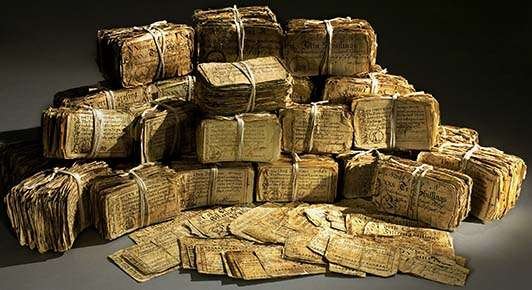
Illustrations, from above: A 1776 one dollar coin; A seven-dollar banknote issued by the Second Continental Congress in 1775; Continental currency 1/3 dollar note (obverse) with the inscriptions “Fugio” and “Mind your business”; an 1776 sheet of uncut $1-$8 Continental Currency; a New York Colonial 5 Dollar note, August 1776 ; and a hoard of colonial currency containing more than 6,000 notes issued between 1748 and 1771 by North Carolina (Colonial Williamsburg Collection).
Recent Comments