
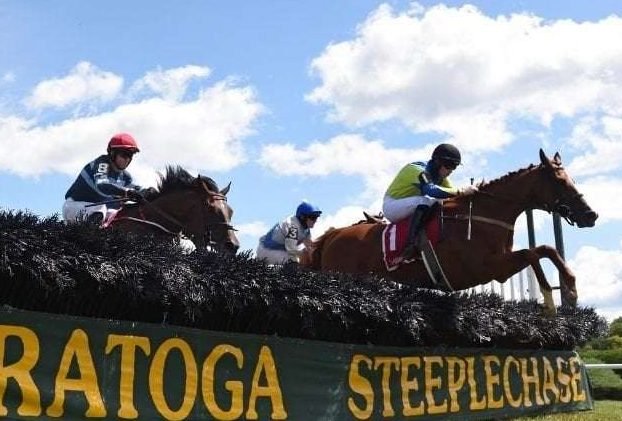
 The Jonathan Sheppard Memorial Stakes race is scheduled to be run at Saratoga Race Course on September 2, this season. This Grade 1 steeplechase race, with a purse of $150,000 will kick off the final week of this year’s track season.
The featured jump race at Saratoga was renamed in 2021, and had formerly been the New York Turf Writers Cup, which had been run previously at other racetrack locations in the Empire State.
This race honors the memory of Hall of Fame Trainer Jonathan Eustace Sheppard, who was born in the West Midlands of England in late 1940, during the height of the Nazi Blitz. Raised on a farm near the Village of Ashwell, horses were always a part of his life. Sheppard became an excellent horseman and rode competitively in point-to-point contests.
In the early 1960s Sheppard began riding in the US for famous jump-jockey turned trainer, W. Burling Cocks. In 1965 Jonathan Sheppard turned from riding to training thoroughbreds. He found success on turf and dirt, on the flat, but especially over fences.
His native proclivity for jump racing shone through, and he had the additional assistance of his wife, Cathy Montgomery Sheppard, a retired jockey herself. They based their operations at Ashwell Stable in West Grove, Pennsylvania.
 Jonathan Sheppard had unparalleled success at Saratoga Race Course. At the nation’s premier meet, he won at least one race from 1969 through 2015, or 47 consecutive years. He won the New York Turf Writers Cup 15 times.
Knowledge and skill are imperative in steeplechase training, yet the real secret is patience, with top jumpers taking years to develop and the best equine competitors being of a fully mature age. Sheppard would often train his horses at the farm rather than the track.
In the mid-1980s Sheppard trained the Hall of Fame brown gelding Flatterer, whom he had bred along with the co-owner William L. Pape, a Long Island auto dealer. Flatterer won the New York Turf Writers Cup in commanding fashion in 1984.
In the 1985 New York Turf Writers’ Cup, with Flatterer entered, nearly all the other entries scratched, forcing a rare cancellation of the race at Saratoga. That unusual edition of the New York Turf Writers Cup was conducted at Belmont Park in October, on the turf without fences.
The Empire State is a long-time host to steeplechase and hunt racing. Long Island’s original Belmont Park opened in 1905, which was comprised of 400 acres north of the Hempstead Turnpike and 160 acres on the south side. The track designers built a passenger rail terminal on the southern acreage, where they also staged jump racing.
The United Hunts Racing Association held amateur steeplechase events there, with the proximity of the rail connection giving rise to the name, Belmont Park Terminal Course.
 In 1922 John McEntee Bowman became the President of the United Hunts Racing Association, he being the personification of the “American Dream.” Mr. Bowman, in rags-to-riches style, ascended from immigrant stable groom, to multi-millionaire owner and track operator, while developing a successful national business brand, the Biltmore Hotel chain.
Track management re-evaluated priorities following August Belmont’s death. They decided to convert the land surrounding the rail terminal into a housing development. United Hunts, whose mantra had always been “for sport’s sake and better sport,” conducted their last meet over the Belmont Park Terminal Course in the spring of 1927.
Prior to the cessation of the Terminal track, Mr. Bowman began building a luxury resort north of Manhattan in Rye, New York. He sought a new standard for accommodation and resident services with this novel operation.
With United Hunts losing their competition site in Metropolitan New York, John Bowman decided this Westchester County location could provide the solution.
A new steeplechase course known as Bowman Park, built in just 30 days, became operational in October 1927. Designed as a complete racing plant and innovative home for sport on 125 acres, visitors would find every comfort and convenience.
The second season in 1928 at Bowman Park was more exciting than the first, with Amelia Earhart shooting touch-and-go’s on the polo grounds in her Avro Avian, while she resided at the Putnam residence in Rye, completing her first book of female flight adventures.
The inaugural running of the New York Turf Writers’ Steeplechase was added to the 1928 season stakes schedule. The conditions were four-year-olds and up, gentleman riders, for 3.5 miles over post and rail. (Gentleman rider is an archaic term for amateur rider, and is always prefixed with the abbreviation “Mr.”)
The scribes who labored under familiar mastheads, most which no longer exist, made a few failed attempts to organize themselves into an association in the early 1900s. Their tasks bound them together in purpose, providing accurate reporting from the press boxes of the racing world, under the pressure of a daily deadline. The New York Turf Writers’ Association was formed as a guild in 1923.
 The first winner of the New York Turf Writers’ Steeplechase was Gold Trap, a bay gelding owned by Walter O. Briggs and ridden by Mr. Alexis G. “Lex” Wilson, a highly regarded amateur jump-jockey of the day. The turf writers cut-up over the runner-up ridden by the legendary Mr. Rigan McKinney, being hard to handle from the start, and appropriately named Lunatic. Polish nobleman Count Alexander Rostworowski finished third on Nimrod.
The same winning owner/rider combination from the initial running prevailed again in the 1929 Turf Writers’ Steeplechase, with a “timber-topper” named Lieutenant Seas finding his usual place out front, navigating over a sloppy course in downpouring rain. Incidentally, Mr. Briggs was the principal owner of the Detroit Tigers baseball franchise for many years.
The 1930 New York Turf Writers’ Cup saw windy and dry conditions at Bowman Park, and a nine-year-old veteran fencer named Barleycorn, in the colors of Mrs. Thomas W. (Adelaide) Durant, ridden by Mr. Charles R. White, succeed by nine lengths in the feature race of the day. It is nearly certain, that Barleycorn would have been a “hunch-bet” for many, attending a race at Rye.
The jump racing events at Bowman Park were sanctioned by the National Steeplechase and Hunt Association, presently known as the National Steeplechase Association (NSA), making these contests regulated and recognized by the official authority for U.S. steeplechase horse racing.
 The Westchester venue enjoyed a few years of success, developing a fine reputation for Bowman Park. Some prolonged poor autumn weather and Mr. Bowman’s health became negative issues for the track, and their fifth season was unfortunately cancelled. In late October 1931, John McEntee Bowman died following complications from gallbladder surgery.
For many years afterward the property which comprised Bowman Park was used for hunt events, polo matches, horse shows and fairs, under the name Blind Brook Turf & Polo Club, which included a golf course. In 1967 PepsiCo acquired the western portion of this property, which included the track and
polo fields, for their global headquarters campus. The eastern half remains viable for golf as the private Blind Brook Club.
These unfortunate circumstances in the early 1930s put the New York Turf Writers’ Cup event into an extended hiatus, and the United Hunts Racing Association without a dedicated venue.
The New York Turf Writers revived sponsorship of their Cup Stake in 1938, at Belmont Park, under differing conditions, a dramatic shift from four-year-olds and up, gentleman riders, for 3.5 miles over post and rail, instead to two miles over hurdles.
The card-carrying members of the New York Turf Writers’ Association were quick to tout in their broadsheets the return of their sponsored event. Bill Vreeland wrote in the Brooklyn Eagle, “The New York Turf Writers’ Cup, which has not been raced for since 1930, is to be brought back into competition at the Autumn Racing Association at Belmont Park Election Day.”
Dan Boehm in the New York Sun wrote, “Of unusual interest is the revival of the Turf Writers’ cup event which had its last running in
1930.”
Fred Van Ness in the New York Times wrote, “There was great interest in the steeplechase for the New York Turf Writers’ Cup, put back into competition after a lapse of seven years. It had last been at stake in 1930, and under the new conditions making it a brush race, it will probably become one of the popular trophies at the meet each year.”
With-tongue-in-cheek, Toney Betts wrote in the New York Post that the Turf Writers’ Cup, “had been lying around a Chatham Square [Chinatown] hock shop since 1930.”
 The United Hunts Racing Association, originally incorporated in 1905 and the sponsor of the New York Turf Writers’ Cup event for many years, was merged into the National Steeplechase and Hunt Association (currently the NSA) in 1968, as their purposes and interests were essentially identical.
This would lead one to believe that all records of the events would transfer as well, yet the initial three New York Turf Writers’ Cup events are not included in the New York Racing Association’s (NYRA) record for the event, which dates back only to the 1938 renewal.
Wesley Faulkenberry, Curator of The National Steeplechase Museum in Camden, South Carolina conjectures that the change in race conditions could be the reason the 1928, 1929 and 1930 occurrences at Bowman Park are not included in modern accounts of the history of the present Grade 1 race, contested for many years at Saratoga Race Course as the New York Turf Writers’ Cup, and presently known as the Jonathan Sheppard Memorial Stakes.
Saratoga denizens will hope for favorable weather for this upcoming annual event, named for the steeplechase sport’s all-time leading trainer.
Read More About Horse Racing in New York
Illustrations, from above: A Saratoga Race Course Steeplechase (courtesy Saratoga Race Course); results from the first running of the New York Turf Writers’ Steeplechase at Bowman Park (from The Official Horse Show Blue Book, 1928); John McE. Bowman in Master of Foxhounds (M.F.H.) toggery. From Westchester Home Life May 1930; Mr. Alexis Wilson in the lead, over post and rail, on Walter O. Briggs’ good jumping gelding Gold Trap (Polo Magazine, June 1928); and Jonathan Sheppard, right, accepts a plaque honoring his 1,000th steeplechase training victory at the 2010 Far Hills Races in New Jersey. Presenting the plaque is Guy Torsilieri, who was then president of the National Steeplechase Association (photo by Don Clippinger).
Recent Comments