
 During the summer of 1776, General George Washington knew that the city of New York had to be held. He also knew that the city could not be held. “Whoever commands the sea must command the town,” General Charles Lee wrote from New York earlier. By the end of June, the British commanded the sea.
From a vast fleet anchored off Staten Island, the largest expeditionary force in British history began landing thousands of regular troops and German mercenaries. Only days later, the Second Continental Congress formally declared independence. “The fate of unborn millions,” Washington wrote to his men, “will now depend on the courage and conduct of this army.”
Determined to contest New York in spite of the British threat, Washington established a ring of fortifications around Brooklyn Heights on the western tip of Long Island. Several miles east of these main works, Continental troops lined a heavily wooded ridge known as the Heights of Guan. They dug in along the narrow passes, hoping to hold off the British advance.
 On August 22, British troop transports crossed New York Bay, landing thousands of redcoats on the southern shore of Long Island. Over the next two days, flatboats ferried thousands more across the water. Hessians and British soldiers assembled across the plains facing the ridge. “A force so formidable,” wrote one British officer, “would make the first power in Europe tremble.”
On August 25, Washington sent reinforcements across the East River to Long Island. He left about half the troops on Manhattan Island. Military convention strongly warned against dividing an army in the presence of a superior enemy. But Washington could not decide — he had to defend both Long Island and the city.
He was afraid the Long Island maneuver might be a feint. He warned officers that a British incursion was likely to be “sudden and violent.”
For twenty-four hours, the lines remained quiet. But British intelligence soon discovered a fatal flaw in the American defense. While the patriots had guarded the passes along the ridge, they had left the far eastern pass — Jamaica Pass — virtually unguarded.
On the night of August 26, a British column of ten thousand men and fourteen field guns marched silently through the darkness, slipping completely around the unsuspecting American left flank.
 On the morning of August 27, the British launched a noisy demonstration against the American right near the coast, while Hessian mercenaries advanced toward the center. Cannon and mortars opened a heavy bombardment along the ridge.
“Both the balls and shells flew very fast,” an American officer observed, “now and then taking off a head.” For many green recruits who had never experienced pitched battle, the sudden decapitation of a comrade was a horrifying introduction to the hallucinatory world of combat. Yet, as the officer noted, “Our men stood it amazingly well.”
But then the veil dropped. The frontal attack was a diversion. Having swept around Jamaica Pass, the main British army poured down the road behind the American lines, marching directly toward the main fortifications at Brooklyn Heights.
At that moment, the Hessian regiments in the center launched a ferocious bayonet charge. Massive, brass-helmeted grenadiers surged up the ridge. Suddenly, the Americans realized British troops were firing on them from behind. They had broken through and were rolling up the whole patriot army.
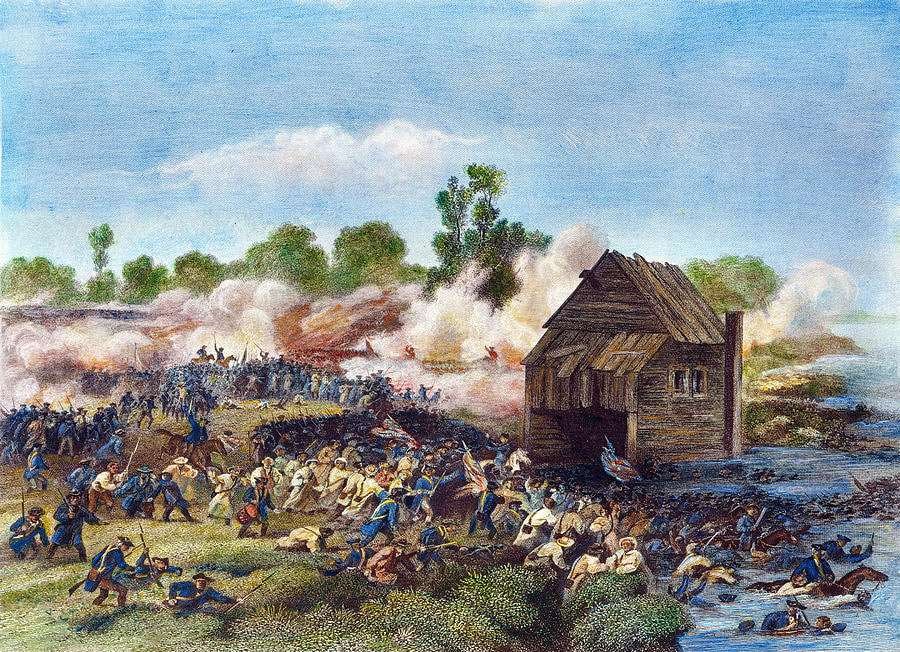
Caught in a vise between Hessians in front and British infantry behind, the American men collapsed into chaos. Soldiers threw down their muskets and fled toward the safety of Brooklyn Heights, fear giving wings to their feet as they sprinted across two miles of open terrain.
 On the American right, however, heroic troops took a stand. To buy time for the retreating army, the Maryland Line held off the British forces. While hundreds of panic-stricken soldiers slogged and swam across the muddy, tide-swollen Gowanus Creek, the Marylanders repeatedly charged superior numbers.
Watching the desperate action through his spyglass from the hill behind them, Washington cried out in anguish: “Good God! What brave fellows I must this day lose!”
By noon, the largest battle of the Revolutionary War was over. Three hundred Americans lay dead, eight hundred were wounded. More than a thousand were captured, including three generals.
The following day, cold rain began to fall. Washington ordered fresh regiments over from Manhattan to reinforce the lines, their beating drums briefly lifting morale. Yet Washington recognized his desperate position.
If the British fleet sailed up the East River behind him, his entire force would be trapped on Long Island—and the rebellion effectively crushed.
Fortunately for the Americans, a fierce nor’easter blew in, preventing British warships from moving into the river.
On August 29, under cover of heavy rain and wind, Washington — who had not slept for forty-eight hours — quietly ordered every available boat along the Manhattan waterfront to be gathered and brought to Brooklyn.
 That night, Washington executed a daring secret evacuation. Moving 9,500 men, heavy artillery, and supplies across a mile-wide river required absolute discipline. Regiments had to hold the trenches to maintain the illusion of a full defense, stepping silently down to the boats in shifts as their turns arrived.
Sailors rowed back and forth all night. Dawn came but hundreds of men remained on the Brooklyn side. Luckily, dense fog formed along the waterfront and continued to obscure the enemy movement of the American escape.
By 7 am the troops had boarded the rest of the boats. Washington himself stepped onto the last vessel. He had safely evacuated his entire army without losing a single life during the retreat.
Following the victory, one British general wrote to his sister. He ended with the poignant soldier’s cliché — he would, he assured her, be home by Christmas. It was not to be. The War of Independence would continue for seven grueling years before peace would return.
Read more about the Battle of Brooklyn (also known as the Battle of Long Island)
Illustrations, from above:a detail from John Trumbull’s “George Washington and William Lee,” 1780 (Metropolitan Museum of Art); British troops landing from the fleet; map showing the battle movements; colonial troops under Stirling retreat across Gowanus Creek in a painting by Alonzo Chapel; and a colorized version of J.C. Armytage’s “Washington’s Retreat at Long Island,” 1860 (Library of Congress).
Recent Comments