
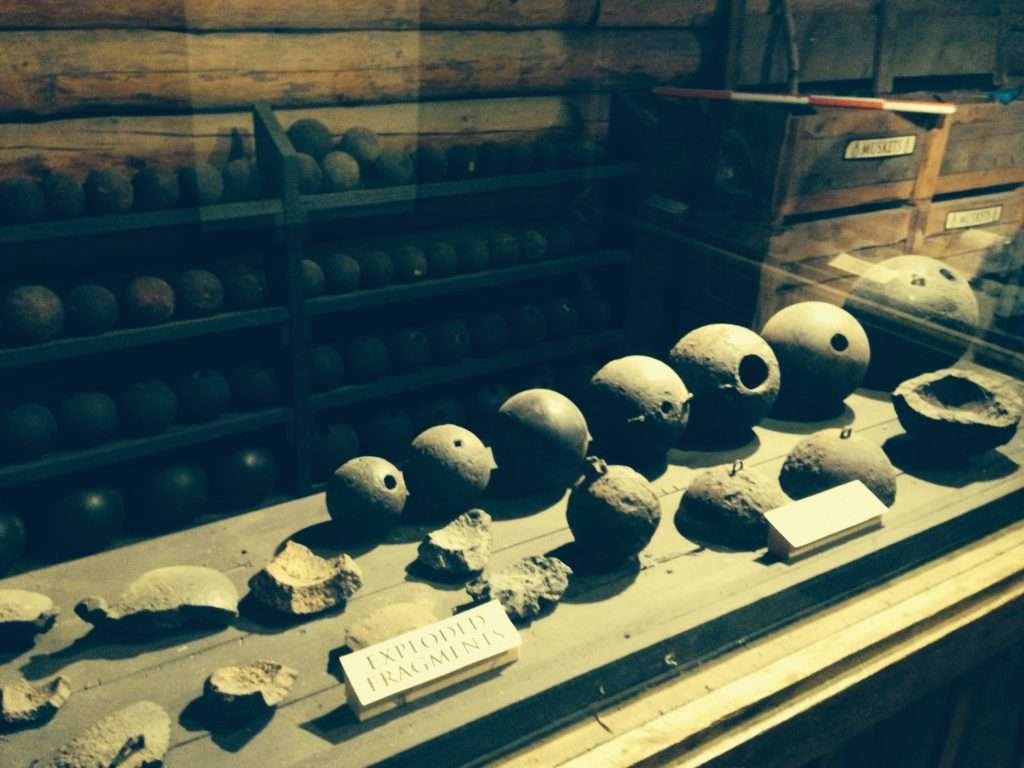
 In November 1940, Clayton Bly, a lumber company employee and a military veteran of World War I (1914–1918), unearthed two cannonballs from the Virgin Hollow neighborhood of Lake George.
At the time, Bly probably did not realize he stumbled upon a little understood chapter of Lake George’s colonial history.
Virgin Hollow is in the southwestern part of Lake George Village, near the foot of Cobble Mountain (aka Rattlesnake Cobble). Virgin Hollow is where famed U.S. Navy polar aviator Floyd Bennett lived as a youngster, before moving to nearby Warrensburg.
The two cannonballs uncovered by Bly were a 6-pounder, 3½ inches in diameter, and another weighing 3½ pounds (either a 3- or 4-pounder) with a diameter of about 2½ inches.
The literature record does not reveal if Bly’s ordnance had identifying marks–a British broad arrow, a French fleur-de-lis, or no markings at all.
 Lake George had significant military occupation in the French & Indian War (1754–1763) and during the Revolutionary War (1775–1783).
Since the 1826 publication of James Fenimore Cooper’s novel The Last of the Mohicans people have been fascinated with the August 1757 Siege of Fort William Henry.
The British garrison was captured by the French and their Indigenous allies. It was then burned by the French before they returned to their forts in the Champlain Valley.
In May 1954, the Fort William Henry Museum, a replica of the original garrison, opened to the public. Since then, the tourist attraction’s staff has interpreted the history of the military garrison and the events of the French & Indian War.
The grounds of Fort William Henry were first professionally excavated in the early 1950s by Stanley Morton Gifford, a Syracuse, New York archaeologist. Gifford’s fieldwork was paid by Fort William Henry Corporation, the entity that owned the replica fortification.
Four decades later, Chestertown’s Dr. David Starbuck began a multi-year excavation of the site of Fort William Henry.
Other archaeological studies over the years have been conducted at nearby 18th-century military locations including Fort George, Fort Gage, Million Dollar Beach, and more recently at a Revolutionary War burial site in a Lake George residential neighborhood.
Further, a comprehensive literature study on Fort George and nearby environs was completed in 2018 by Hartgen Archaeological Associates.
From 1993–1996, a five-acre French & Indian War military encampment was intermittently excavated by Albany’s Collamer & Associates, hired by Niagara Mohawk Power Corporation (NiMo), today’s National Grid. That archaeological site appears to have been close to where Clayton Bly made his 1940 ordnance find.
The NiMo site’s artifacts, now in the New York State Museum’s archaeological collection, include gun flints, lead balls, bottle fragments, kitchen bones, kaolin pipe fragments, and other material culture.
 Those relics appear to be mostly from a French military encampment. However, no cannonballs, either French or British, were recovered at the NiMo site during the cultural resources management fieldwork in the 1990s.
Dr. Russell P. Bellico is author of several regional history books, including Sails and Steam in the Mountains–A Maritime and Military History of Lake George and Lake Champlain and Empires in the Mountains: French and Indian War Campaigns and Forts in the Lake Champlain, Lake George, and Hudson River Corridor.
A few years ago, Bellico commented on the military occupation along the higher ground, southwest of Fort William Henry, near Bly’s 1940 recovery of two cannonballs.
“It is too bad we don’t know the exact location of the 1940 Bly discovery,” said Bellico, today a professor emeritus at Westfield State University, Westfield, Massachusetts.
“The locale of these two cannonballs, the NiMo colonial military site, and the 1758–1759 Fort Gage were areas with 18th-century military activities. French troops were near there during their August 1757 siege of Fort William Henry. Also, Gage’s Light Infantry, a British unit, spent time in this district in 1758.”
Read more about Fort William Henry.
A version of this article first appeared on the Lake George Mirror, America’s oldest resort paper, covering Lake George and its surrounding environs. You can subscribe to the Mirror HERE.
Illustrations, from above: An exhibit of cannonballs and mortar bombs excavated in the 1950s at Fort William Henry (photo by Joseph W. Zarzynski); a ca. 1870 stereograph, showing Cobble Hill (Deloss Barnum); and an artifact bag, in the collection of the New York State Museum, with a lead musket ball (Susan Winchell-Sweeney, New York State Museum).
Recent Comments