
 Before East Line Road marked the boundary between the town line between Ballston and Malta, it marked a community. Today, only a roadside sign hints at what once stood at the crossroads of Route 67 and East Line Road:
“East Line. An early community ca. 1780. ME Church built in 1809. Nearby was a hotel, a tavern, and by 1837 an RR stop.”
East Line Hamlet emerged in the late 1700s as a small but active settlement shaped by early turnpikes, farming families, and the growing influence of nearby Ballston Spa.
Originally part of Stillwater, the area became part of the newly formed Town of Malta in 1802. Though East Line never incorporated or grew into a village, it served as a recognizable hub for travel, trade, and rural life.
The Eastline Hamlet became an important stop on the Rensselaer and Saratoga Railroad (R&S). The R&S was part of a railroad company that operated in both New York and Vermont. When it was chartered in 1832, it ran between Troy and Ballston Spa, the first 25.2 miles of its tracks.
Interestingly enough, it never reached Saratoga Springs but connected with the Saratoga and Schenectady Railroad in Ballston, providing service to both of those cities. The railroad was built by businessmen in Troy, to compete with the construction of the Mohawk and Hudson Railroad.
However, when R&S could not reach an agreement for access to the Saratoga and Schenectady as a connecting point, investors bought up the stock for that railroad, taking control of both lines.
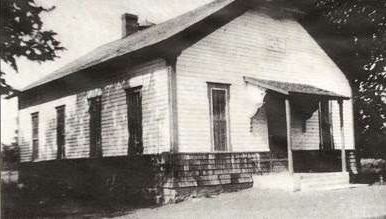
However, the hamlet was more than just a railroad stop. It was a crossroads that was once called The Four Corners. The Methodist Episcopal Church was built in 1809 at the northeast corner of what is currently Route 67 and Eastline Road.
In 1823, it hosted the New York Annual Conference of the Methodist Episcopal Church. The Church was transformed into a one-room schoolhouse in 1870 and became known as Ballston School #3, and Malta District School #8. The schools were one and the same, however – located at the boundary of the towns of Ballston and Malta.
The local farming families sent their children to this one-room schoolhouse, no matter what side of the boundary they were from. Closing the school doors in 1937, it later served as an auction barn in the 1960s, a store, and a produce stand.
This building still stands but is vacant, and it makes passersby wonder about its origins, why it is not an official landmark, and if it will ever be restored.
A Crossroads Community
In the early to mid‑1800s, East Line sat along a major north–south route linking Ballston Spa, Round Lake, Malta, Mechanicville, and the Hudson River corridor.
Travelers, farmers, and tradespeople passed through daily. The hamlet’s meeting house, built in 1809, later became a railroad stop by 1837, becoming an anchor for both Malta and Ballston residents.
Families living at the crossroads and surrounding countryside balanced the demands of agriculture with seasonal work in mills, hotels, and transportation. Women sustained households through dairy production, gardens, preserving, and textiles, while men often worked beyond the hamlet.
The outlet of Ballston Lake, once called Long Lake, flowed into Malta at East Line before becoming an inlet of Round Lake, tying the hamlet into the region’s natural and economic landscape.
Among the families who defined East Line were George and Nancy Relyea. Married in 1882, they spent more than 50 years together in a home that blended domestic life with ministry. Both were active missionaries for St. John’s Episcopal Church, founded nearby in 1876.
Nancy served as president of the Women’s Auxiliary, organizing charitable efforts during the Great Depression, including a “mission box” of clothing sent to a Virgin Islands congregation for Easter. The couple also helped serve meals to Schenectady Savings Bank employees, a gesture of dignity during difficult times.
Local newspapers of the 1930s regularly recorded the rhythms of East Line life. These brief notes preserved the heartbeat of a hamlet that, though small, was socially vibrant. In November 1932, the Ballston Journal reported George’s hospitalization, marking the final chapter of his life. He and Nancy now rest in Dunning Street Cemetery in Malta.
The local press faithfully documented the life of East Line Hamlet, a living, breathing community. More than just a dot on the map. In the early 1930s, newspaper columns regularly noted the comings and goings of its residents, from church suppers to family visits.
These snippets, often just a few lines long, served as a social ledger, preserving the memory of everyday life. As late as the 1970s community events were noted in the Schenectady Gazette. The East line Homemakers were still active, meeting and planning social events
[1970] “Hostesses were named for fall meetings and final plans were made for the picnic at the meeting of the East Line Homemakers held recently at the Malta Ridge Methodist Church. The picnic will be held June 18 at Saratoga State Park.”.
[1972] “The Christmas party and dinner of the East Line Homemakers will be held Dec. 14 at Malta Ridge Methodist Church with members of the church serving the dinner.”
Decline and Disappearance
East Line’s decline mirrored that of many rural hamlets across New York State. As the Rensselaer & Saratoga Railroad and later the automobile redirected travel and commerce toward Ballston Spa, Round Lake, Mechanicville and Saratoga Springs, crossroads communities lost their purpose. Blacksmiths, wagon shops, taverns, and small stores faded away as transportation modernized.
The 1809 Methodist Episcopal Church, once the heart of East Line, did not survive as a congregation. By the late 1800s, its members had joined Methodist churches in Ballston Spa, Malta Ridge, and Round Lake.
By the early 20th century, East Line was no longer a functioning community, only the name of a road, one that still weaves around and provides access to other townships and lakes.
Historic maps, such as the 1856 county map showing “East Line P.O.,” confirm its presence: property owners, farm boundaries, a schoolhouse, and small businesses.
Nathaniel Bartlett Sylvester’s 1878 History of Saratoga County also documents its officers and notable residents, referring to them as living “at East Line” or “of East Line.” All the residents of East Line Hamlet should be remembered. They raised their children, went to church, and supported their community.
Though the hamlet itself has vanished, its stories that speak of families who worked the land, of churches and rail stops that once connected two towns, and of a community that quietly shaped the region’s early history.
East Line was not merely a road dividing Malta and Ballston; it was once a place that brought people together and has a place in the history of both towns.
Read more about Saratoga County.
Amy Shannon, an American storyteller from upstate New York, who operates the popular book review site Amy’s Bookshelf Reviews and a writer’s blog. Her books include Balls-Town: A Community of History, Friends, Neighbors, and Lingering Spirits, and Reminiscences of Balls-Town: Echoes and Whispers of Forgotten Legacies.
This essay is presented by the Saratoga County History Center.
Illustration: The Methodist Episcopal Church, built in 1809.
Recent Comments