
LinkedIn continues to see steady growth, based on insights shared by parent company Microsoft in its latest quarterly performance update.
However, the company doesn’t share a lot of insight into LinkedIn-specific performance within Microsoft’s broader report.
Before the app was acquired by Microsoft, LinkedIn used to share data on total users, user engagement and monthly actives. That provided tangible insights into how LinkedIn was growing, or not, with real numbers and notes.
But these days, not so much.
So what LinkedIn insight did Microsoft’s latest earnings update provide?
“LinkedIn revenue grew 12% (up 10% in constant currency) primarily driven by growth in Marketing Solutions,” the company reported.
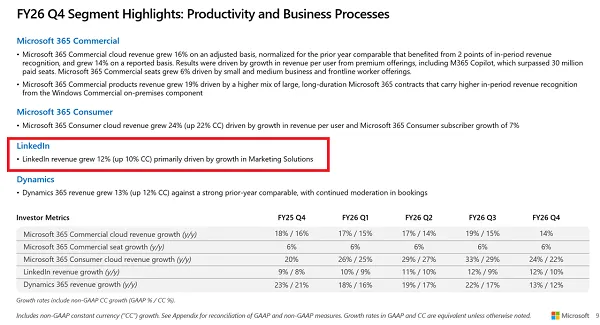
That’s not a lot to go on. Essentially, LinkedIn is making more money, based on growth in its ads business.
LinkedIn CEO Daniel Shapero did, however, post his own LinkedIn-specific performance notes shortly after the publication of Microsoft’s larger report, sharing that:
- LinkedIn saw double-digit member growth in Q2
- Content consumption is up 10% year-over-year
- Time spent on LinkedIn comments is up 18% year-over-year
Shapero also noted that more B2B brands are partnering with creators to enhance their LinkedIn promotions. That’s a key trend LinkedIn is looking to facilitate through the development of its Creator Marketplace and BrandLink initiatives.
Essentially, LinkedIn continues to grow at a steady pace as professionals turn to the app to engage in industry-related discussion in order to boost their profile.
LinkedIn is also working to stem the rise of bot-generated comments and artificial intelligence-generated replies.
Last week, the platform began testing a new option that will enable members to report any comment that “seems like AI slop” in-stream, which will also provide new signals to help LinkedIn improve its AI and bot detection measures.
The acknowledgment of the rising impact of AI comments could also relate to the reported rise in comments overall, so it’s hard to say whether LinkedIn is seeing an increase in genuine human engagement, or a rise in bots and AI posting to the app.
Maybe the differences will become clearer as these countermeasures take effect. These new measures may also help to ensure that LinkedIn maintains user trust by suppressing artificial interactions and highlighting real engagement among human users.
Though that’s also an interesting shift in tactics from an app that has been increasingly keen to add AI into every element.
Is this the beginning of a broader anti-AI movement from LinkedIn?
It’ll be interesting to see how users respond to its efforts to disincentivize AI use and drive more actual human interaction in-stream.
Recent Comments