
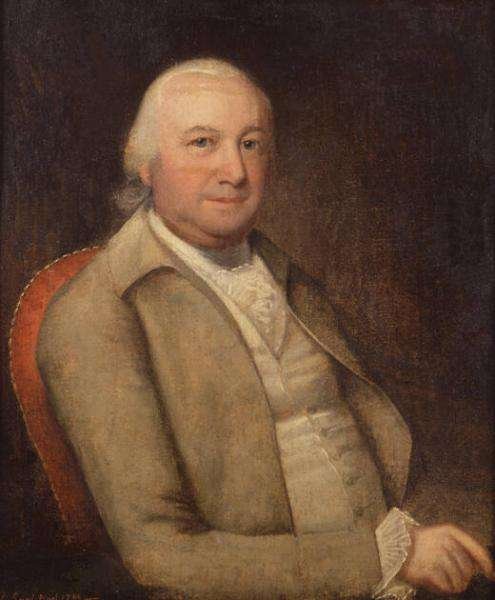
 William Gilliland was born in 1734 in Caddy, Northern Ireland. His father died while he was a boy and his mother re-married. He was said to have been talented and ambitious and initially sought to establish himself in business and society in the city of Armagh.
However, a frowned-upon liaison with the daughter of a local upper class family caused him to seek his fortune elsewhere.
He enlisted in the 35th Regiment of the British army. About 1756, he shipped out for America. In that year, he reportedly saw action at Lake George.
[At the time Lake George was a heavily contested frontier area. The year before had seen the construction of Fort William Henry, designed by the British Indian Supervisor of the Northeast Sir William Johnson as a forward position from which to attack the French position at Fort St. Frédéric (Crown Point), resulting in the September 1755 Battle of Lake George.]
[In 1756, British forces were busy building a fleet of armed sloops and bateaux. That summer saw the first of massacres at Half-Way Brook by French-allied raiding parties, and in September a provincial scouting party led by Captain Joseph Hodges was ambushed and nearly wiped out.]
[1757 saw an unsuccessful raid on Fort William Henry by French forces. In August they returned with a massive army led by General Marquis de Montcalm. After Lieutenant Colonel George Monro surrendered the infamous massacre of the the withdrawing, disarmed British column occurred, an event dramatized in James Fenimore Cooper’s The Last of the Mohicans.]
In 1758, Gilliland he was characterized as “sickly” when he was discharged from the army at Philadelphia.
He soon found work in a mercantile house in the city of New York, a was known as a New York “merchant” by 1760.
He married Elizabeth Phagen of the same city in February 1759. She was said to be “beautiful and accomplished,” the daughter of his business partner. The marriage produced a number of children before her death about 1780.
As a veteran, in 1764, Gilliland was able to obtain a number of soldier’s land bounty shares to ultimately secure title to 2,000 acres on Lake Champlain.
In March 1765, he read a paper before the Society for Promoting Arts, Agriculture, and Economy in the Province of New York on the value of wilderness land. Two months later, he set off for the north and stopped at Albany.
[Founded in the city of New York in 1764, the society’s mission was to foster domestic manufacturing and agricultural self-sufficiency in the Province of New York.]
In 1766, the Albany holdings of “Gilliland and Shipboy” in Albany’s First Ward were valued on the assessment roll. In 1779, his house and lot in the Second Ward was taxed as well.
In 1766, he brought his family north and, with a number of recruited tenant/settlers, established the town he named Willsboro on the western shore of Lake Champlain. About that time, he secured an appointment as Justice of the Peace for “the whole of the Hampshire Grants.” Later, he would erect a mill at the falls of the Boquet River.
During the American Revolutionary War, he was removed from his settlement by the Revolutionaries and taken to Albany for confinement as a loyalist. More than once, he was released only to be confined again.
At the same time the governor of Canada also considered him disloyal to the crown. However, afterwards, he was accorded a land bounty right in conjunction with the Albany militia regiment.
[In 1776, the name of a “William Gilliland” appeared as a first lieutenant on the roster of the first regiment of the New York Line. Probably a different individual altogether.]
In 1782, he filed a claim for extensive damages done to his Champlain Valley property by the British. At that time, he identified himself as “at present of the City and County of Albany Merchant.” He did not mention Albany property, and by 1788, his Albany property was no longer listed on the assessment roll.
Afterwards, he spent some time in debtors’ prison in the city of New York.
In 1790, his household in “Wellsburgh” [Willsboro] in [what was then] Clinton County was enumerated on the first Federal Census.
He lived out the rest of his life in the home of his daughter in nearby “Bessboro” [Westport, NY].
He is said to have become deranged and wandered around the estate subject to the elements. Thus, William Gilliland died in 1796 of exposure at the age of sixty-two.
Read more about William Gilliland.
A version of this article was originally published as “William Gilliland” by the late Stefan Bielinski, founder and director of the Colonial Albany Social History Project, a model community history program he ran at the New York State Museum. It has been slightly edited and annotated by John Warren.
Illustration: William Gilliland portrait by Ralph Eleaser Whiteside Earl (1785/88–1838).
Recent Comments