

By William Schroeder, LPC – Clinically reviewed by Teri Schroeder, LCSW
Watching my nephew, who’s new to Austin, I’m reminded of an ever-present challenge that comes up for all of us with ADHD: staying focused and on track when motivation runs thin. Or, put simply, the challenge of ADHD and motivation.
There’s a neurological reason this happens. Research published in JAMA found that people with ADHD have measurable differences in the brain’s dopamine reward pathway, which helps explain why novelty and new ideas feel so intoxicating and it’s why the follow-through feels so much harder.
I have so many memories of that feeling of euphoria when imagining something new: moving to a new place, finding a new job, starting an ambitious plan. And then running into a brick wall of challenges and small steps before the thing can actually come to fruition.
Remember that feeling from youth… driving fast, the rush of it filling your soul? So many people describe their inspired stage of ADHD like this. Anything feels possible. It’s like a low-grade mania, and it can absolutely tie into the impulsive side of ADHD. That same dopamine reward pathway lights up around novelty and excitement. Simply put, the rush is real and it’s wired into your brain.
First off, I don’t want to discourage this. I believe it’s a valuable asset that people with ADHD have. It’s what allows them to start companies, build creative things, and become willful people who shape the world around them — and touch those lucky enough to know them. And this isn’t just romantic talk about ADHD strengths. Research from Johan Wiklund and colleagues at Syracuse University has found that ADHD traits – especially the impulsive, action-oriented side – correlate with stronger entrepreneurial intentions and a higher likelihood of actually starting a business.
The challenge is that this is the beginning of the process of pushing a boulder uphill, not the end of it. Weaknesses in planning and executive function, combined with any past shame around incomplete projects, can be detrimental. So when you hit that dip (and you will) know that it’s part of the process. All ambitious people hit it.
I was reminded of this watching my 25-year-old nephew ride the roller coaster of applying for new jobs. The excitement of landing interviews at these companies and dreaming through what a day in the life would look like, only to find out he wasn’t advancing in the process despite being a great candidate. An avalanche of frustration would hit, and a gloom-filled view of the world would overtake his perspective. And then having to keep mustering the motivation to apply for more jobs that might also be dead ends.
This isn’t that different from the person with a million great ideas who has a hard time turning them into action. In fact, this is all part of the process of change, ADHD or not. These dips happen regardless of your goals or capabilities.
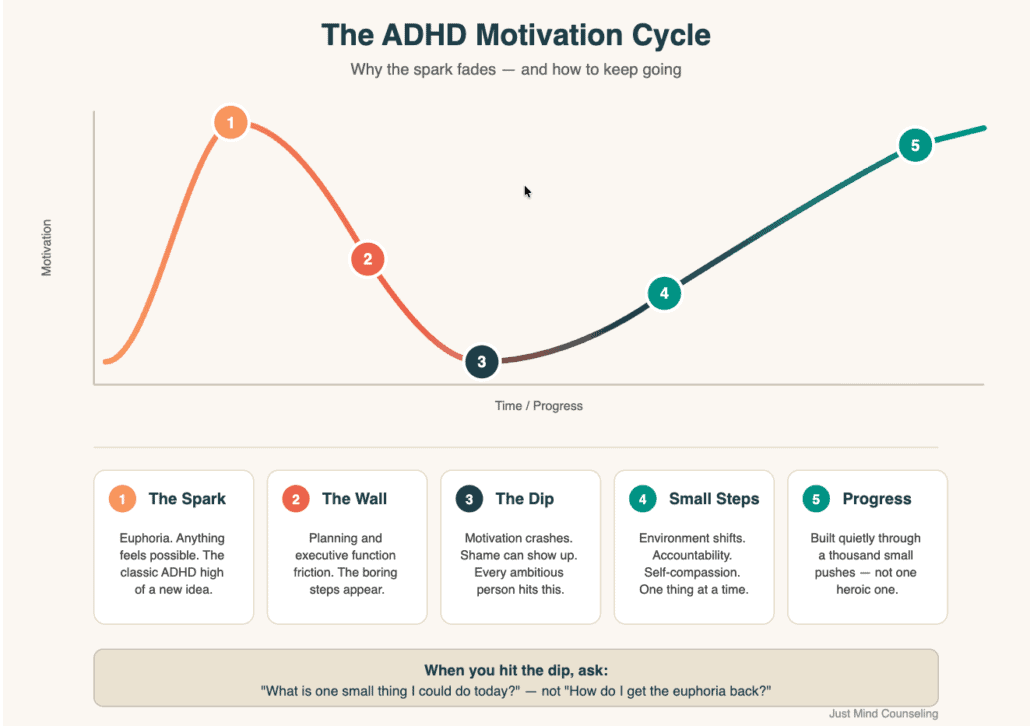
A simple framework for ADHD and motivation when the spark fades
When motivation runs thin, it helps to slow down and interview yourself about what’s actually getting in the way. Let’s say your goal is something simple, like eating healthier, but then you hit the wall of not really being much of a cook. Try these questions:
- On a scale of 0–10, how motivated are you to make this change?
- What is one thing that would help you be more likely to accomplish this goal? (This could be a roommate or friend who acts as an accountability partner.)
- Is there anything else you might adjust to make this goal more likely? (For example, the frequency — like only cooking something in a crock pot once or twice a week.)
- Do you need to change anything about your environment to accomplish this goal?
- Is there something small you could do to help you make progress? (Maybe it’s just buying some slightly healthier items to have around the house.)
- How are you treating yourself and taking care of your stress?
The strengths that come with ADHD
People with ADHD have unique strengths that often help them go on to be wildly successful in the things they’re passionate about such as opening small businesses, creating art, and building something out of nothing. The same brain that sparks the big idea is the brain that can carry it forward. The trick isn’t waiting for the euphoria to come back. It’s learning to trust the small, incredibly unglamorous steps that happen after the inspiration fades.
If you’re in the dip right now, you’re not failing. You’re in the part of the process most people don’t talk about. Be kind to yourself. Pick one small thing. Do it tomorrow. Then do another. That’s how the boulder moves. It’s not one heroic push, but in a thousand quiet ones.
Research also shows us that being kind to ourselves is an important part of progressing. Self-compassion helps to reduce procrastination by lowering the shame-avoidance loop. EMDR therapy can also help with this if shame feels deeply embedded.
If you’re tired of trying to push the boulder alone, working with a therapist who actually understands ADHD can help. Reach out. We work with ambitious people in Austin and across Texas who are looking for a thinking partner, not a quick fix.
Resources
Fuschia Sirois, multiple papers (2014–2020) on self-compassion and procrastination
Volkow et al. (2009), JAMA — “Evaluating Dopamine Reward Pathway in ADHD”
Russell Barkley, Taking Charge of Adult ADHD
Recent Comments