
 The following text is from articles printed in March 1832 about the destruction of one of the Hudson River lighthouses on a tidal marsh flat near Stuyvesant Landing, only shortly after its construction in 1830.
A massive, moving field of spring ice crushed the 20 by 34 feet stone structure and killed four children.
In 1828, to deal with a narrow place in the river between Columbia and Greene Counties, Congress appropriated $8,000 for two small light-houses: The northern one, which these reports deal with, about 1.5 miles north of Stuyvesant Landing on the east side of the river (called Kinderhook Light, and then Stuyvesant Lighthouse); and a southern one, on the northern tip of Coxsackie Island (also known as Rattlesnake Island), on the west side of the river opposite the Landing (also known as the Coxsackie Light).
The New York Evening Post, Saturday, March 17, 1832
Sir, — I am about to record one of the most afflicting and singular providences I ever witnessed. The Hudson River had been rising for more than 24 hours, when the ice began to give way. It was thought that the light-house standing about one mile above the [Stuyvesant] landing, was in danger of being injured by the large bodies of ice which were floating down the river.
About two o’clock to-day, two gentlemen [one named Charles M. Beecher, the other is unknown], with great difficulty, made the light house in a small boat, as it was now standing in and entirely surrounded by water.
They advised Mr. Witbeck, the occupant of the house, to leave it, together with his family, immediately.
[Volkert Whitbeck was the keeper of the lighthouse, his wife, and their daughter, Mrs. Van Hoesen were at the lighthouse. From 1841 to 1853 Whitbeck’s wife Christina (Van Alen) Whitbeck would become one of the first women to serve as lighthouse keepers on the Hudson River.]
They accordingly made preparations to do so, by removing their furniture into the upper story, and making a comfortable disposition of their cows and other stock.
When nearly ready to leave their threatened home, suddenly and with terrible violence the ice came rushing upon the house — they were startled by one awful and tremendous crash, and in less than a minute the whole two story stone edifice was a mingled heap of ruins.
The family, consisting of ten persons, with the exception of one, were in the building when it fell. Four of them disappeared, and were either buried beneath the ruins, or swept off by the impetuous flood.
 Two daughters of Mr. Witbeck — one aged 15 and the other 13 [sic, Elizabeth, age 11], and two of his grandsons, one 14 and the other 8 months old — were the unfortunate victims of this dire catastrophe.
By the timely assistance afforded by the two gentlemen above alluded to, who were near in a boat, six persons out of ten, were saved. The survivors were badly bruised, and on reaching the shore, so chilled and exhausted, that they were unable to walk.
They were taken to a house near by, and made as comfortable as circumstances would admit.
I am informed that it is not expected Mrs. Witbeck will recover, and that the recovery of the other members of the family is considered very doubtful. This family is now left in a destitute condition to share the lot of the suffering and of the poor.
The (Coxsackie) Greene County Advertiser, Wednesday, March 14, 1832
Damage by the Ice. The freshet in the river broke the ice at this place yesterday. In the morning footmen passed over; at 1 o’clock the ice began to move and in three hours it had nearly all disappeared.
At Coeymans [below Albany] they have sustained heavy loss. The store house on the dock of N. Stephens is nearly destroyed, together with a considerable quantity of grain; about one half of the store is carried away, and a schooner was driven into and nearly through the part left standing, where she remains.
[Nathan Stephens (1805–1885) was a prominent local figure during the peak era of Coeymans landing trade with Albany and the surrounding river towns.]
Another store house, with a quantity of hay in bundles, was swept off, and two or three vessels sunk.
We have sustained no damage at this place [Coxsackie], except that part of the new pier, which is to connect this with the Lower Landing, is carried away.
The (Poughkeepsie) Independence, Wednesday, March 21, 1832
MELANCHOLY OCCURRENCE — On Tuesday last, about 12 o’clock, the ice in the Hudson River at Stuyvesant Landing, began to give way. The river had at that time risen to an unusual height, the water being twelve feet above low-water mark, covering the docks to the depth of four feet, and making an entrance into most of the storehouses on the wharfs.
Serious and well-grounded apprehensions were entertained that every building along the margin of the river would be swept away, but happily those fears were not realized, the buildings having sustained only a trifling damage. The ice continued to move about, and apparently in one solid mass several miles in extent.
 During this interval, a most distressing scene was witnessed at the site of the upper lighthouse, situated a mile and a half above the Landing. This was a stone building, 20 feet by 34, and two stories high, with a mole surrounding it 4 feet in height.
[A mole is a massive stone structure used as a protective barrier, from from the Latin moles, meaning a large mass.]
The water had risen to the top of the mole before the ice began to move, which rendered the situation of the inmates truly alarming. Soon the immense field of ice above was seen to swing from its moorings, and coming down with irresistible force, struck the lighthouse, which in a moment was a heap of ruins.
There were at the time ten individuals in the building, four of whom, melancholy to relate, were buried under its crumbling walls.
Mr. Volkert Whitbeck, the keeper of the lighthouse, his wife, their daughter, Mrs. Van Hoesen, and three other individuals escaped from the falling edifice, barely in time to save their lives. Those who perished were: two daughters of Mr. Whitbeck, aged 15 and 13 years, and a son of Mrs. Van Hoesen, aged 12, and her infant child.
All must inevitably have found a premature death, but for the intrepid exertions of Mr. Charles M. Beecher, to whose praiseworthy efforts the rescue of the survivors is mainly attributed.
Mr. Beecher put off in a small boat from the shore to relieve Mr. Whitbeck and his family from their perilous situation, but owing to some delay in arranging the furniture etc., they were not prepared to leave the building until it began to fall — and then too late for some of the unfortunate inmates.
Afterward
The three older children killed at Stuyvesant Lighthouse are buried in the Butler Cemetery in Stuyvesant; the body of the infant was never recovered.
The disaster highlighted the dangers of placing lighthouse stations on unprotected tidal marsh flats without accounting for the sheer force of spring ice breakups.
Despite the tragedy, on June 30, 1834, Congress appropriated more money to replace this lighthouse on a pier at the end of the flat, six feet above the high-water mark. That light went into service in 1838.
 The lantern of this light contained five lamps with 13¾-inch spherical reflectors, each weighing about 2 pounds and six ounces.
This second lighthouse was considerably rebuilt in 1867-1869 and a solid granite pier was added.
In 1902 ice extensively damaged both the light and the one at the Coxsackie. The westerly wall was broken through; the northerly wall was cracked, and the parlor was filled with ice which broke through the floor into the cellar.
Ice also destroyed the outhouse, bridge, railing, and 700 feet of “four-strand wire-ribbon fence” with 2 by 4-inch cap that was built in 1897, and all the trees.
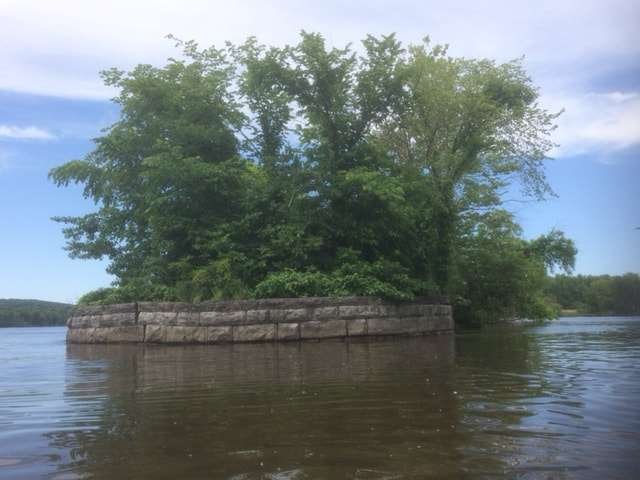
In 1933 the Stuyvesant Lighthouse was deactivated by the U.S. Lighthouse Service. It was torn down shortly thereafter, though its granite foundation remains today.
Stuyvesant Lighthouse Keepers: Volkert Whitbeck (1830 – 1832), Volkert Whitbeck (1835 – 1840), Jonas D. Whitebeck (1840 – 1841), Christina Whitbeck (1841 – 1853), Ann Whitbeck (1853 – 1866), Orville Gilmore (1866 – 1869), Henry McAllister (1869 – 1884), Edwin M. McAllister (1884 – to at least 1921), Charles R. Riley (from at least 1925 to at least 1930).
Read more about the Hudson River.
Read about The Ecological Impacts of 200 Years of Hudson River Dredging.
Thank you to Contributing Scholar Carl Mayer of the Hudson River Maritime Museum, for finding and transcribing these articles. John Warren contributed annotations with the help of reach from Lighthouse Friends.
Illustrations, from above: Remains of the granite foundation of the latter-day Stuyvesant Lighthouse (courtesy Lighthouse Friends); grave stone of Elizabeth Whitbeck in Bulter Cemetery, Suyvesant, NY, with inscription “In memory Elizabeth, youngest d/o Volkert & Christina Whitbeck, who died Mar 13, 1832, by the destruction of the light house, aged 11 yr, 11 mos, 13 days”; David H. Burr’s 1829 Columbia County Atlas map showing “Kinder Hook,” at the location of the Kinderhook-Stuvesant Lighthouse.
and the Stuyvesant Lighthouse in 1915, following being rebuilt in 1867-69 (National Archives).
Recent Comments