
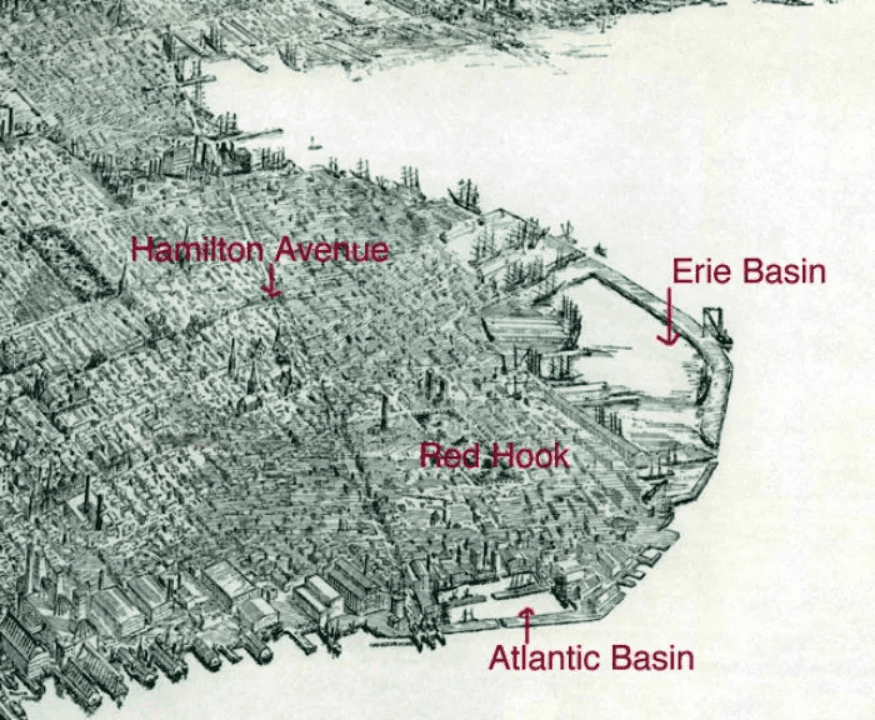
 With the construction of the Atlantic Basin on Red Hook‘s western shore in the 1840s, Brooklyn became the region’s great bulk goods handling center. The material dredged from the basin provided fill for other areas of Red Hook.
Around 1856, work began on the largest waterfront project in 19th century Brooklyn – Erie Basin, developed by William Beard and two brothers, Jeremiah and George Robinson.
This project, completed in 1880, occupied most of Red Hook’s remaining undeveloped marsh, beach, and land – primarily sand spits and islands – between Gowanus Bay and the Atlantic Basin.
 When completed, Erie Basin was a manmade harbor, surrounded by a hook-shaped protective breakwater and lined with piers and warehouses.
The construction of Erie Basin involved creating a narrow, temporary breakwater around the projected outer edge of the basin, and dredging the area behind it; the dredged material was then used to create inner bulkhead lines.
Then, outlines of the outer break-waters and bulkheads were completed (ca. 1864), enclosing about 60 acres of water, and the temporary barrier was removed.
The initial phase of construction on the long outer breakwater was begun about 1873. At this time, a 1,700-foot-Iong bulkhead was built facing the inside of the basin, with an unretained pile of fill outside, and an open pile bridge at the elbow.
Another open pile bridge connected this uncompleted breakwater to the mainland where Columbia Street is today. The breakwater consisted of crib-work extending 20 to 25 feet deep below mean low water, probably laid on level trenches excavated underwater.
Bulkheads, rising 10 feet above mean low water, were usually square timbers fitted onto crib-work logs. According to local legend, Beard filled his breakwaters with European rock ballast that had been carried on returning American ships, charging the ships to unload the material.
Development of Atlantic and Erie Basins transformed Red Hook into a major shipping and warehousing center for grain and general cargo storage.
Erie Basin became an important center for shipbuilding and a focus for local industries, and, for several decades, was one of the major grain storage and handling facilities in the Port of New York.
 By about 1910, most of the basin’s warehouses were converted from grain to general cargo handling, and a large shipyard occupied part of the basin.
By the end of World War I, the Todd Shipyard in the basin was the largest in the Port of New York, and shipbuilding support industries surrounded the basin, along with large lumber yards and sugar and firebrick manufacturing.
About 1920, a second phase of construction on the project site completed the long outer breakwater: the breakwater’s outer bulkhead, which had been an unretained pile of fill, was completed, and the open pile bridge connecting the breakwater to the mainland was filled in.
This involved building up and retaining the mass of fill behind the finished inner face of the breakwater. New York City soon took over this new section of the breakwater and rebuilt the bulkhead with steel sheet piling and a concrete wall to support a paved road, the extension of Columbia Street.
At the same time, surfaces along the rest of the breakwater were waded and new sheds were built.
By the early 1930s (and continuing at least until the 1950s), the bulkheads around the basin were gradually but extensively rebuilt. Often, this work involved replacing rotted timber bulkhead sections with new concrete walls on pile supports. Earth fill behind the new walls supported new concrete decks in the place of original earth surfaces.
In the late 1940s and 1950s, the Beard company modernized Erie Basin for changing shipping practices, replacing the old frame and metal sheds on the project site and continuing the complete rebuilding of the bulkheads there.
On the inner face of the south breakwater, all the crib-work was removed and replaced with an anchored steel sheet pile structure containing solid fill and surfaced with asphalt.
Handling a variety of commodities from South America and Asia, Erie. Basin served as a major shipping facility during World War II and the Korean War. However, the general decline m the port’s trade as a result of containerization led the Beard company to sell Erie Basin to the Port of New York Authority in the 1950s.
Construction of the Brooklyn-Queens Expressway further isolated the Red Hook area and use of the basin continued to decline. A bargeport remains.
Reprinted from an assessment of the archaeological sensitivity of the site of the Erie Basin, July 1991, submitted by Allee King Rosen & Fleming, Inc.. and available online here. Erie Basin map from the collection of Maggie Land Blanck.

Recent Comments