

CC-BY, provided by the author
What happens when students step outside the classroom and begin learning with their hands in the soil, sensors in their hands, and data on their screens?
At Primary School “Strasho Pindjur” in Negotino, North Macedonia, the Erasmus+ project Smart Green Spaces turned this question into a living learning experience.
Smart Green Spaces is not just about planting gardens or using technology—it is about reconnecting students with nature through inquiry, creativity, and digital innovation, while empowering them to understand and improve their own environment. Over the past months, students, teachers, and parents worked together to transform green areas into interactive learning laboratories, where biology, technology, mathematics, and civic responsibility naturally intersect.
Exploring Local Green Spaces Through Digital Eyes
The journey began with students stepping into their community as young researchers. They explored urban and peri-urban green spaces in Negotino, observing parks, gardens, and biodiversity hotspots. Using collected environmental data, they collaboratively created an interactive digital map that visualises local green areas and highlights their ecological importance.
Through this activity, students did not just learn about green spaces—they learned to care for them, understanding how digital tools can support environmental awareness and community engagement. Sharing the map with the wider community strengthened their sense of responsibility and showed them that their work can have real impact beyond the school walls.
From Seeds to a Smart Garden: Learning by Doing
At the heart of the project lies the school garden, fully designed, planted, and maintained by students. From preparing the soil and planting vegetables to monitoring growth, they experienced the full lifecycle of plants. What made this garden “smart” was the integration of sensors and micro:bit technology.

CC-BY, provided by the author
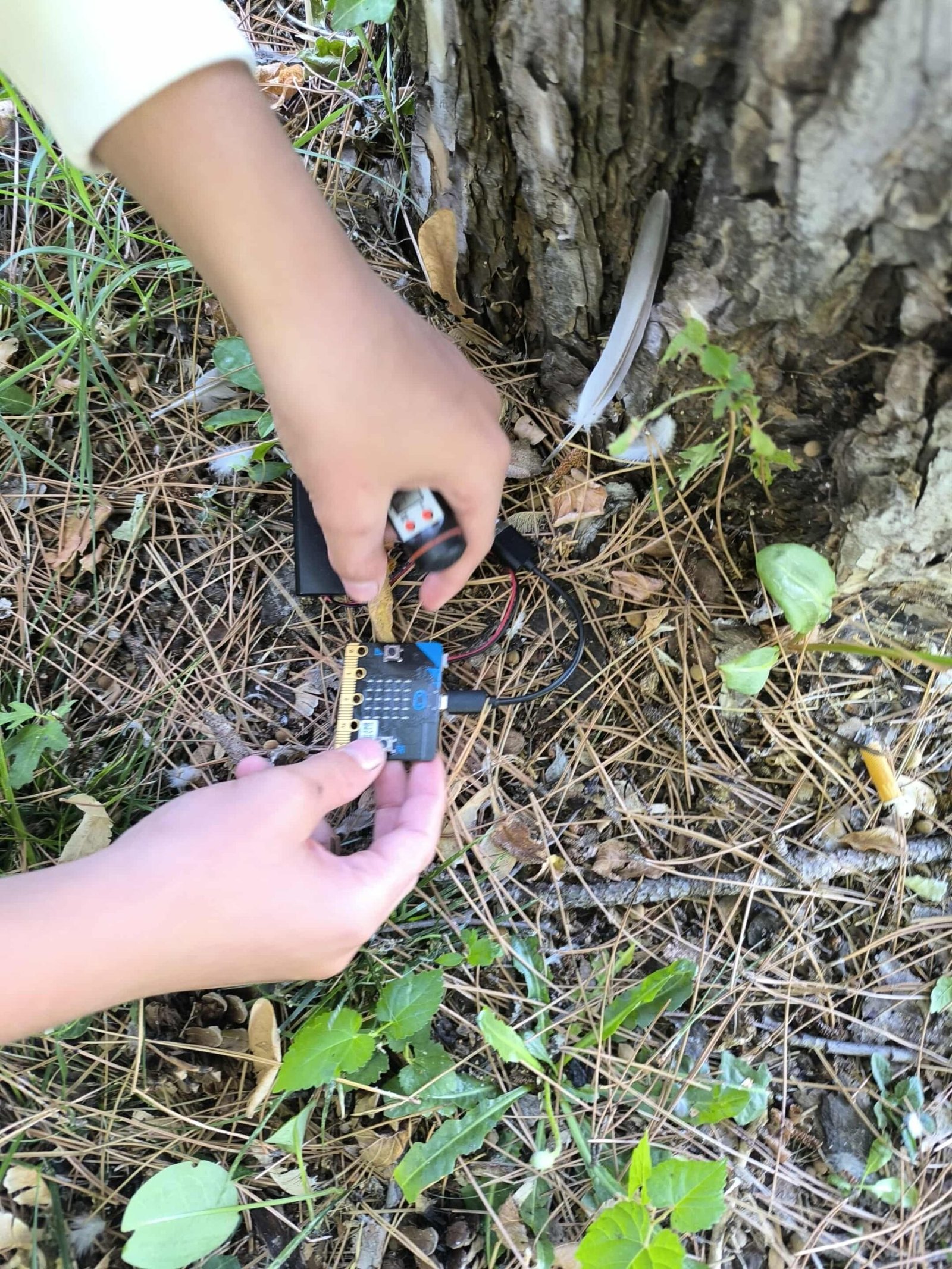
Students measured soil moisture, temperature, humidity, and pH values, then interpreted the data during Informatics, Science, and Mathematics lessons. One of the most engaging activities was the creation of Smart Pots—devices that alert when plants need watering. By programming micro:bits and calibrating sensors, students learned that technology can support sustainable water use and responsible gardening practices.


CC-BY, provided by the author
Many students proudly reflected that they were “teaching technology how to care for nature”—a powerful moment in which STEM learning became meaningful and personal.
Discovering Microclimates: Where Is It Cooler and Why?
Another memorable learning story unfolded through the Microclimate Trail activity. Students investigated temperature differences between green areas and concrete surfaces around the school using micro:bit sensors. The results were striking: the green park area was more than 10°C cooler than the concrete sports yard.
This hands-on discovery helped them truly understand abstract concepts such as urban heat islands and climate change. Even more importantly, they moved from observation to action—using AI-based tools to design nature-based solutions, such as planting trees, creating green walls, and adding shaded areas. Learning became a bridge between scientific evidence and responsible decision-making.


CC-BY, provided by the author
Caring for Biodiversity and Well-Being
Smart Green Spaces also focused on biodiversity and emotional well-being. Students built bee hotels from recycled materials, learning about pollinators and their essential role in ecosystems. Indoors, classrooms were transformed with green corners and mini gardens, creating calmer, more welcoming learning environments.
These activities nurtured creativity, empathy, and care—skills just as important as coding and data analysis. Parents and teachers joined many of the eco-activities, strengthening school–community cooperation and showing students that sustainability is a shared responsibility.
What the Project Showed: Growing Skills, Values, and Confidence
Across all activities, Smart Green Spaces demonstrated how learning becomes deeper when students are active creators. Through the project, students developed:
- environmental awareness and sustainable habits
- digital, STEM, and data-literacy skills
- teamwork, responsibility, and problem-solving abilities
- a stronger connection between school learning and real life
Most importantly, they learned that small actions—when guided by knowledge and care—can lead to meaningful change.
Resources created by the teachers in the project:
developed scenarios, games, and tutorials
https://spingur.mk/wp-content/uploads/2025/10/developed-scenarios-games-tutorials.html
Looking Ahead
Smart Green Spaces is not an endpoint, but a starting point. The developed learning scenarios, digital materials, and smart garden practices will continue to be used and shared, inspiring both students and teachers to explore new ways of learning at the intersection of nature, technology, and community.
In a world facing environmental and climate challenges, projects like Smart Green Spaces remind readers that education can grow solutions—one seed, one sensor, and one curious learner at a time.
Author: Gjorgjina Dimova, Informatics teacher
Gjorgjina Dimova is an Informatics teacher at Primary School “Strasho Pindjur” in Negotino, North Macedonia, and a Scientix Ambassador with a strong interest in science education, STEM, and digital innovation in teaching. My professional background is in informatics, and over the years I have become especially interested in creating learning experiences that connect technology, creativity, and real-world problem-solving. Through projects, international collaboration, and classroom practice, I aim to make science education engaging, inclusive, and meaningful for all students.
Tags: Education, Environment, experiment, Innovation, learning, STEAM education, STEM, STEM education, STEM practices, sustainability
Recent Comments