
 In the early 1950s, a Senate investigative drama captivated the nation. Three years before the famed Army-McCarthy hearings, the Kefauver Committee – officially the Senate Special Committee on Organized Crime in Interstate Commerce – probed organized crime and its entanglement in the political fabric of New York City.
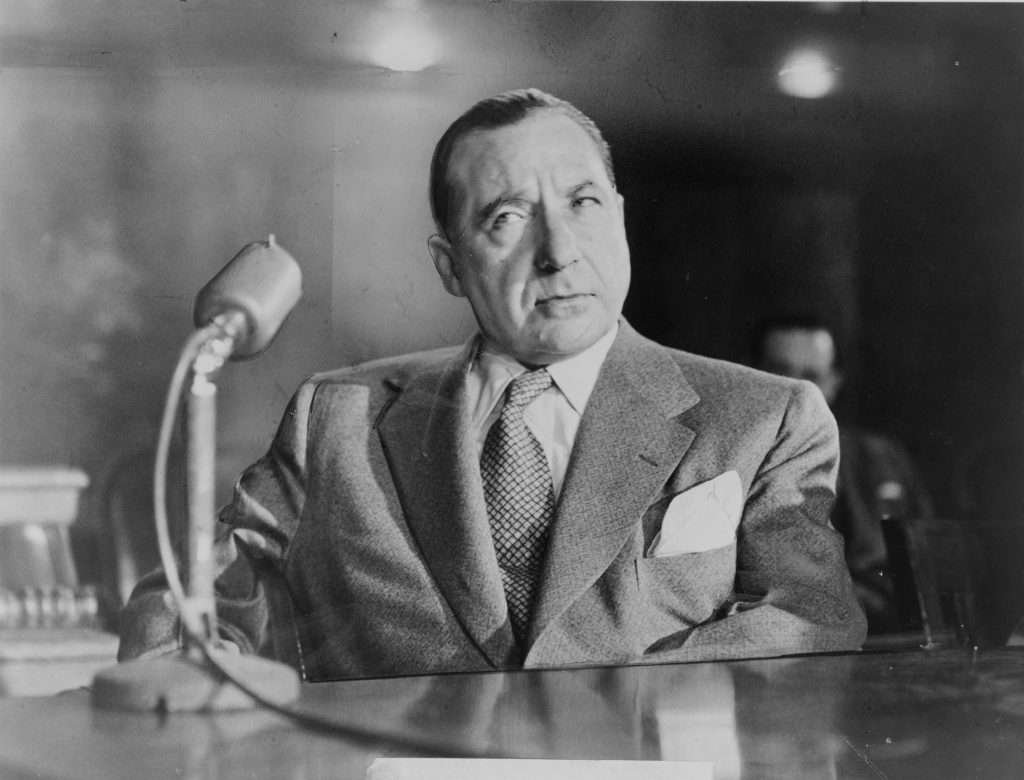
The hearings provided drama in the early days of television, and among the parade of characters summoned to the cramped hearing room in New York’s Foley Square courthouse was the redoubtable Frank Costello, known as the “Prime Minister of the Underworld” and cozy with the city’s Tammany Hall Democratic machine.
The man insistently questioning the burly, fidgety Costello from the dais that day in March 1951 was his physical and temperamental opposite. The Committee’s chief counsel, Rudolph Halley, 37, was a tightly wound and keen figure, almost a caricature of an avenging prosecutor: five-foot-seven with horn-rim glasses and slicked back hair.
The son of a Westchester County dentist, Halley grew up in the South Bronx and attended Columbia University, earning his bachelor’s degree at 19 and his law degree at 21, then serving as secretary to a federal judge.
Joining the U.S. Attorney’s office after law school, Halley played a visible role in headline cases such as the 1939 conviction of Paine Webber scion Stephen Paine on mail fraud, and the 1941 conviction of tycoon Howard C. Hopson in the theft of more than $20 million from Associated Gas and Electric Company.
 During the Second World War, Halley joined the staff of the Truman Committee (formally the Senate Special Committee to Investigate the National Defense Program), chaired by then Senator Harry S. Truman and aiming to root out waste and abuse among defense contractors.
Truman’s role helped gain him the 1944 vice presidential nomination. After the Truman Committee, Halley in 1950 joined Tennessee Senator Estes Kefauver’s investigative panel.
There Halley found a true spotlight as, in the words of his Washington Post obituary, “a mild-mannered but bulldog inquisitor in one of the Nation’s most spectacular crime probes.”
More than 400 witnesses in an inquiry spanning 14 cities. But New York in March 1951 represented its dramatic peak.
“The dignified law chambers of Foley Square had never seen anything like it — even during the dramatic trials of Alger Hiss or the Communist Party hierarchy,” Time magazine reported that month, calling it the committee’s “big finale.”
In grilling Costello, Halley and the Committee were also targeting Tammany Hall and recent New York City Mayor William O’Dwyer.
“Before they were done, they had made the legendary Frank Costello squirm in view of millions of television watchers, and provided titillating evidence that unobtrusive Frank Costello was just what they had claimed — the boss of one of the nation’s two big crime syndicates,” wrote Time.
“They had also charted some tortuous trails that led straight out of Costello’s underworld and wound up in ex-Mayor William O’Dwyer’s anteroom.”
 During his first day on the stand, Costello spent five hours sparring with Halley. In a modulated, even voice with a slight lisp, Halley questioned Costello about whether he had used aliases, his past role running liquor from Canada, his naturalization as a U.S. citizen, his wealth and property ownership, and his involvement with horse racing venues in New York and with slot machines in Louisiana.
“Costello a ‘Flop’ in Starring Role” a New York Times headline blared the next day, saying the mob boss was “Nervous and Weary, Occasionally Shrewd.”
The next morning, Costello returned and Halley read him wiretap recording transcripts exposing Costello as setting a price on the Louisiana slot machines.
Halley: “Did you ever ask anybody to check whether you had a wire tap?”
Costello: “To check if I had one? Not that I remember.”
Halley: “Did you ever hear of a man named James McLaughlin?”
Costello: “Never.”
Halley: “Did not Mr. Irving Sherman introduce you to a man named James McLaughlin, who worked for the telephone company?”
Costello: “Not to my recollection now.”
Halley: “And didn’t James McLaughlin check your wires at your request?”
Costello: “Not to my recollection. I never give anybody a contract to check my wires.”
Halley: “Did you ever give anybody any money to check your wires?”
Costello: “Absolutely not.”
That afternoon, the committee called McLaughlin as a surprise witness, and the former New York Telephone Company employee flatly contradicted Costello, saying the gang leader had paid him $50 to $100 per instance to check for taps at his Central Park West apartment.
The next day, Costello refused to answer Halley’s question about whether he’d heard McLaughlin’s testimony, then walked out of the hearing as his attorney pleaded his client’s ill health. Kefauver said he’d ask the Senate to bring contempt charges; Costello was later convicted and sentenced to 18 months.
Tammany Hall was a strong focus of the Kefauver investigations, or, as Time put it, “the shadowy connections between New York’s politicos and New York’s bosses of crime,” writing, “Costello had walked out before the Senators could grill him on his relations to Tammany politics. But they could explore Tammany politicians and the men around Mayor O’Dwyer for traces of the underworld’s power.”
 Tammany-backed Brooklyn District Attorney O’Dwyer had won the mayoralty in 1945 and was re-elected in 1949, but soon faced a police corruption scandal and resigned in August 1950. Soon after, President Truman appointed him ambassador to Mexico.
A week after Costello’s walkout, O’Dwyer returned from Mexico to face the committee, which Time said had already “hustled a whole covey of O’Dwyer’s political friends and underlings onstage.” Indeed,
John Crane, president of the Uniformed Firemans Association, swore he had given O’Dwyer a $10,000 cash gift on the porch of the mayor’s official residence, Gracie Mansion, a charge O’Dwyer denied. Said Halley, “one of the two is lying.” (O’Dwyer wasn’t charged and remained ambassador until 1952.)
In May 1951, the committee issued an 80,000-word report summarizing its year-long efforts – with Halley as a primary author. O’Dwyer came in for particular criticism as a personage who “contributed to the growth of organized crime, racketeering and gangsterism in New York City.”
As both D.A. and Mayor, “neither he nor his appointees took any effective action against the top echelons of the gambling, narcotics, waterfront, murder or bookmaking rackets. In fact, his actions impeded promising investigations of such rackets.”
The New York Times noted, “At great length, the report traced the former Mayor’s association, as an individual and through connections, with Frank Costello, tagged as an ‘underworld emperor’ whose “sinister influence is still strong in the councils of the Democratic party organization of New York county.”
On NBC’s “Meet the Press,” Halley was asked whether O’Dwyer’s failure to take action was deliberate. “I think it was the result of all the circumstances surrounding his administration,” Halley said, and “the political flavor of his administration, resulted in his making certain appointments which were bad, in his permitting the gamblers to operate almost unobstructed, in his failing to do anything about the police department.”
Asked whether those parts of the report dealing with O’Dwyer had been toned down prior to its release, Halley was categorical, saying, “anybody who knows me knows that I’m not much of a toner downer.”
In the fall of 1951, Halley rode his Kefauver fame to a perch hosting a CBS television show called “Crime Syndicated,” where each week he’d introduce a felony saga (Newsweek called it “a sponsored whodunit dressed up with significance”) — this coming decades before true crime became a pop culture sensation.
Not everyone applauded. As Kefauver counsel, New York Herald Tribune media critic John Crosby opined, Halley had been “a monstrously cool character – skeptical, urbane, precise, and knowledgeable.” But Crosby wasn’t sure Halley was a natural as a TV host, “lacking in the special graces that are required for this sort of work.”
Halley was already juggling another prominent post-Kefauver endeavor: in June, New York’s Liberal party nominated him for City Council president, a potential stepping stone to the mayoralty.
“If Rudolph Halley is elected president of the New York City Council Nov. 6, television will be the reason why,” wrote Newsweek. “And he will be the first TV-made official.”
 Halley won in November by a 163,000-vote plurality in a three-way race – a win, the Times editorialized, that “can only be interpreted as the people’s protest against corruption in government, against political ties with the underworld, against Costelloism in party councils.”
By 1952, Halley was an influential presence at the Democratic National Convention in Chicago – according to columnist Drew Pearson’s published diary he urged his old boss Senator Kefauver to concede the presidential nomination to Adlai Stevenson; Kefauver then won the vice-presidential nod on Stevenson’s losing ticket.
The mayoralty was in Halley’s sights, and in 1953, he again waded into a crowded field. Tammany’s chosen candidate was Robert F. Wagner Jr., son and namesake of a legendary U.S. senator. After the Liberal party tapped Halley and Republicans tapped little-known lawyer and longtime civic affairs volunteer Harold Riegelman, the race was on, but Halley’s comet had already faded at City Hall.
“Partyless, Halley found himself shut out in the Council chambers,” Daily News reporter Owen Moritz later wrote. “His wild charges and investigations into city government soon were ignored by the media and public. Crime, a hot-button topic when the Democrats were in the White House, was no longer a national issue with Dwight Eisenhower as President. America wanted to be left alone… and, as TV became less of a household novelty, his appearances lost their magic.”
In the mayor’s race, even his old boss Estes Kefauver declined to endorse Halley – or fellow Democrat Wagner; according to Drew Pearson, Kefauver told him that “after considerable hesitation, he decided that he had better not come out against Halley, his former Crime Committee counsel. He felt it would have a bad reaction in Tennessee, though personally he is for Wagner, not Halley.”
 In November, the weight of opposing forces finally overwhelmed Rudolph Halley, as he finished a distant third behind Wagner (46%) and Riegelman (30%) with just 21% of the vote. His political career was over, as was a particular strain of good-government momentum (though Wagner would later break with Tammany).
The klieg lights had faded, as had Halley’s health. In November 1956, he died of acute inflammation of the pancreas at the age of 43.
When the lights were at their brightest, back in the fall of 1951, the Herald Tribune’s Crosby had written with prescience, “I can’t help thinking that Halley’s comet is getting a little overextended, that it may just explode and vanish in a shower of brilliant sparks.”
Read More New York Political History
Illustrations, from above: Senator Estes Kefauver, standing, during the committee hearing in the federal courtroom in Las Vegas on November 15, 1950, Rudolph Halley sits at left with bow tie and glasses (today the courtroom is part of The Mob Museum); Senators, counsel, witnesses, and visitors at a 1943 meeting of the Truman Committee (Harry S. Truman at center) ; Frank Costello testifying before the Kefauver Committee (photo by World Telegram staff photographer Al Aumuller); Mayor William O’Dwyer in February 1946; Halley being sworn in as President of the New York City Council by Justice Matthew M. Levy in 1951; and Halley in about 1953.
Recent Comments