
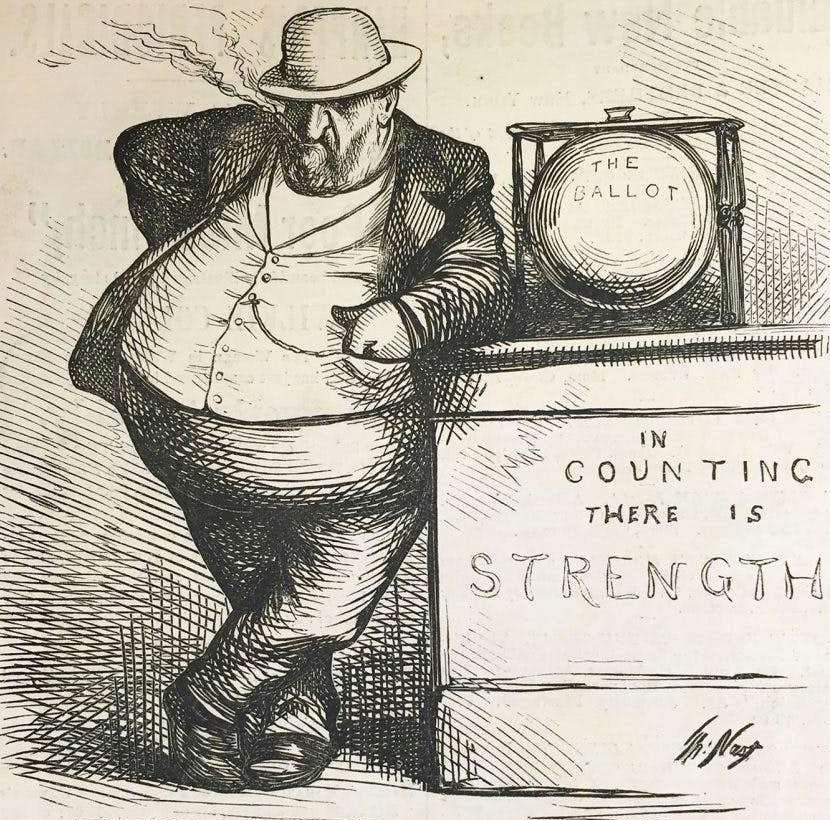
 In 1926 Upstate New York newspapers were aflame with alarm about voting rights and a Tammany Hall takeover of state government.
The Democratic Party in New York City was reportedly plotting to deny upstate counties their historic representation rights in the State Legislature by redrawing the district lines.
Of course, in the North Country the knee-jerk reaction is frequently that New York City is trying to steamroll us one way or the other. On the other hand, Tammany claimed that upstate districts were “voting graveyards” and “carrying tombstones on the registry lists,” according to the Ticonderoga Sentinel in March 1926.
A few years earlier, the political story was reversed. In 1921, Upstate New York voters led an effort to include an English literacy test for new voters into the State Constitution.
 Essex County voted for that 3,005 to 2,019. Why would they do that? To promote education? Were they afraid that women, who had just finally won the right to vote in 1917 might not be up to the task? Most upstate rural communities had voted against women’s suffrage (though not Essex, in 1917.)
More likely it was fear of immigrants, especially Puerto Ricans who were coming into New York City in bigger numbers. A federal law, the Immigration Act of 1917, passed just four years earlier classified Puerto Ricans as American citizens. So when they got to the City, they could vote. Newly arrived Yiddish speakers were also affected.
The whole New York literacy story is something few people remember. But beginning back in the 1920s, every school in the state was required to offer literacy classes and literacy tests for new voters.
At first the state told election officials to pick a section of the Constitution for an applicant to read, and then answer questions. That was deemed too open to abuse, and it certainly sounds similar to what Southern states used to do to keep Black Americans from voting.
So New York brought in the Board of Regents to develop tests for English competency. The topics ranged all over the place: Mark Twain, the role of public libraries, basic US Geography (including the Gulf of Mexico), a milk truck accident.
The tests were written by students at the State Teachers College in Albany and other colleges. An applicant didn’t have to know the subject matter, just be able to read a brief paragraph and then answer questions based on that reading.
One of my favorites is about Peter Stuyvesant, one governor of New Amsterdam. The paragraph said he had to surrender to the British in 1664
because his Dutch settlers “did not like fighting and were unwilling to take up arms.”
 One of the questions was, “What were the Dutch people unwilling to do?” “Unwilling to commit suicide” might have been a good answer, since they were outnumbered and vastly outgunned. (The Dutch were hardly pacifists when it came to Native Americans.)
But no knowledge of history or interpretation was required, and the correct answer was, “Unwilling to take up arms.”
The professional educators took great pride in their Literacy tests, and there were articles in magazines and national educational journals about the project.
The test requirement may have started as an exclusionary tactic, but it turned into a statewide educational effort, part of New York’s “Americanization” program. In old Essex County newspapers, we can find articles advertising both the availability of literacy classes and the schedule for taking the tests.
You’d also have to say that as an exclusionary tactic, it didn’t work very well. The failure rate kept going down and down, from 21% in 1923 to
6% in 1938, meaning more and more immigrants were getting into the voting booth.
Only 10% of the test takers in 1928 failed the test, while 116,760 people passed. Another 33,435 got literacy certificates from special day and evening school classes.
Though we don’t know how many people were discouraged from even trying, and of course there were glitches: “Literacy Test Fails Due to Postal Delays,” was a 1924 headline in Brooklyn, and the story reported disappointed first time voters being turned away from five schools that didn’t receive the tests in the mail. The educators blamed the postal delays on the Jewish holidays.
The New York literacy requirement stayed on the books until the federal Voting Rights Act of 1965. (An early version of that act was
proposed by President John F. Kennedy, whose home state of Massachusetts enacted the very first voter literacy test in 1855.)
In 1920 when women did vote in state elections for the first time, in Upstate New York they voted Republican just like the men did. Of course, it seemed like that year the whole world lined up Republican. President Warren G. Harding won New York by an honest-to-goodness landslide of more than one million votes, and the party gained big majorities in the Legislature.
Many of us bemoan today’s sharp partisan divides, and search for issues that can bring people together. Back in 1921 the state was certainly divided about that literacy test, but almost everybody was totally against the idea of raising the pay of state legislators.
“Snowed under in the county by the vote of 4,042 against to 1,304 in favor,” reported the Adirondack Record of Elizabethtown. Downstate was pretty much the same.
There are no statewide ballot questions this year to bring us together. We’ll have to find another way. And it is true that in politics nothing lasts forever. That Republican blow-out win of 1920 was gone in less than a decade, as hundreds of thousands of voters changed their minds.
Then came the eras of Al Smith and Franklin D. Roosevelt, which led to significant and ongoing changes in the American system, such as the New Deal, with it’s massive job programs like the Civilian Conservation Corps (CCC) and Public Works Administration, and Social Security.
A version of this essay by the Essex County Historical Society/Adirondack History Museum in Elizabethtown, NY was originally published in the Sun Community News.
Illustrations, from above: Boss Tweed in a nineteenth century Thomas Nast voting rights cartoon from Harpers Weekly; Northern New York counties suffrage vote results in 1915 and 1917; and the New York Regents Voting Literacy Test.
Recent Comments