
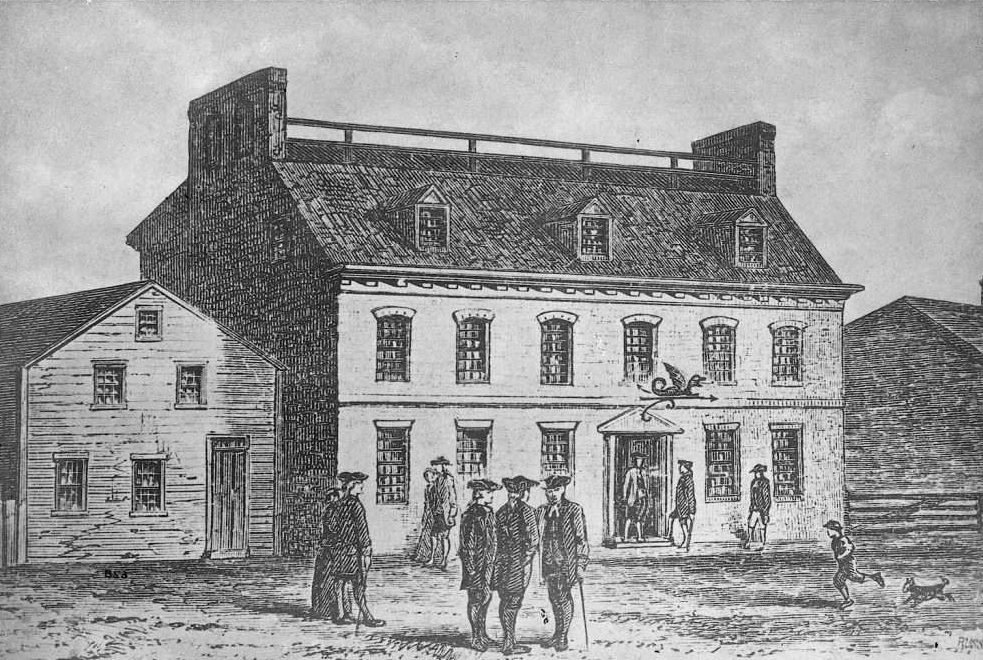
 Paul Revere was Joseph Warren’s brother Mason. In 1760, when Revere was 25, he entered St. Andrew’s Lodge, a newer lodge whose members were mostly craftsmen.
It met at the Green Dragon Tavern on Union Street (then known as Green Dragon Lane) in Boston’s North End.
St. Andrew’s Lodge was chartered in 1756 by the Grand Lodge of Scotland, during a period in which a rift in England had divided Masons between “Ancient” and “Modern” groups. St. Andrew’s represented Ancient Masonry.
In 1761, St. Andrew’s Lodge met twenty-six times. Paul missed only one meeting. In one of the other twenty-five meetings he met Joseph Warren, the namesake of Warren County, NY, who had been initiated in September of that year.
To their dismay, the Ancient Freemasons of St. Andrew’s Lodge were rejected by Boston’s Modern brethren, who considered these “Scotts Masons” to be “irregular.”
As a result, a committee including Revere and Joseph Warren and two British traveling lodges petitioned the Scottish Grand Lodge to charter a Grand Lodge of Ancient Masons in Boston, which would have the authority to charter additional lodges.
The petition was granted and on December 27, 1769 the Massachusetts Grand Lodge came into existence. Dr. Joseph Warren served as the first Grand Master and Revere held numerous offices in the Grand Lodge over the years.
 Like Warren, Revere’s membership in the Masons connected him to the men who would lead the resistance to overreaches of the British Crown and Parliament. Men like Samuel Adams, James Otis, and John Hancock.
The death of Grand Master Joseph Warren, killed at the Battle of Bunker Hill on June 17, 1775, was a personal loss for Revere, who held his friend in such high esteem that he named a son after him in 1777.
It also created a crisis for Ancient Masons, who thought that Warren’s commission as Grand Master had died with him, leaving the Lodge “without a Head, & without a Single Grand Officer.”
As a means of self-preservation, the Massachusetts Grand Lodge elected their own Grand Master in 1777, independent of Scotland.
A report issued by Revere and three others in 1782 justified this election, without which Lodges “must Cease to Assemble, the Brethren be dispersed, the Pennyless go unassisted, the Craft Languish & Ancient masonry be extinct in this Part [of the] World.”
A version of the essay was first published by the Dr. Joseph Warren Foundation, a 501(c)(3) non-profit organization dedicated to preserving and promoting the legacy of Dr. Joseph Warren, a prominent physician, major general, and political leader of the American Revolution who was killed at the Battle of Bunker Hill in 1775.
Illustrations, from above: Engraving of the Green Dragon Tavern, ca. 1898; and portraits of Joseph Warren (r) and Paul Revere (l).
Recent Comments