

CC-BY Yusuf Dedeoğlu
The starting point of a scientific research project can sometimes be an observation made in the laboratory, a question raised in the classroom, or an intriguing news article. Our research journey began with a news report published in 2025 under the headline “50-Year-Old Physics Theory Confirmed: Scientists Discover the Black Hole Bomb.”
The report described a recent study conducted by Marion Cromb, Maria Chiara Braidotti, Andrea Vinante, Daniele Faccio, and Hendrik Ulbricht. The researchers examined the interaction between electromagnetic waves and a rotating system and created a laboratory analogue of an energy amplification mechanism theoretically expected to occur around black holes—the Press–Teukolsky black hole bomb.
At first glance, there seemed to be a considerable gap between black hole physics and a school laboratory. However, the curiosity sparked by the news led us to ask: How could we understand the wave–rotation interaction underlying this study at the high school level and investigate it through a feasible experiment?
Exploring Contemporary Research through a School Experiment
Our aim was not to replicate the electromagnetic experiment conducted by Cromb and colleagues. Such a study required not only specialised equipment beyond the resources of a school laboratory but also advanced knowledge of theoretical and experimental physics beyond our existing expertise. We therefore focused on understanding the wave–rotation interaction at the heart of the study and translating this concept into an acoustic setup that we could investigate in a school laboratory.
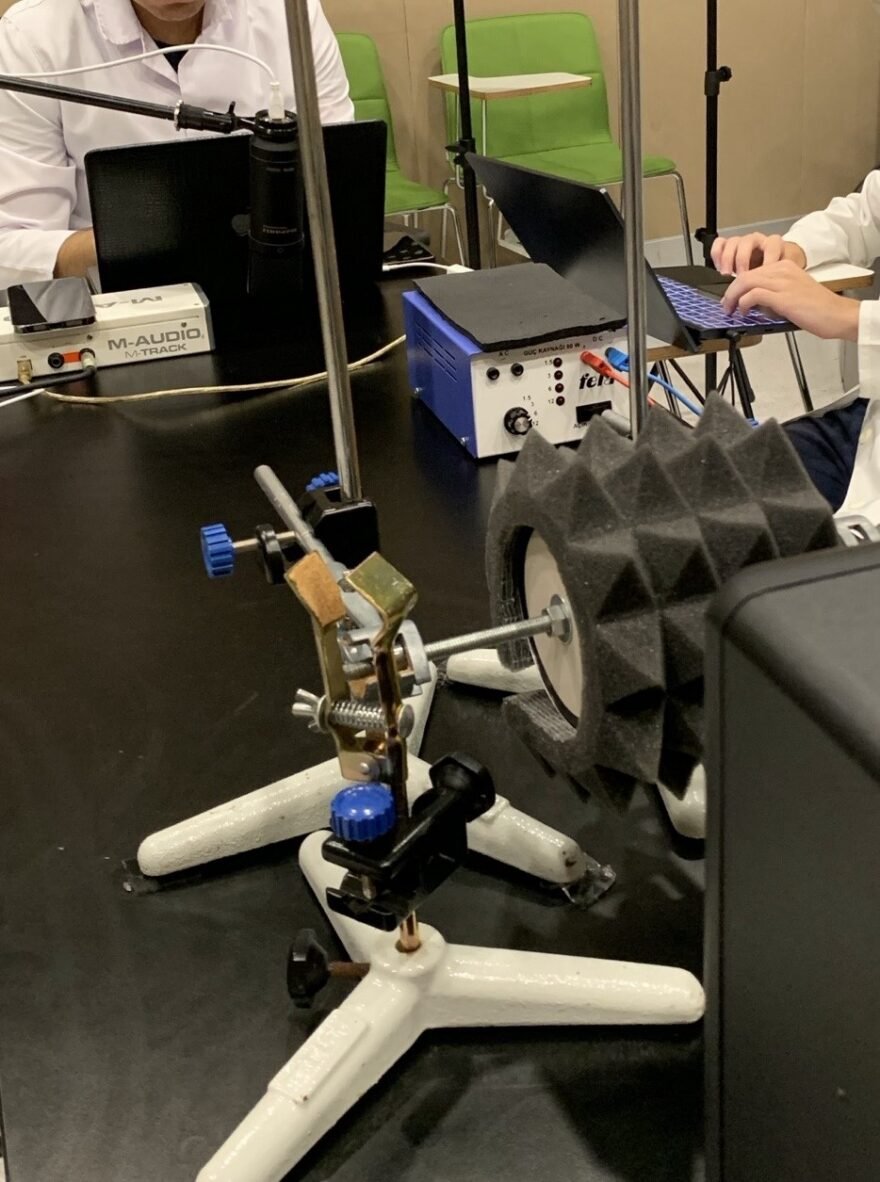
As the project lead and supervisor, I conducted the research with the active participation of high school students Erdem Toy, Ekim Deniz Alpkıray, and Ali Tarık Tanrısever. We built a modular experimental setup consisting of a sound source, a rotating aluminium cylinder, and a microphone. We investigated how covering the cylinder with different surfaces affected the acoustic behaviour measured in the system. In addition to bare metal, we used readily available materials such as felt, acoustic foam, corrugated cardboard, bubble wrap, and sandpaper.

CC-BY Yusuf Dedeoğlu
We conducted measurements at two different rotational speeds and three different sound frequencies, repeating each condition to obtain a total of 144 measurements. The students were not merely participants who collected data. They were directly involved in every stage of the research, from assembling the setup and analysing the data to creating graphs and preparing the report.

CC-BY Yusuf Dedeoğlu
In this respect, the study differed from traditional laboratory activities with predetermined outcomes. During the experiment, we encountered unexpected results, checked our measurements again, and discussed together what the data might mean.
When the Competition Did Not Go as Expected
We entered the study in a national competition as a student research project. Having devoted considerable time to the project and believed in its scientific value, the students were naturally disappointed when it did not achieve the outcome they had hoped for.
At this stage, we had two options: to accept the competition result as a final judgement on the value of the project, or to use the feedback we received to develop the study further. We chose the second path.
We had confidence in the project, but this did not mean that we considered it beyond criticism. The assessments we received prompted us to reconsider our experimental design, measurement method, and interpretation of the data. The competition process therefore became not the end of the research, but the beginning of its next stage.
Together with the students, we re-examined the data, discussed the strengths and limitations of the study, and decided to develop the project into a scientific paper.
Rethinking the Study Through Peer Review
After submitting our manuscript to the European Journal of Physics, the study entered a new stage of evaluation. The reviewers’ requests for revisions required us to explain more clearly what we had measured in the experiment and the limits within which our results could be interpreted.
We did not regard the reviewers’ comments as obstacles to be overcome. We examined each one as a team and considered our graphs, uncertainty analyses, and the educational use of the study in the classroom in greater detail. One of the most important lessons we learned was that clearly stating the limitations of a study does not weaken the research. On the contrary, it increases its reliability.
Following the revisions, the reviewers supported publication, stating that the study was coherent and that its experimental limitations had been appropriately addressed. They also noted that it offered an engaging approach to teaching wave–rotation interactions. Our paper was published in the European Journal of Physics in August 2026.
Moving Forward Through Feedback
Both the competition and peer-review processes showed us that feedback is not an obstacle to scientific work, but one of the key elements that helps it develop.
Beyond becoming co-authors of a published paper, the students learned through direct experience that initial attempts in scientific research may not always produce the expected outcome. They also learned that a study can develop through asking questions, taking measurements, making mistakes, evaluating feedback, and changing one’s approach when necessary.
What We Learned from the Process
This experience showed us that contemporary scientific developments can be brought together with high school students through meaningful research questions. Although an advanced study may not be replicated exactly in a school laboratory, the concept underlying the research can be transformed into a new question appropriate to the students’ level.
In such a process, the teacher assumes the role of guiding the direction of the research and supporting students’ scientific thinking. Reading relevant sources, designing experiments, and discussing data together enable students to become active participants in the process of producing knowledge.
Our journey, which began with curiosity sparked by a news article, evolved into a co-authored paper published in an international physics education journal. The publication of the paper provided tangible evidence that high school students can play an active role in producing scientific knowledge and that curiosity sparked by a news article can be pursued in a school laboratory and developed into an academic study.
Related Publication
Dedeoğlu, Y., Toy, E., Alpkıray, E. D., & Tanrısever, A. T. (2026). Surface morphology effects on acoustic behaviour in a rotating cylinder system: an educational analogue study. European Journal of Physics, 47, 045801.
https://doi.org/10.1088/1361-6404/ae88d4
About the Author
Yusuf Dedeoğlu is a physics teacher at İstanbul ENKA Schools Science and Technology High School. He completed his master’s degree in Physics at Gazi University, specializing in Atomic and Molecular Physics. He works with students in advanced physics, Physics Olympiad preparation, and research projects.
In 2026, he was the corresponding author of a paper published in the European Journal of Physics together with three high school students.
His academic interests include physics education, experimental and computational physics, and studies that support students’ active participation in scientific research processes.
He values introducing students to science at an early age and believes that becoming familiar with scientific research processes during this period, when imagination and curiosity are vibrant, can spark their creativity.
Tags: Black Hole, electromagnetic experiment, European Journal of Physics, experiment, high school students, laboratory, physics, research, research in classroom, Technology in Classrooms
Recent Comments