
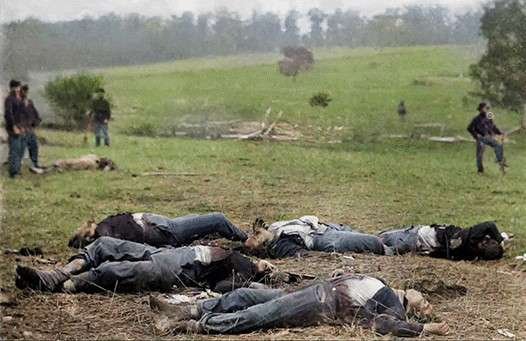
 For a story that is part of a series marking 175 years of eyewitness journalism from The New York Times, Dan Barry visited the Gettysburg battlefield.
In his article Barry described “a war correspondent for The New York Times named Samuel Wilkeson Jr.” who “trudged through the violated Pennsylvania landscape on a solitary quest. The weary journalist was searching for one particular Union soldier who was said to have had his leg blown off. His teenage son.”
Bayard Wilkeson was born in Buffalo in 1844 and enlisted in October 1861 when he was seventeen. He was a lieutenant in Battery G, Fourth U.S. Regular Light Artillery out of Cincinnati, Ohio and before Gettysburg, he fought at the Battle of Fredericksburg in Virginia.
After losing his leg, Lieutenant Wilkeson gradually bled to death. Samuel Wilkeson and his brother John found Bayard’s body “wrapped in a blanket and buried in the shallow mud. When it was exhumed, John Wilkeson wrote, there was a cotton bandage wrapped around the right knee, one he imagined Bayard had tied with “his own hands in the vain hope of stanching the flow of blood.” Bayard Wilkeson was just nineteen years old.
These are excerpts from Samuel Wilkeson’s report from “Gettysburgh” published on the front page The New-York Times on July 6, 1863 under the headline “DETAILS FROM OUR SPECIAL CORRESPONDENT.”
Wilkeson wrote the dispatch while mourning his son. He opened his report “Who can write the history of a battle whose eyes are immovably fattened upon a central figure of transcendently absorbing interest – the dead body of an oldest born, crashed by a shell in a position where a battery should never bare been sent, and abandoned to death in a building where surgeons dared not to stay?”
In a last paragraph in his report on the battle, he told readers “My pen is heavy. Oh, you dead, who at Gettysburgh have baptized with your blood the second birth of Freedom in America. … I rise from a grave whose wet clay I have passionately kissed.”
HEADQUARTERS ARMY OF POTOMAC, Saturday Night, July 4.
The battle of Gettysburgh! I am told that it commenced, on the 1st of July, a mile north of the town, between two weak brigades of infantry and some doomed artillery and the whole force of the rebel army.… From the moment that our artillery and infantry rolled back through the main street of Gettysburgh and rolled out of the town to the circle of eminences south of it.
We were not to attack but to be attacked. The risks, too difficulties and the disadvantages of the coming battle were the enemy’s. Our were the heights for artillery; ours the short, inside lines for maneuvering and reinforcing; ours the cover of stonewalls, fences and the crests of hills.
The ground upon which we were driven to accept battle was wonderfully favorable to us. A popular description of it would be to say that it was in form an elongated and somewhat sharpened horseshoe, with the toe to Gettysburgh and the heel to the south.
LEE’s plan of battle was simple. He massed his troops upon the east side of this shoe of position, and thundered on it obstinately to break it. The shelling of our batteries from the nearest overlooking hill, and the unflinching courage and complete discipline of the army of the Potomac repelled the attack. It was renewed at the point of the shoe – renewed desperately at the southwest heel – renewed on the western side with an effort consecrated to success by EWELL’s earnest oaths, and on which the fate of the invasion of Pennsylvania was fully put at stake.
Only a perfect infantry and an artillery educated in the midst of charges of hostile brigades could possibly have sustained this assault.
HANCOCK’s corps did sustain it, and has covered itself with immortal honors by its constancy and courage. The total wreck of CUSHING battery – the list of its killed and wounded – the losses of officers, men and horses COWEN sustained – and the marvelous outspread upon the board of death of, dead soldiers and dead animals – of dead soldiers in blue, and dead soldiers in gray – more marvelous to me than anything I have ever seen in war – are a ghastly and shocking testimony to the terrible fight of the Second corps that none will gainsay.
That corps will ever have the distinction of breaking the pride and power of the rebel invasion… Then there was a lull, and we knew that the rebel Infantry was charging. And splendidly they did this work – the highest and severest test of the stuff that soldiers are made of. HILL’s division, in line of battle, came first on the double quick. Their muskets at the “right-shoulder-shift.”
LONGESTREET’s came as the support, at the usual distance, with war cries and a savage insolence as yet untutored by defeat. They rushed in perfect order across the open field up to the very muzzles of the guns, which tore lanes through them as they came. But they met men who were their equals in spirit, and their superiors in tenacity.
There never was better fighting since Thermopyalae than was done yesterday by our infantry and artillery. The rebels were over our defenses. They had cleaned cannoniers and horses from one of the guns, and were whirling it around to use upon us.
The bayonet drove them back. But so hard pressed was this brave infantry that at one time, from the exhaustion of their ammunition, every battery upon the principal crest of attack was silent, except CROWEN’s. His service of grape and canister was awful. It enabled our line, outnumbered two to one, first to beat back LONGSTREET, and then to charge upon him, and take a great number of his men and himself prisoners…
The rebels had retreated to their lines, and opened anew the storm of shell and shot from their 120 guns. Those who remained at the riddled headquarters will never the crouching, and dodging, and running, of the Butternut-colored captives when they got under this, their friends, fire. It was appalling to as good soldiers even as they were.
What remains to say of the fight? It staggled surlily [sic] on the middle of the horse shoe on the west, grow big and angry on the heel at the southwest, lasted there till 6 o’clock in the evening, when the fighting sixth corps went joyously by as a reinforcement through the wood, bright with coffee pots on the fire. I leave details to my excellent friend and associate Mr. HENRY.”
Illustration: A colorized version of Timothy O’Sullivan’s “View in field on right wing,” made at Gettysburg after the battle, from Savas Beatie’s book Gettysburg in Color.
Recent Comments